MXL20T Synchronous Wheel Timing Belt Pulley Pilot Bore For 6/10mm Width Belt

No reviews

Price:
Sale price$4.20 USD
Stock:
In stock (500 units), ready to be shipped

Payment & Security

Ach Direct Debit Amazon American Express Apple Pay Bancontact BLIK Diners Club Discover EPS Google Pay iDEAL Wero JCB Maestro Mastercard Multibanco MobilePay PayPal Przelewy24 Shop Pay Twint Union Pay USDC Visa

Your payment information is processed securely. We do not store credit card details nor have access to your credit card information.

Limited Offer — Spend More, Save More
Spend $55+
Save $5
Spend $100+
Save $10
Spend $200+
Save $25
HomeDIYer DIY Expert Support

DIY Expert Support

Get fitment advice & recommendations

Mon–Fri  8:30 AM – 8:00 PM
24-Hour Fast Ship
Arrives in 3–14 Days
Worldwide Shipping
30-Day Returns
1 tree planted with every purchase

Description

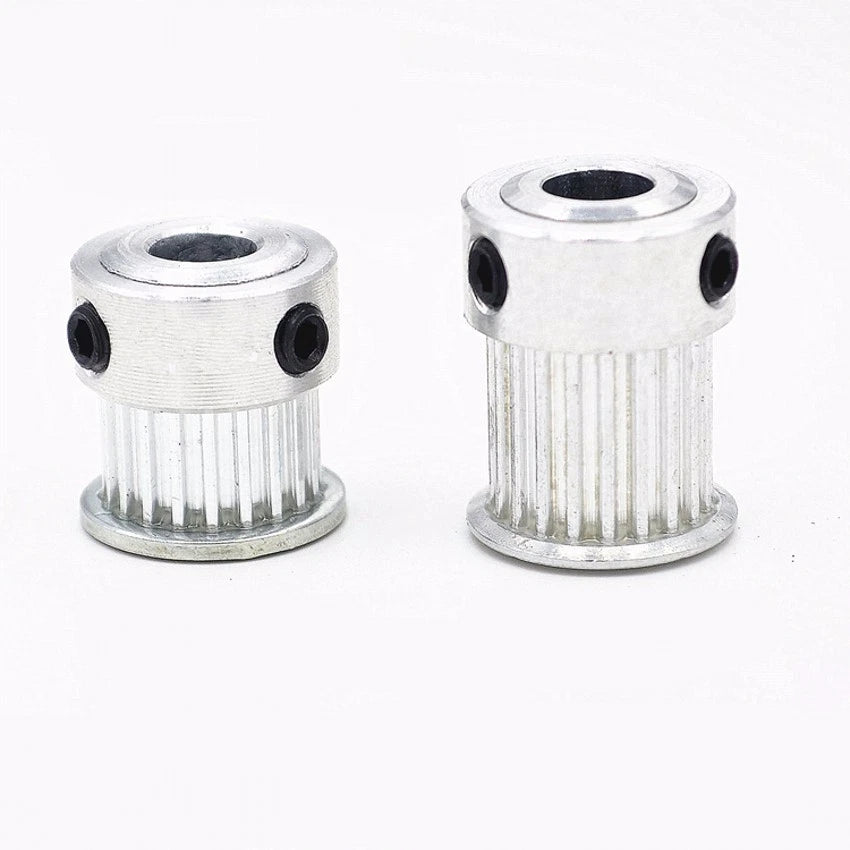
MXL20T Timing Belt Pulley — Aluminum Synchronous Wheel for Precise Motion Control

When your 3D printer, CNC router, or DIY automation rig demands repeatable, slip-free motion, the shaft-to-pulley interface is where projects succeed or fail. Makers, hobbyists, and small-workshop engineers who need a reliable MXL20T timing belt pulley with a pilot bore will find this aluminum synchronous wheel a straightforward drop-in solution — no custom machining required.

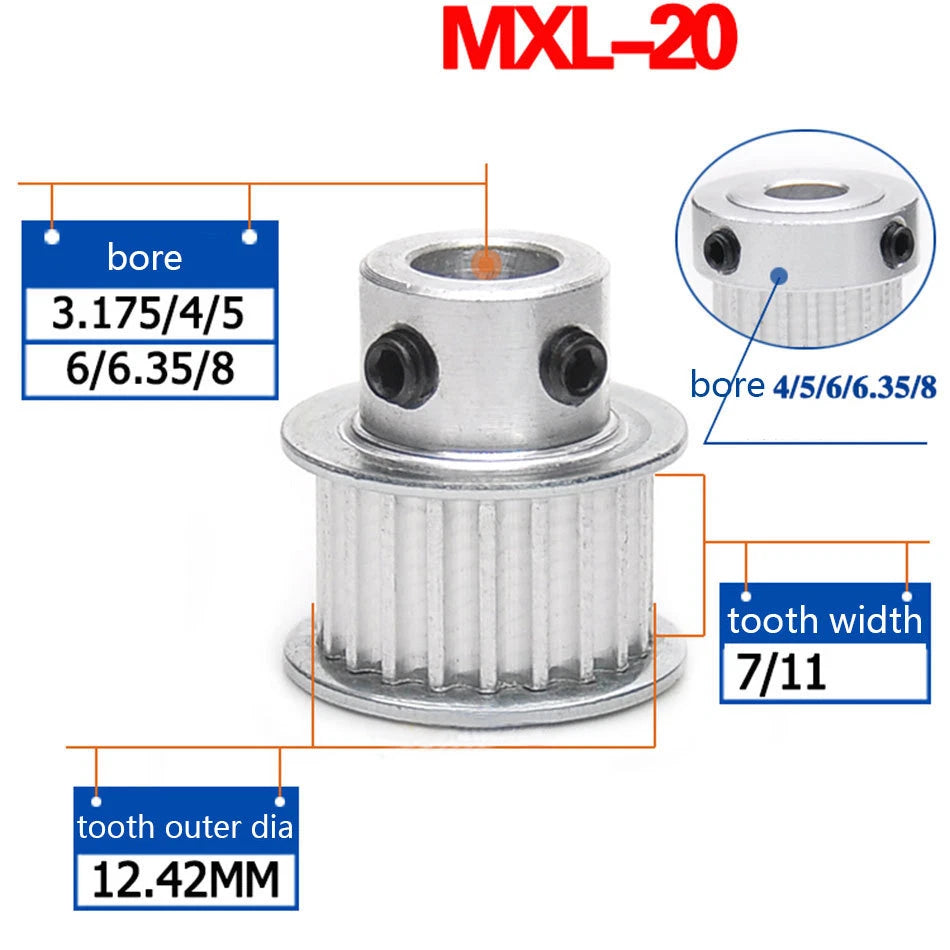
Each pulley is machined from aluminum alloy with a silver anodized finish, offering a good balance of light weight and rigidity. The MXL tooth profile (2.032 mm pitch) meshes with standard MXL timing belts. Belt bandwidth options are 7 mm (~0.28 in) and 11 mm (~0.43 in); pilot bore sizes range from 4 mm to 8 mm (approximately 0.16 in to 0.31 in), covering the most common motor shaft diameters used in desktop automation.

Typical use cases include X/Y axis drive systems on FDM 3D printers, lead-screw-free CNC pen plotters, and lightweight conveyor or indexing mechanisms in educational robotics labs — anywhere a compact MXL synchronous pulley with a selectable bore is needed for a timing belt drive system.

⚙️ Compatibility: Fits standard MXL timing belts (2.032 mm pitch). Belt width 6 mm belts use the 7 mm bandwidth variant; 10 mm belts use the 11 mm bandwidth variant. Verify your motor shaft diameter before selecting bore size.

✅ Key Features of These MXL20T Timing Belt Pulleys

🔩 20-Tooth MXL Profile

20 teeth on the standard MXL (2.032 mm pitch) tooth form deliver smooth, low-backlash power transmission suited to light-duty automation and motion-control applications.

🪨 Aluminum Alloy Construction

Machined from aluminum alloy with a silver finish, the pulley keeps rotating mass low while providing sufficient rigidity for continuous-duty desktop automation loads.

📐 Pilot Bore Design

Pilot bore format allows the bore to be finished to your exact shaft size. Available pre-bored at 4 mm, 5 mm, 6 mm, 6.35 mm (1/4 in), 7 mm, and 8 mm to fit the most common stepper and servo motor shafts.

📏 Dual Belt-Width Options

Choose 7 mm bandwidth for 6 mm wide MXL belts or 11 mm bandwidth for 10 mm wide MXL belts — both variants share the same 20-tooth count and bolt pattern for easy swapping.

🔄 Consistent Tooth Spacing

CNC-machined tooth geometry maintains consistent pitch across all 20 teeth, reducing cumulative positioning error in open-loop stepper-driven systems like 3D printers and plotters.

🛠️ Broad Application Fit

Compatible with RepRap-style 3D printers, DIY CNC routers, laser engravers, and small conveyor systems that use MXL timing belt drive trains.

📐 Technical Specifications — MXL Timing Belt Pulley

Tooth Profile MXL (2.032 mm pitch)
Number of Teeth 20T
Belt Width Compatibility 6 mm belt (7 mm bandwidth) / 10 mm belt (11 mm bandwidth)
Bandwidth Options 7 mm / 11 mm
Bore Options 4 mm, 5 mm, 6 mm, 6.35 mm, 7 mm, 8 mm
Material Aluminum Alloy
Finish / Color Silver (anodized)
Bore Type Pilot Bore
Outside Diameter See variant options
Hub / Flange See variant options
Weight See variant options

❓ Frequently Asked Questions

How do I choose between the 7 mm and 11 mm bandwidth variants?

Match the bandwidth to your belt width: the 7 mm bandwidth variant is designed for 6 mm wide MXL timing belts, while the 11 mm bandwidth variant is designed for 10 mm wide MXL timing belts. Using a mismatched width can cause the belt to ride off the pulley flange under load.

Which bore size should I select for my stepper motor shaft?

Measure your motor shaft diameter with calipers before ordering. Common NEMA 17 stepper motors use a 5 mm shaft; NEMA 23 motors typically use an 8 mm shaft. The 6.35 mm (1/4 in) bore suits imperial-shaft motors common in North American CNC kits. If your shaft falls between sizes, the pilot bore can be finish-bored or reamed to the exact diameter by a machine shop.

Is this pulley compatible with GT2 or HTD timing belts?

No. This pulley uses the MXL tooth profile (2.032 mm pitch), which is not interchangeable with GT2 (2 mm pitch, different tooth form) or HTD profiles. Always pair MXL pulleys with MXL belts to ensure proper mesh and avoid premature wear or tooth skipping.

How strong is an aluminum MXL pulley for continuous-duty use?

Aluminum alloy pulleys are well-suited for the light-to-medium loads typical of 3D printers, laser engravers, and small CNC machines. For high-torque or heavy industrial applications, consider steel pulleys. In desktop automation, aluminum's weight advantage generally outweighs any strength trade-off.

Will this pulley corrode or oxidize over time?

The silver anodized finish provides a protective oxide layer that resists surface corrosion in normal indoor workshop environments. Avoid prolonged exposure to salt spray, strong acids, or alkaline solutions, which can degrade the anodizing. For outdoor or high-humidity environments, periodic inspection is recommended.

Do I need a set screw or keyway to secure the pulley to the shaft?

This is a pilot bore pulley — it does not include a pre-cut keyway or set screw from the factory. Most users secure it with a set screw drilled and tapped into the hub, or by finish-boring and adding a key. Check your specific variant's hub dimensions to confirm there is sufficient wall thickness for your preferred fastening method.

Can I use this pulley in a 3D printer like an Ender or Prusa?

Most consumer FDM printers (Ender series, Prusa i3 variants, etc.) use GT2 pulleys, not MXL. Verify your printer's belt and pulley specification before ordering. If your printer uses MXL belts — common in some older RepRap designs — then this 20T MXL pulley is a direct fit for the drive system.

🛒 Select your bandwidth and bore size above, then add to cart.

You may also like

Recently viewed