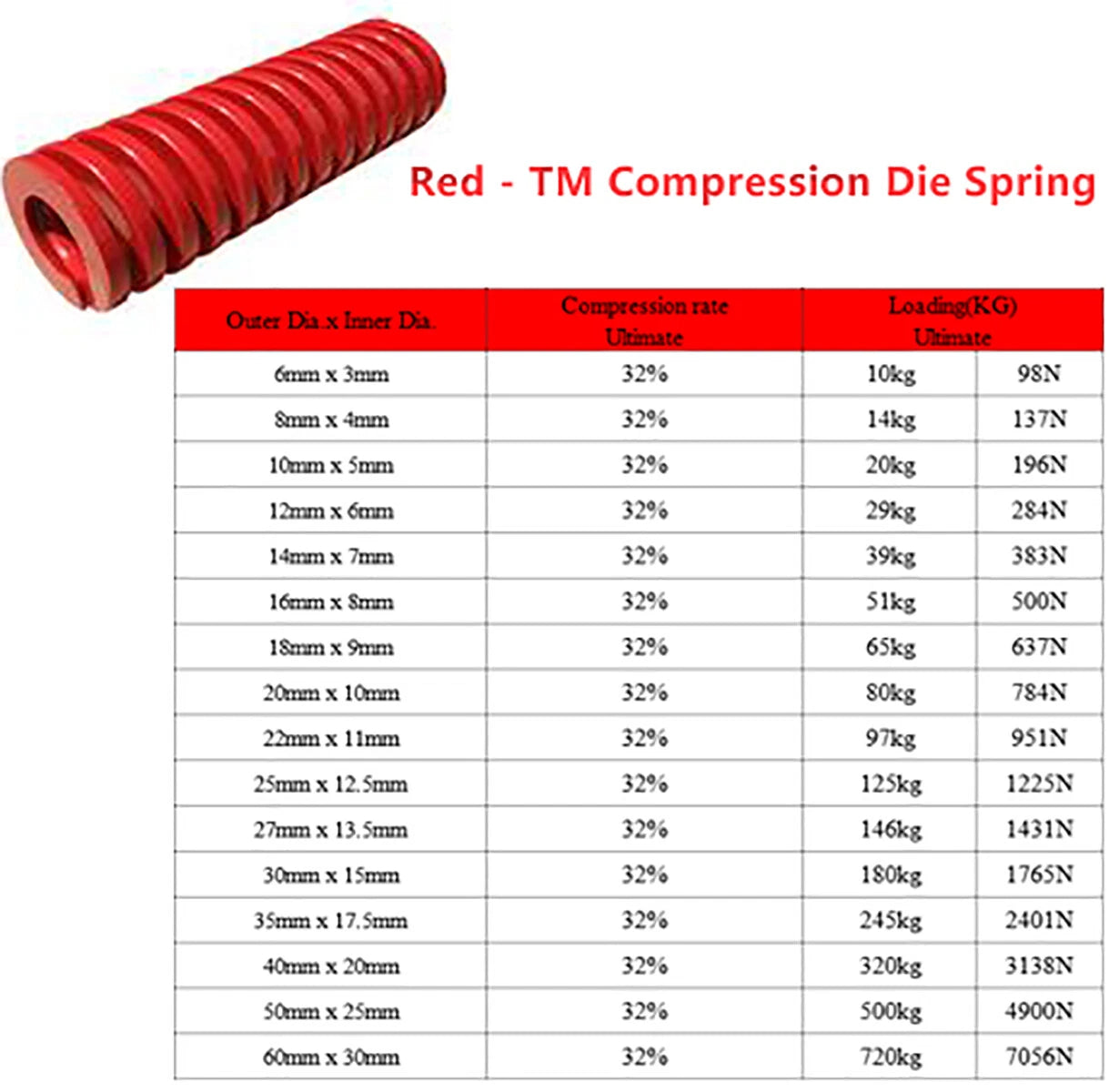
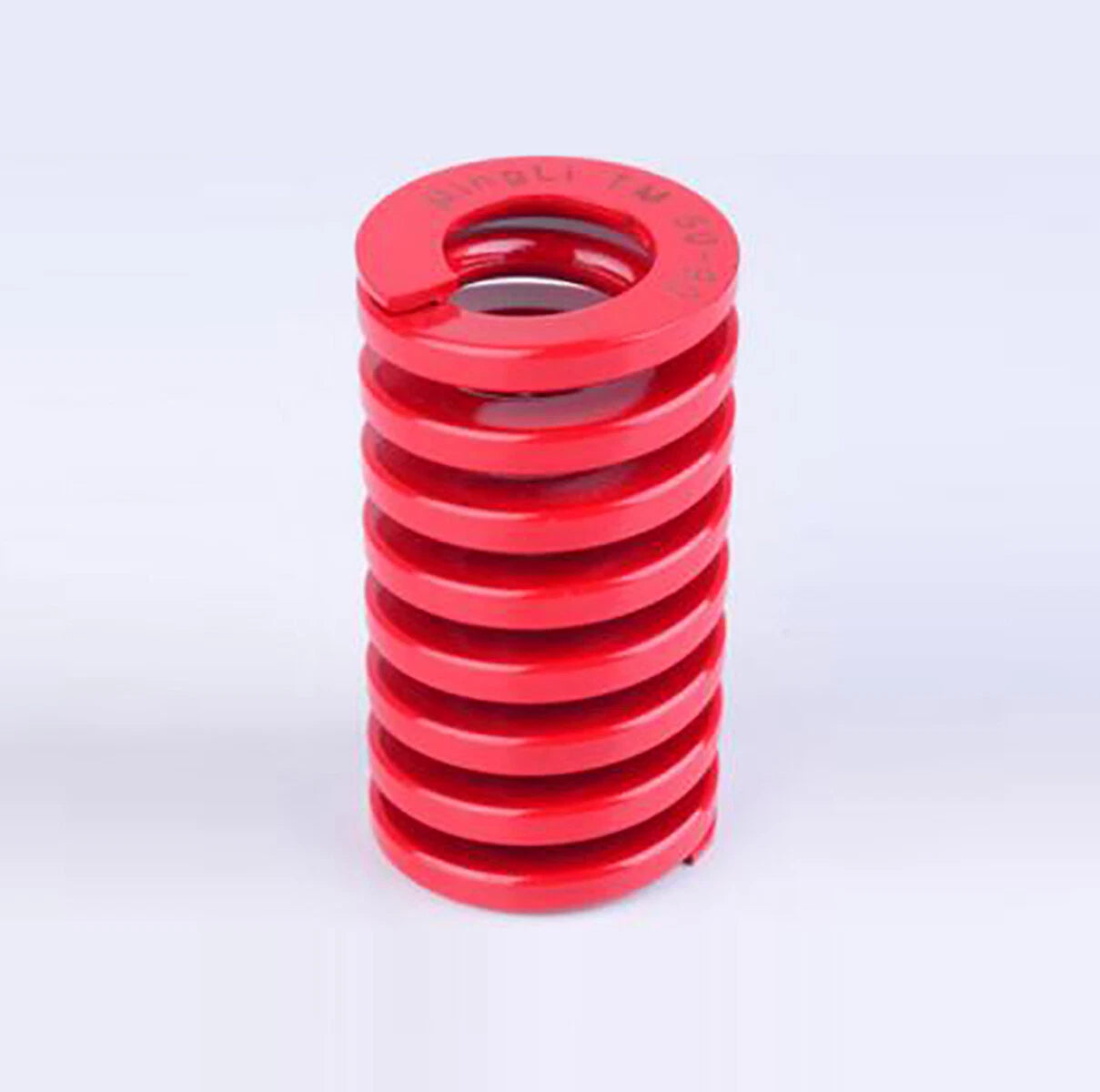
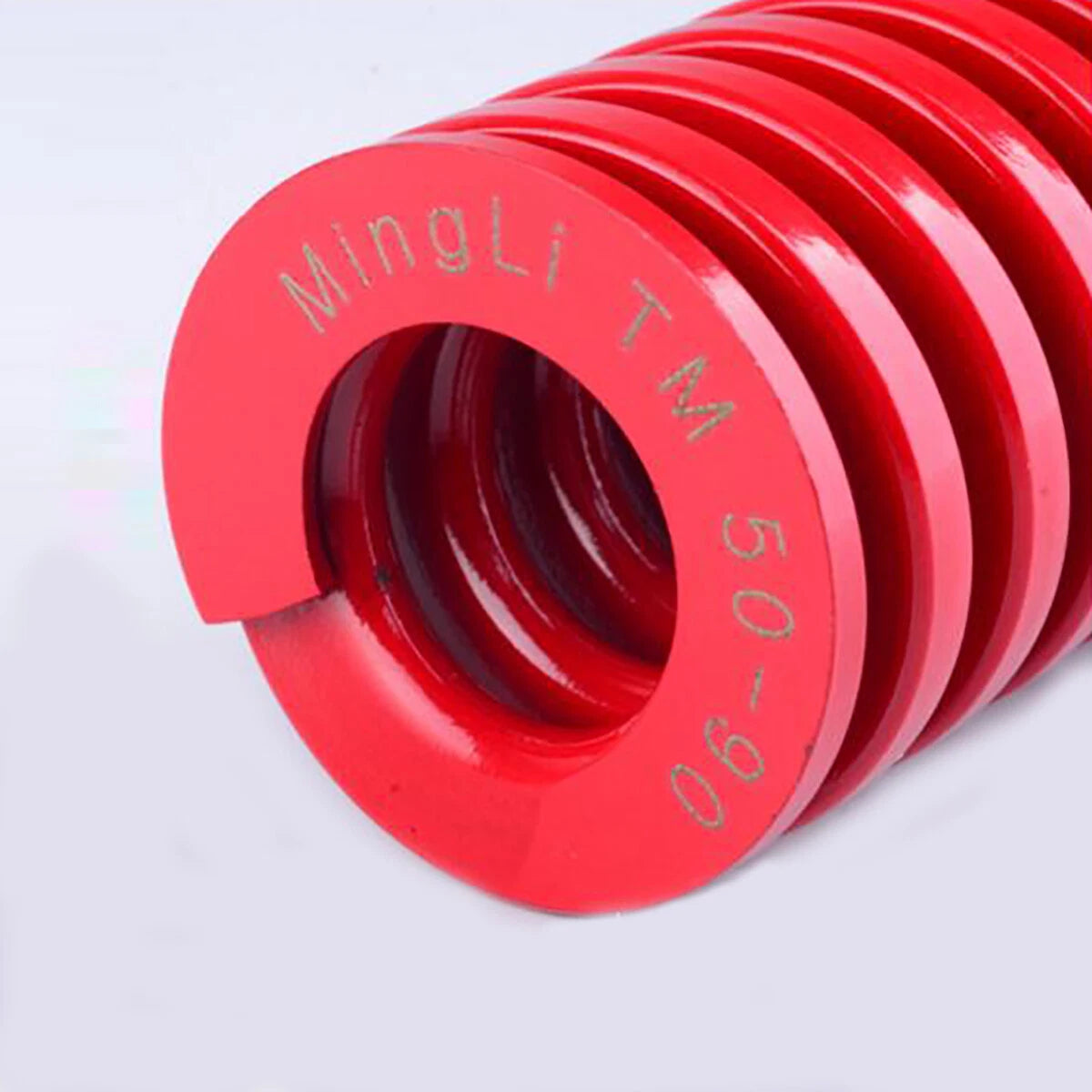
Red - TM Compression Die Spring (Medium Load) Mold Mould Springs,OD Ø6mm-60mm

No reviews

Price:
Sale price$7.11 USD
Stock:
In stock (500 units), ready to be shipped

Payment & Security

Ach Direct Debit Amazon American Express Apple Pay Bancontact BLIK Diners Club Discover EPS Google Pay iDEAL Wero JCB Maestro Mastercard Multibanco MobilePay PayPal Przelewy24 Shop Pay Twint Union Pay USDC Visa

Your payment information is processed securely. We do not store credit card details nor have access to your credit card information.

Limited Offer — Spend More, Save More
Spend $55+
Save $5
Spend $100+
Save $10
Spend $200+
Save $25
HomeDIYer DIY Expert Support

DIY Expert Support

Get fitment advice & recommendations

Mon–Fri  8:30 AM – 8:00 PM
24-Hour Fast Ship
Arrives in 3–14 Days
Worldwide Shipping
30-Day Returns
1 tree planted with every purchase

Description

TM Red Compression Die Springs — Reliable Medium-Load Force for Mold & Mould Tooling

When a mold or die-tooling project demands consistent, repeatable spring force without premature fatigue failure, engineers and toolmakers reach for a spring that can handle the cycle count. TM red-coded compression die springs are rated for medium load applications, making them the go-to choice for injection mold ejector systems, stamping dies, and precision jig fixtures where force consistency matters every cycle.

Each spring is manufactured from high-fatigue chromium-silicon alloy wire, wound to close tolerances and finished in a distinctive red coating that identifies the medium-load rating at a glance. Outer diameters span 6 mm (0.24 in) to 60 mm (2.36 in); inner diameters run at approximately 50 % of OD (e.g., 3 mm ID for 6 mm OD, up to 30 mm ID for 60 mm OD). Free lengths range from 15 mm (0.59 in) to 175 mm (6.89 in) across the available variants.

Typical use cases include: injection mold ejector-plate return springs for automotive and consumer-electronics tooling; blanking and forming die stripper springs in sheet-metal stamping operations; and precision fixture clamping springs in machining and inspection jigs where controlled deflection under medium loads is critical.

⚙️ Compatibility: Designed to ISO 10243 / JIS B 5012 medium-load (red) standard. Fits standard die-spring pockets sized to match the selected OD. Confirm pocket depth and pre-load requirements against your tooling drawings before ordering.

✅ Key Features of These TM Red Compression Die Springs

🔴 Medium-Load Red Rating
Color-coded red per ISO 10243 / JIS B 5012 for instant load-class identification on the shop floor — no guesswork when restocking tooling.
🔩 Wide Size Range
OD from 6 mm to 60 mm and free lengths from 15 mm to 175 mm cover the majority of standard mold and die spring pockets without custom ordering.
Chromium-Silicon Alloy Wire
Cr-Si alloy construction delivers superior fatigue resistance and load retention compared to standard carbon-steel springs, extending service intervals in high-cycle tooling.
📐 Close Winding Tolerances
Precision-wound coils maintain consistent spring rate and free-length accuracy, ensuring repeatable ejection force and stripper-plate travel across the full production run.
🛡️ Corrosion-Resistant Finish
The red epoxy coating provides a protective barrier against coolant splash and light oxidation common in mold and stamping environments, helping maintain surface integrity during storage and use.
📦 Single-Piece Ordering
Available per individual spring so you can replace only the failed unit in a multi-spring ejector layout — no need to purchase full sets when spot-replacing worn springs.

📐 Technical Specifications — Compression Die Spring

Load Class Medium Load (Red)
Standard ISO 10243 / JIS B 5012
Material Chromium-Silicon (Cr-Si) alloy spring wire
Surface Finish Red epoxy coating
Outer Diameter (OD) 6 mm – 60 mm (0.24 in – 2.36 in)
Inner Diameter (ID) See variant options
Free Length 15 mm – 175 mm (0.59 in – 6.89 in)
Spring Rate See variant options
Max. Deflection See variant options
End Type Closed & ground (flat ends)
Coil Direction Right-hand wound
Quantity per Order 1 piece

❓ Frequently Asked Questions

How do I choose the correct OD and ID for my die spring pocket?

Measure the pocket bore diameter in your mold or die plate — this is your maximum OD. The spring OD should be 0.5 mm to 1 mm smaller than the pocket bore to allow free movement. The inner diameter must clear the guide pin with at least 0.5 mm radial clearance on each side. Use the Size (Outer Dia. × Inner Dia.) option above to match your pocket and pin dimensions.

What does the red color code mean, and how does it compare to other load ratings?

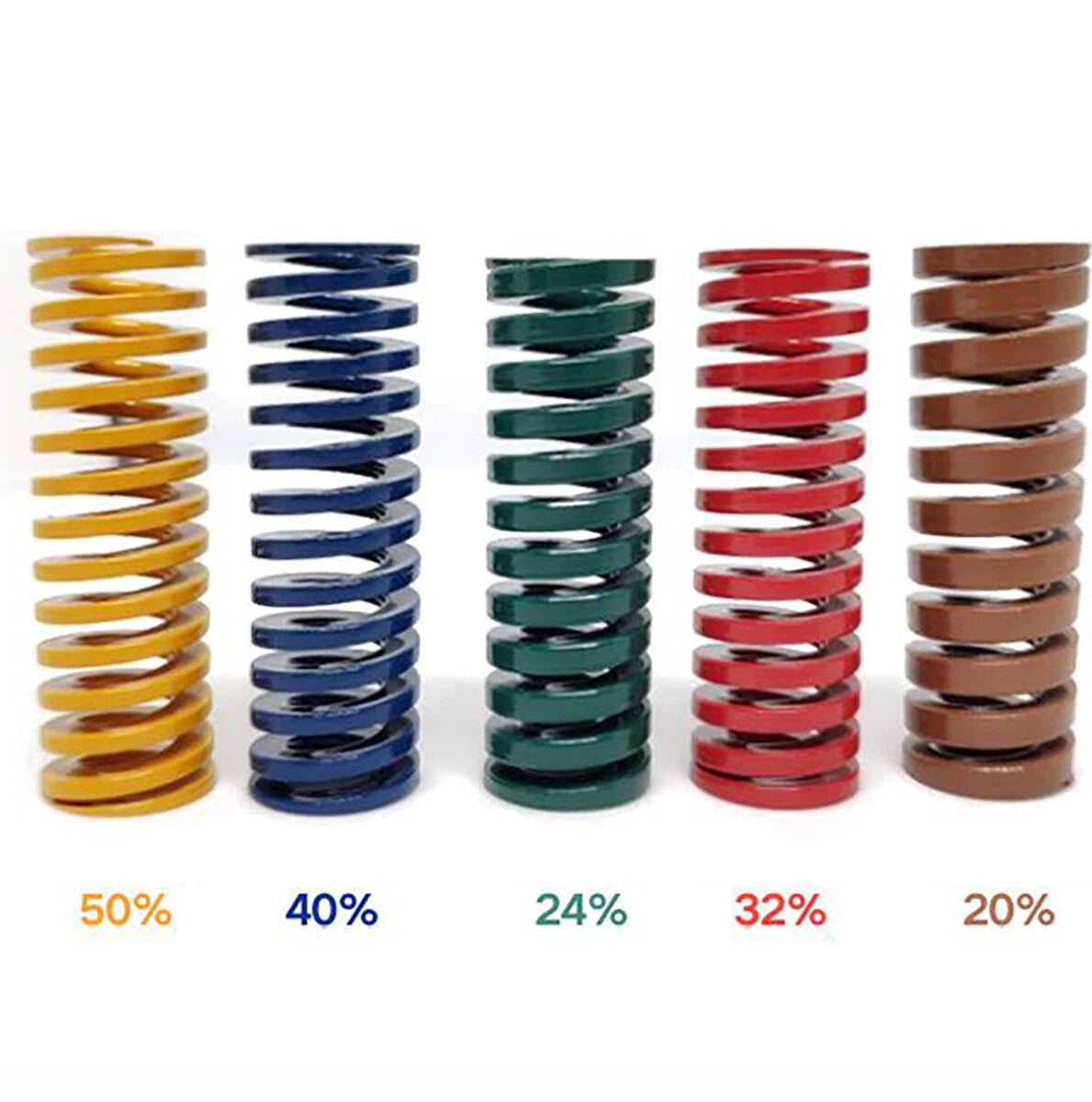
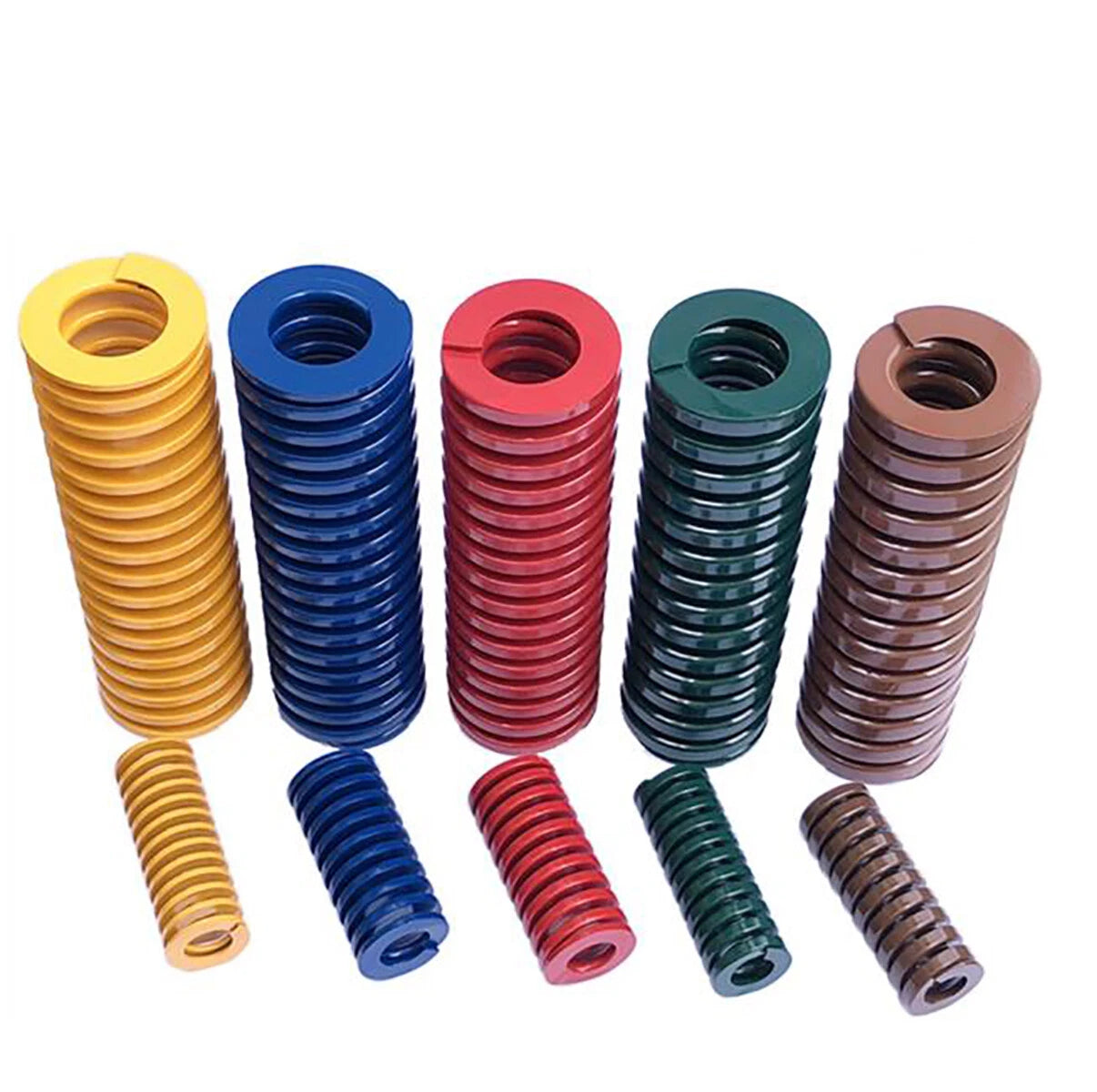
Per ISO 10243 and JIS B 5012, die springs are color-coded by load class: light load = yellow, medium load = red, heavy load = blue, extra-heavy load = green. Red (medium load) springs offer a balanced combination of deflection range and force output, making them suitable for ejector-plate return, stripper-plate actuation, and general clamping applications where neither maximum force nor maximum travel is the sole priority.

What material are these springs made from, and how does it affect fatigue life?

These springs are wound from chromium-silicon (Cr-Si) alloy wire. Cr-Si alloy has a higher tensile strength and better relaxation resistance than standard carbon-steel (e.g., SWC/SWP) wire, which translates to longer fatigue life at equivalent stress levels. This makes them well-suited for high-cycle injection molding and stamping operations where springs may compress millions of times before replacement.

Are these springs compatible with standard mold and die spring pockets?

Yes. The OD and free-length dimensions follow ISO 10243 / JIS B 5012 standard series, so they are dimensionally interchangeable with other ISO-compliant medium-load (red) die springs. Always verify the OD, ID, and free length against your tooling drawings before installation to confirm fit.

How do I calculate the correct free length and pre-load for my application?

Determine the required working load (force at compressed length) and the available stroke (deflection). Divide the working load by the spring rate for the selected size to get the required deflection. Add the compressed length to the deflection to get the minimum free length needed. Apply a pre-load of 10–15 % of the maximum rated deflection to keep the spring seated during operation. If you need assistance with spring rate data for a specific variant, contact us to confirm.

How should I maintain and inspect these die springs during tooling service?

Inspect springs at each scheduled mold or die maintenance interval. Look for visible coil cracking, permanent set (free length shorter than nominal by more than 3 %), or surface corrosion that has penetrated the coating. Replace any spring showing these signs immediately. Lubricate the guide pin lightly with a compatible grease to reduce friction-induced wear on the ID coils. Store spare springs horizontally in a dry environment away from solvents that could degrade the epoxy coating.

Can I use these springs in applications other than molds and dies?

Yes. While designed to die-spring standards, these Cr-Si compression springs are also used in industrial machinery, hydraulic valve assemblies, jig and fixture clamping, and automation equipment wherever a compact, high-fatigue compression spring with a known load class is required. Confirm that the spring rate and deflection range suit your specific load and travel requirements before use outside of tooling applications.

🛒 Select your Size (Outer Dia. × Inner Dia.) and Length above, then add to cart.

You may also like

Recently viewed