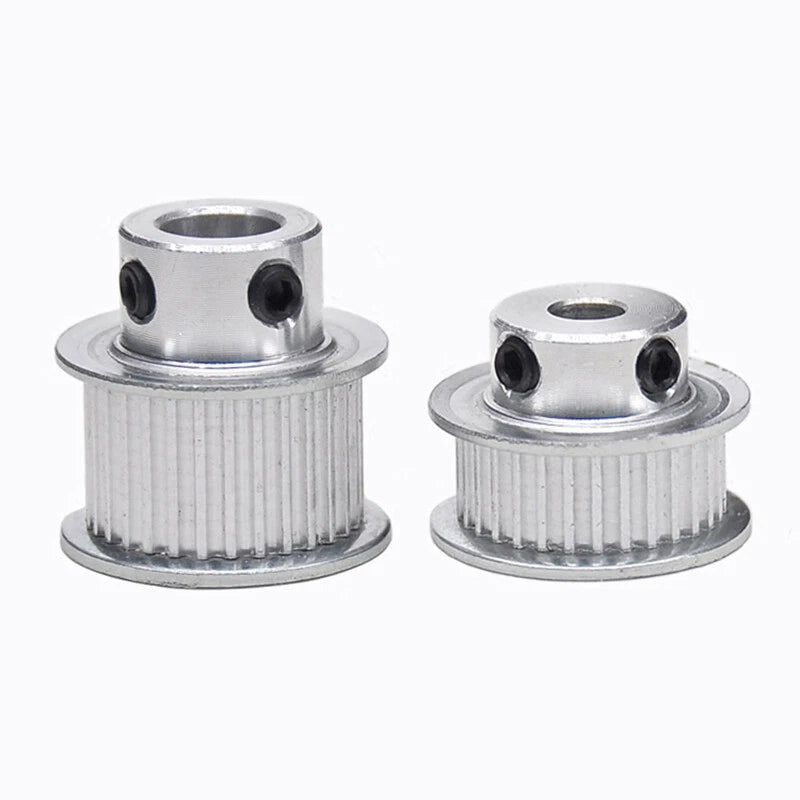
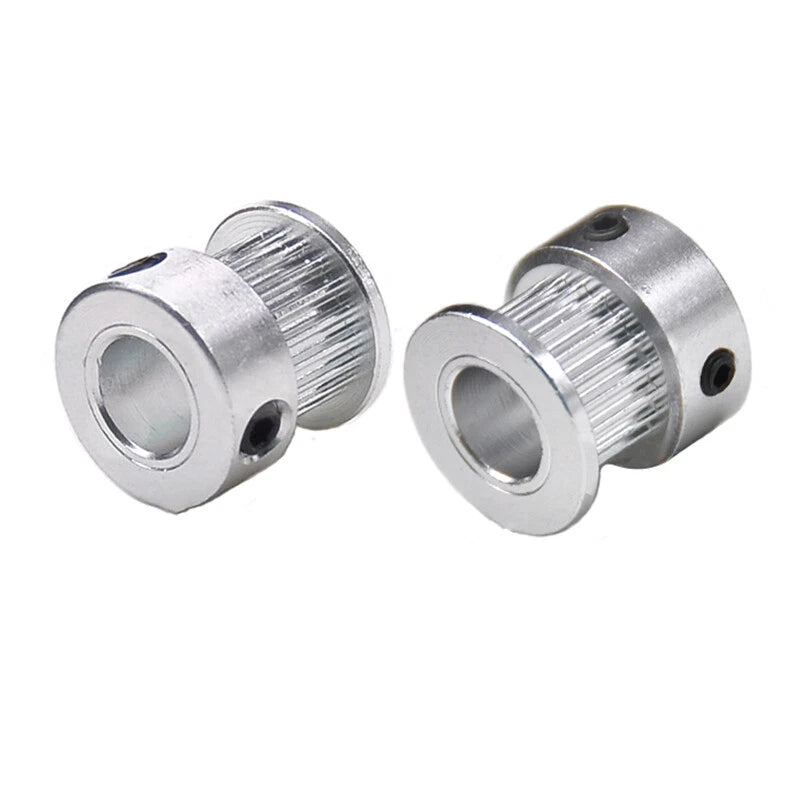
S2M 16-60 Teeth Timing Belt Pulley BF/K Type Synchronous Wheel Bore 4mm-15mm

No reviews

Price:
Sale price$8.12 USD
Stock:
In stock (500 units), ready to be shipped

Payment & Security

Ach Direct Debit Amazon American Express Apple Pay Bancontact BLIK Diners Club Discover EPS Google Pay iDEAL Wero JCB Maestro Mastercard Multibanco MobilePay PayPal Przelewy24 Shop Pay Twint Union Pay USDC Visa

Your payment information is processed securely. We do not store credit card details nor have access to your credit card information.

Limited Offer — Spend More, Save More
Spend $55+
Save $5
Spend $100+
Save $10
Spend $200+
Save $25
HomeDIYer DIY Expert Support

DIY Expert Support

Get fitment advice & recommendations

Mon–Fri  8:30 AM – 8:00 PM
24-Hour Fast Ship
Arrives in 3–14 Days
Worldwide Shipping
30-Day Returns
1 tree planted with every purchase

Description

S2M Timing Belt Pulley — Precision Sync Wheels for Demanding Drive Systems

When a slipping or misaligned pulley costs you a failed print, a crashed axis, or a mis-timed cut, you need a synchronous wheel you can trust. This S2M timing belt pulley is engineered for makers, CNC builders, robotics integrators, and automation engineers who require repeatable, zero-slip power transmission in compact drive trains.

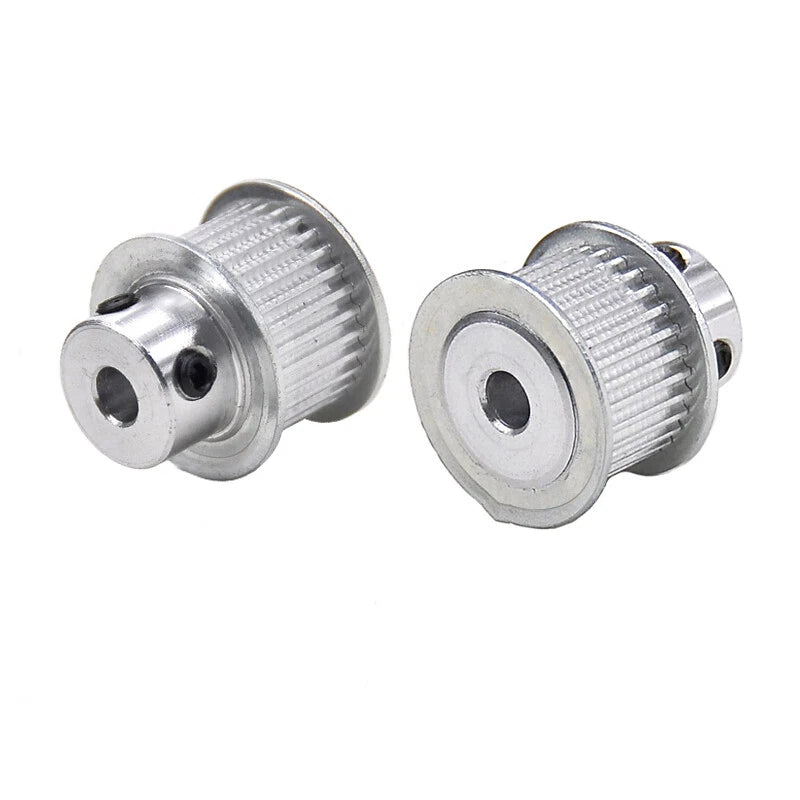
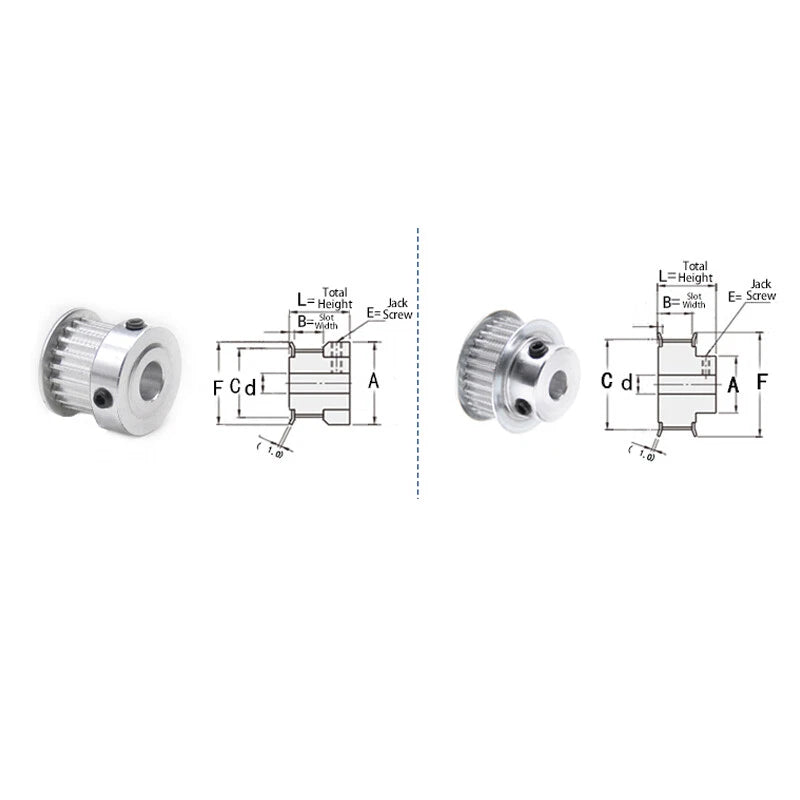
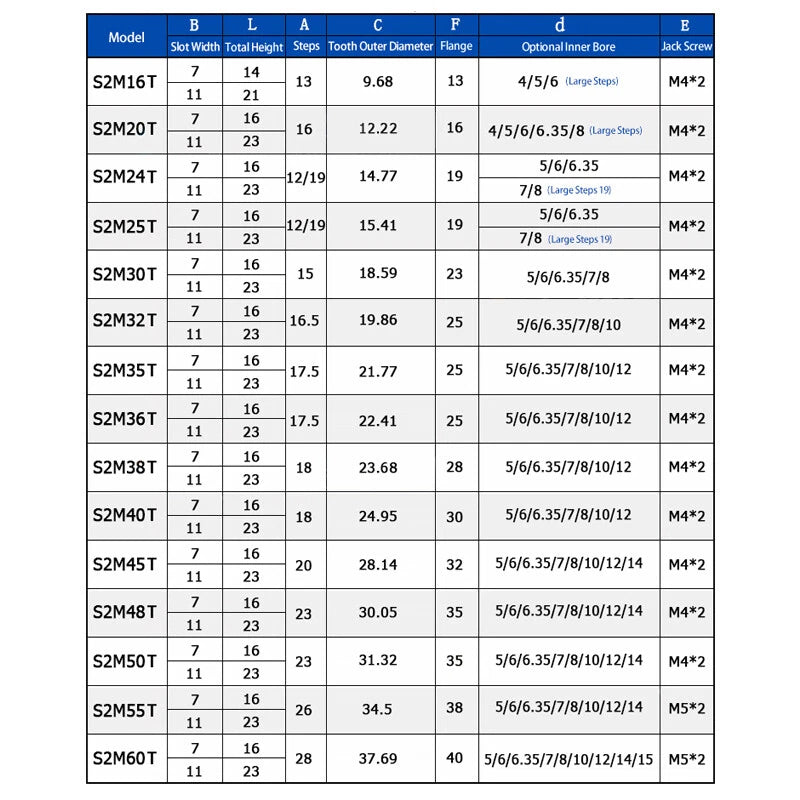
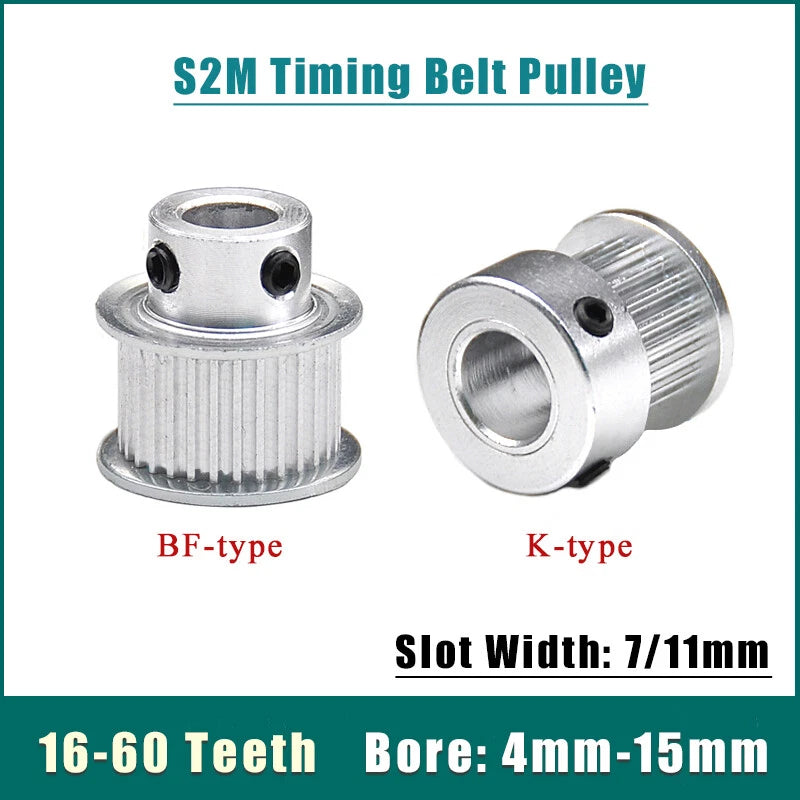
Each pulley is machined from aluminum alloy with an anodized or natural finish and is available in two flange configurations — BF-type (double-flanged) for guided belt retention and K-type (single or no flange) for open-ended belt paths. Tooth counts span 16T to 60T, and bore diameters range from 4 mm (~0.157 in) to 15 mm (~0.591 in), with slot widths of 7 mm or 11 mm to match standard S2M belt widths.

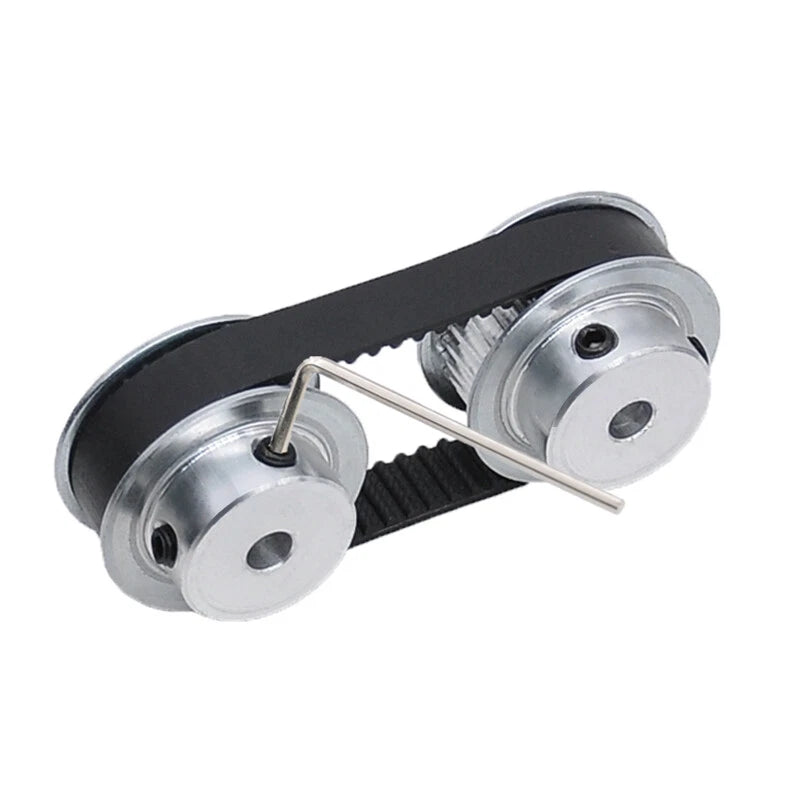
Typical use cases include S2M belt-driven 3D printer X/Y axes, lightweight CNC router gantries requiring low-backlash synchronous drive, and compact robotic joint actuators where a small-pitch 2 mm S2M pulley keeps the drive train tight and responsive.

⚙️ Compatibility: Designed for S2M (2 mm pitch) synchronous timing belts. Slot width 7 mm fits S2M-7 belts; slot width 11 mm fits S2M-11 belts. Verify bore diameter and tooth count against your drive ratio before ordering.

✅ Key Features of These S2M Timing Belt Pulleys

🔩 Two Flange Types

BF-type offers double flanges for positive belt tracking; K-type provides single or open flange for flexible belt routing in constrained spaces.

📐 Wide Tooth Count Range

Available from 16T to 60T, enabling drive ratios from 1:1 to approximately 3.75:1 within a single product family.

🕳️ Multiple Bore Options

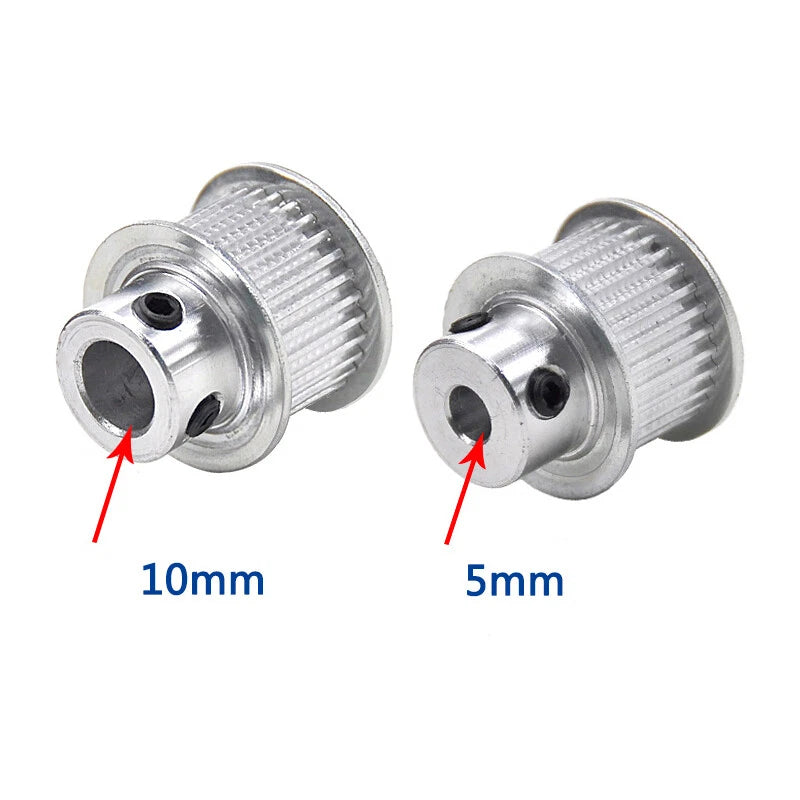
Bore diameters from 4 mm to 15 mm (approx. 0.157–0.591 in) cover common motor shaft sizes including 4, 5, 6, 6.35, 7, 8, 10, 12, 14, and 15 mm.

🏗️ Aluminum Alloy Construction

Lightweight yet rigid aluminum body keeps rotational inertia low — critical for high-acceleration motion control applications.

🔄 S2M 2 mm Pitch Standard

Conforms to the S2M synchronous belt standard, ensuring interchangeability with off-the-shelf S2M belts from major belt manufacturers.

🛠️ Set-Screw Bore Retention

Bore includes a set-screw flat or keyway slot (depending on variant) for secure shaft locking without adhesives or press-fit tooling.

📐 Technical Specifications — S2M Timing Belt Pulley

Belt Standard S2M (2 mm pitch)
Flange Type BF-type (double flange) / K-type (single/no flange)
Tooth Count 16T, 20T, 24T, 25T, 30T, 32T, 35T, 36T, 38T, 40T, 45T, 48T, 50T, 55T, 60T
Bore Diameter 4 mm / 5 mm / 6 mm / 6.35 mm / 7 mm / 8 mm / 10 mm / 12 mm / 14 mm / 15 mm
Slot Width 7 mm (S2M-7 belt) or 11 mm (S2M-11 belt)
Material Aluminum alloy
Outer Diameter See variant options
Hub Length See variant options
Weight See variant options
Surface Finish See variant options
Shaft Retention Set screw (M3 or M4, contact us to confirm per variant)

❓ Frequently Asked Questions

How do I choose between BF-type and K-type?

BF-type pulleys have double flanges on both sides of the tooth profile, which physically guides the belt and prevents it from walking off the pulley — ideal for horizontal or vibration-prone drive systems. K-type pulleys have a single flange or no flange, which is useful when the belt must enter or exit at an angle, or when space constraints prevent a flanged pulley from fitting. For most 3D printer and CNC applications, BF-type is recommended for the driven pulley and K-type for the idler.

What belt width should I pair with the 7 mm vs. 11 mm slot?

The slot width dimension refers to the usable belt-contact width. A 7 mm slot is designed for S2M-7 belts (7 mm wide), and an 11 mm slot is designed for S2M-11 belts (11 mm wide). Using a belt narrower than the slot is generally acceptable but reduces torque capacity; using a belt wider than the slot will cause the belt to ride on the flanges and wear prematurely.

Which bore diameter should I select for my motor shaft?

Match the bore diameter to your motor shaft diameter exactly. Common NEMA 17 stepper motors use a 5 mm shaft; NEMA 23 motors typically use an 8 mm shaft; servo motors and DC gearmotors vary widely from 4 mm to 15 mm. If your shaft is imperial (e.g., 1/4 inch = 6.35 mm), select the 6.35 mm bore variant. Always verify with calipers before ordering.

How strong is an aluminum S2M pulley compared to a steel one?

Aluminum alloy pulleys are well-suited for light-to-medium duty S2M applications — the 2 mm pitch belt itself is the limiting factor in torque capacity, not the pulley material. For typical 3D printer, small CNC, and robotics loads, aluminum provides sufficient strength while keeping rotational inertia low. Steel pulleys are generally only needed in high-cycle industrial applications where surface wear over millions of revolutions becomes a concern.

Will this pulley corrode if used in a humid or outdoor environment?

Aluminum alloy naturally forms a thin oxide layer that provides moderate corrosion resistance. Anodized variants offer enhanced protection. For prolonged outdoor or high-humidity exposure, applying a light coat of dry lubricant or corrosion inhibitor to the bore and set-screw area is recommended. The tooth profile itself does not require lubrication when used with standard rubber S2M belts.

How do I calculate the correct tooth count for my drive ratio?

Drive ratio = driven pulley teeth ÷ driving pulley teeth. For example, a 40T driven pulley paired with a 20T driving pulley gives a 2:1 reduction (output torque doubles, speed halves). For a 1:1 ratio (common in CoreXY 3D printers), use identical tooth counts on both pulleys. Center distance and belt length must also be calculated — use the formula: Belt length ≈ 2 × center distance + π × (D1 + D2) / 2, where D1 and D2 are the pitch diameters of each pulley.

Can I use this pulley with GT2 or HTD belts?

No. S2M pulleys are designed exclusively for S2M synchronous belts. Although S2M and GT2 both have a 2 mm pitch, their tooth profiles differ — GT2 uses a curvilinear (arc) tooth form while S2M uses a trapezoidal tooth form. Mixing profiles causes poor meshing, increased noise, accelerated wear, and potential belt skipping under load. Always match pulley and belt profiles.

🛒 Select your model type, tooth count, and bore diameter above, then add to cart.


You may also like

Recently viewed