Shaft Coupling Flexible Plum Spider Jaw Coupler Stepper Motor Connector Ø20 mm

No reviews

Price:
Sale price$9.55 USD
Stock:
In stock (500 units), ready to be shipped

Payment & Security

Ach Direct Debit Amazon American Express Apple Pay Bancontact BLIK Diners Club Discover EPS Google Pay iDEAL Wero JCB Maestro Mastercard Multibanco MobilePay PayPal Przelewy24 Shop Pay Twint Union Pay USDC Visa

Your payment information is processed securely. We do not store credit card details nor have access to your credit card information.

Limited Offer — Spend More, Save More
Spend $55+
Save $5
Spend $100+
Save $10
Spend $200+
Save $25
HomeDIYer DIY Expert Support

DIY Expert Support

Get fitment advice & recommendations

Mon–Fri  8:30 AM – 8:00 PM
24-Hour Fast Ship
Arrives in 3–14 Days
Worldwide Shipping
30-Day Returns
1 tree planted with every purchase

Description

Flexible Plum Spider Jaw Shaft Coupling — Reliable Motion Transfer for Stepper Motors

When shaft misalignment, vibration, or torque shock threatens the precision of your CNC router, 3D printer, or automation rig, a rigid coupling simply isn't enough. Engineers and DIY builders who demand consistent, low-backlash motion transfer rely on flexible jaw couplings to protect their motors and lead screws from the stresses of real-world operation.

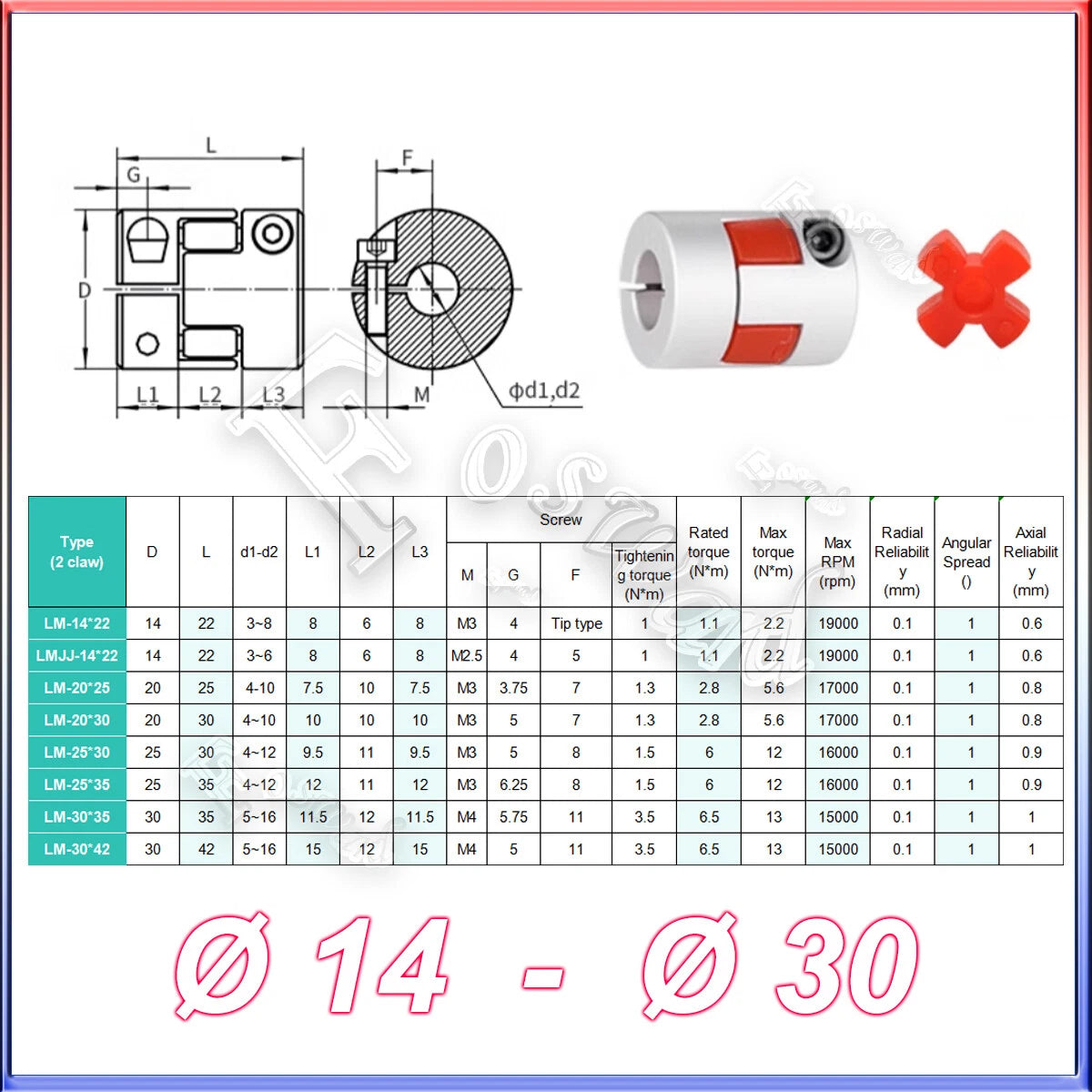
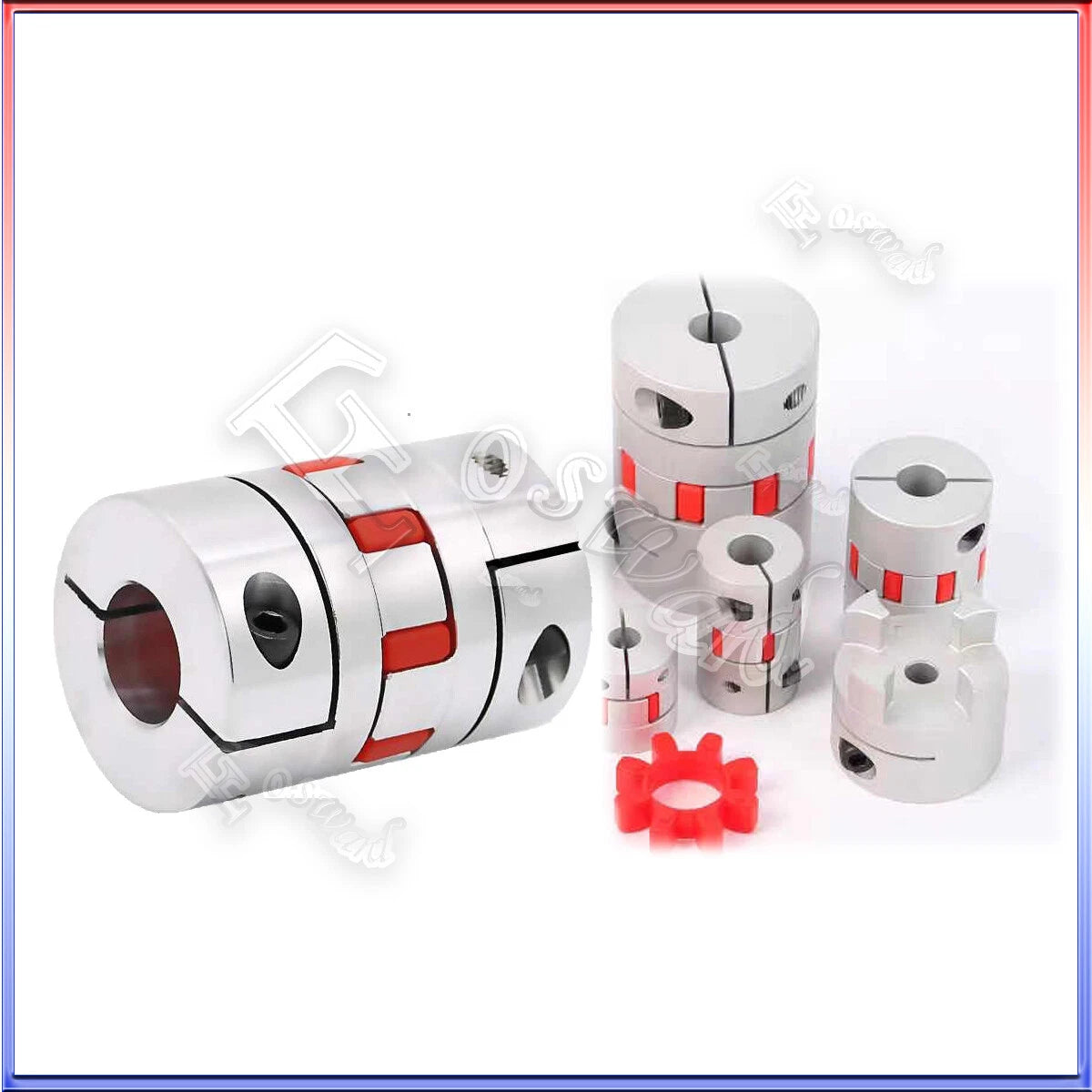
This flexible plum spider jaw shaft coupling features an outer diameter of Ø20 mm (~0.79 in) and a length of 25 mm (~0.98 in). The two-piece aluminum alloy hubs grip each shaft independently, while a polyurethane spider insert sits between them to absorb shock and dampen vibration. Bore sizes range from 4 mm to 10 mm (d1 and d2), covering a wide range of motor shaft and lead screw combinations.

Typical applications include stepper motor to lead screw connections on CNC milling machines, flexible coupling for 3D printer Z-axis drives, and servo motor shaft connectors in light industrial automation — all scenarios where angular and parallel misalignment compensation is critical for long-term accuracy.

⚙️ Compatible with: NEMA 17 / NEMA 23 stepper motors, standard lead screws (T8, T12), servo motor shafts, and encoder shafts with 4–10 mm diameter. Verify bore size (d1 × d2) before ordering.

✅ Key Features of These Flexible Plum Spider Jaw Shaft Couplings

🔩 Two-Piece Aluminum Hub Design

Each hub clamps independently onto its shaft via set screws, allowing different bore sizes on each end (d1 ≠ d2) — ideal for mixed motor and lead screw shaft diameters.

🌟 Polyurethane Spider Insert

The star-shaped elastomer spider absorbs torque shock, reduces vibration transmission, and compensates for angular, parallel, and axial misalignment between connected shafts.

📐 Ø20 mm Outer Diameter, 25 mm Length

Compact form factor fits within tight motor mounts and gantry assemblies. Outer diameter of 20 mm (~0.79 in) and length of 25 mm (~0.98 in) suit most desktop CNC and 3D printer builds.

🎯 Low Backlash for Positioning Accuracy

The interference-fit spider insert minimizes rotational play, maintaining positioning repeatability in open-loop stepper motor systems where backlash directly affects part accuracy.

🛡️ Corrosion-Resistant Aluminum Alloy Hubs

Lightweight aluminum alloy construction resists oxidation in workshop environments. Anodized finish (where applicable) adds surface hardness and extends service life.

🔧 Wide Bore Size Selection (4–10 mm)

Available in 28 bore size combinations from 4×4 mm up to 9×10 mm, covering the most common stepper motor shaft and lead screw diameter pairings used in DIY CNC and automation projects.

📐 Technical Specifications — Flexible Jaw Shaft Coupling

Outer Diameter (Ø) 20 mm (0.79 in)
Coupling Length 25 mm (0.98 in)
Bore Size d1 Range 4 mm – 9 mm
Bore Size d2 Range 4 mm – 10 mm
Hub Material Aluminum Alloy
Spider Insert Material Polyurethane (PU)
Coupling Type Flexible Jaw / Plum Spider
Misalignment Compensation Angular, Parallel, Axial
Fastening Method Set Screw (grub screw)
Finish See variant options
Max Recommended RPM See variant options
Max Torque See variant options

❓ Frequently Asked Questions

How do I choose the right bore size (d1 × d2)?

Measure the shaft diameter of your motor (d1) and the shaft or lead screw it connects to (d2) using a caliper. Select the variant where d1 matches your motor shaft and d2 matches your lead screw or driven shaft. Both bores are clamped independently, so d1 and d2 do not need to be equal.

Can this coupling handle angular and parallel misalignment?

Yes. The polyurethane spider insert flexes to accommodate angular misalignment (typically up to 1°–3°) and small amounts of parallel offset. For best results, align shafts as closely as possible — the spider compensates for residual misalignment rather than replacing proper alignment practice.

Will the aluminum hubs corrode in a humid workshop environment?

Aluminum alloy naturally forms a thin oxide layer that resists further corrosion in typical indoor workshop conditions. For environments with exposure to cutting fluids or high humidity, periodic inspection of the set screws is recommended to prevent galvanic corrosion at the fastener contact points.

Is this coupling suitable for NEMA 17 and NEMA 23 stepper motors?

Yes. NEMA 17 motors typically have 5 mm shafts and NEMA 23 motors commonly use 6.35 mm or 8 mm shafts — all within the 4–10 mm bore range of this coupling. Select the bore size that matches your specific motor shaft diameter.

How does the spider insert affect backlash?

The polyurethane spider is designed to fit snugly between the hub jaws, minimizing rotational play. In open-loop stepper motor systems, low backlash is essential for repeatable positioning. The interference fit of the spider insert keeps backlash to a minimum under normal operating loads.

Can I replace the spider insert separately if it wears out?

The spider insert is a separate component from the aluminum hubs. In many cases, replacement spiders of the same jaw count and outer diameter can be sourced independently, extending the service life of the aluminum hubs. Contact us to confirm compatibility with your specific coupling size.

What is the difference between a plum spider jaw coupling and a rigid coupling?

A rigid coupling transmits torque without any flex, requiring near-perfect shaft alignment. A plum spider jaw coupling uses an elastomer insert to absorb vibration, compensate for minor misalignment, and protect motor bearings from shock loads — making it the preferred choice for CNC and 3D printer applications where some shaft runout is unavoidable.

🛒 Select your Ø-(mm) x Length and Bore Size (d1–d2) above, then add to cart.

You may also like

Recently viewed