Small Pressure Spring Compression Springs 0.2 0.3 0.4 0.5mm Wire Various Sizes

No reviews

Price:
Sale price$8.55 USD
Stock:
In stock (500 units), ready to be shipped

Payment & Security

Ach Direct Debit Amazon American Express Apple Pay Bancontact BLIK Diners Club Discover EPS Google Pay iDEAL Wero JCB Maestro Mastercard Multibanco MobilePay PayPal Przelewy24 Shop Pay Twint Union Pay USDC Visa

Your payment information is processed securely. We do not store credit card details nor have access to your credit card information.

Limited Offer — Spend More, Save More
Spend $55+
Save $5
Spend $100+
Save $10
Spend $200+
Save $25
HomeDIYer DIY Expert Support

DIY Expert Support

Get fitment advice & recommendations

Mon–Fri  8:30 AM – 8:00 PM
24-Hour Fast Ship
Arrives in 3–14 Days
Worldwide Shipping
30-Day Returns
1 tree planted with every purchase

Description

Small Compression Springs — Precision Wire Diameters for Tight-Tolerance DIY Applications

When a repair stalls because you can't find a spring small enough to fit, it's frustrating — especially for electronics hobbyists, model builders, and precision instrument technicians who need exact dimensions. These small pressure compression springs are engineered for applications where standard hardware-store springs are simply too large or too stiff.

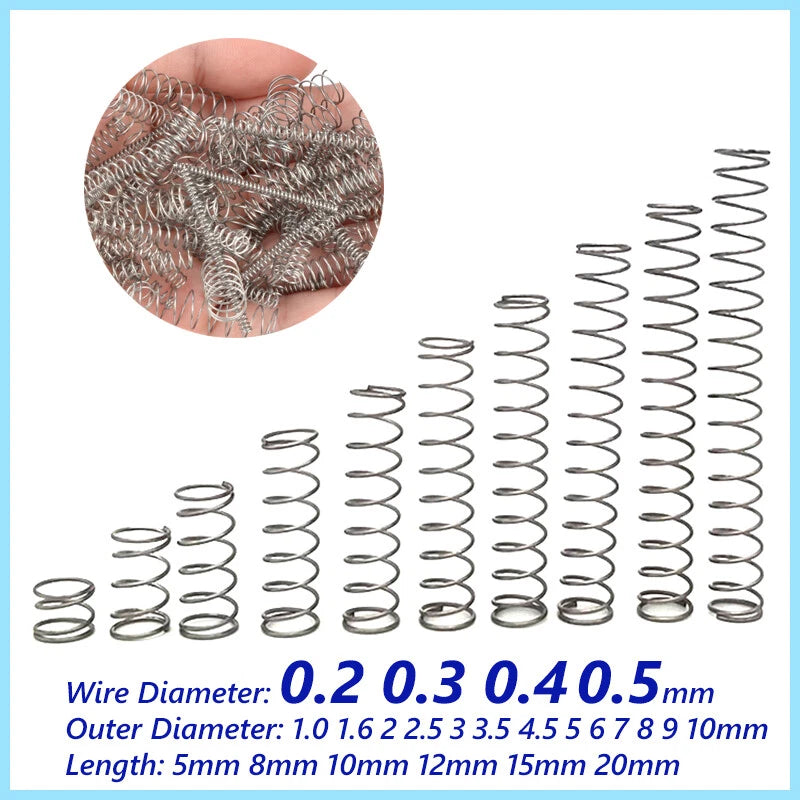
Each pack contains 10 pieces of stainless steel compression springs. Wire diameters range from 0.2 mm to 0.5 mm (approximately 0.008 in to 0.020 in), outer diameters from 1.0 mm to 10 mm (approximately 0.039 in to 0.394 in), and free lengths from 5 mm to 25 mm (approximately 0.197 in to 0.984 in). Select your exact wire diameter, outer diameter, and length combination from the variant options above.

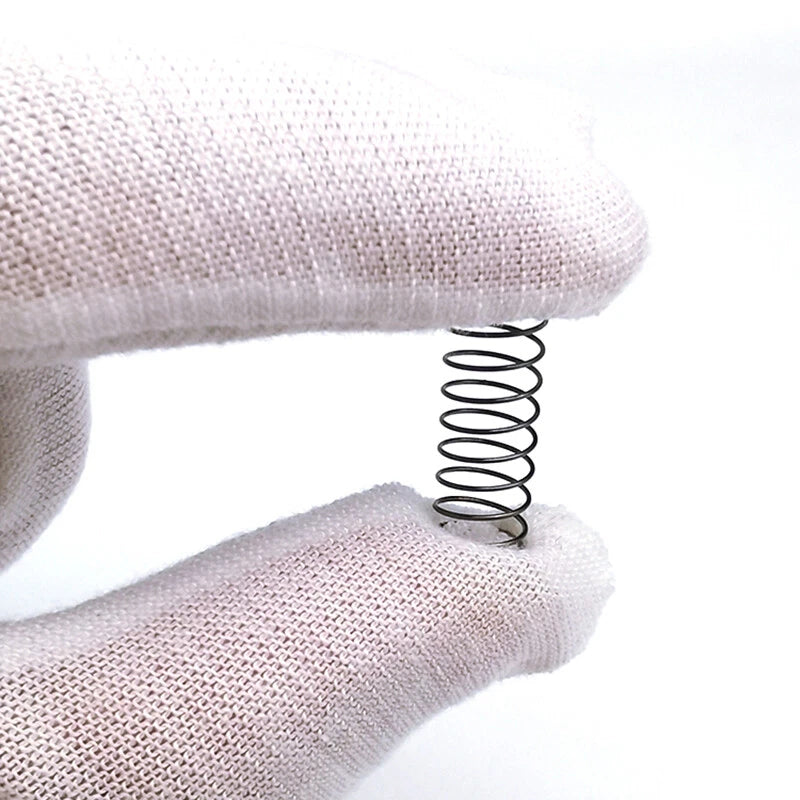
Typical use cases include small compression spring replacement in mechanical pencils and retractable pens, precision spring for RC model suspension and servo mechanisms, and miniature compression spring for electronic switch assemblies and PCB-mounted contacts.

🔧 Compatibility: Suitable for applications requiring wire diameters of 0.2 mm, 0.3 mm, 0.4 mm, or 0.5 mm. Verify your required free length, outer diameter, and wire gauge before ordering. See variant options for the full size matrix.

✅ Key Features of These Small Compression Springs

📐Wide Size Matrix
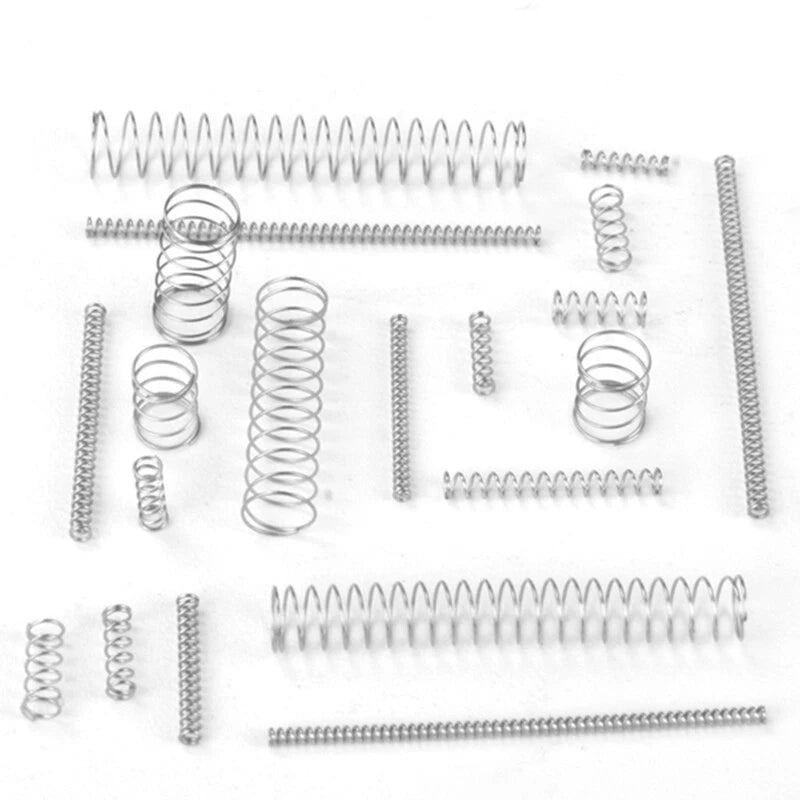
Wire diameters from 0.2–0.5 mm paired with outer diameters from 1.0–10 mm and free lengths from 5–25 mm — covering hundreds of size combinations in a single product listing.
🔩Stainless Steel Construction
Made from stainless steel wire for corrosion resistance and consistent spring-back force across repeated compression cycles.
📦10-Piece Pack
Each variant ships as a pack of 10 identical springs, giving you spares for prototyping, repair batches, or replacement stock.
⚙️Precision-Wound Coils
Uniform coil pitch and consistent wire diameter ensure predictable load characteristics suitable for instrumentation and fine-mechanism applications.
🎯Exact Variant Selection
Three-axis variant system (wire diameter × outer diameter × free length) lets you pinpoint the exact spring geometry you need without guesswork.
🛠️Broad Application Range
Suitable for electronics, model engineering, watchmaking tools, pen mechanisms, medical device prototyping, and general precision DIY repairs.

📐 Technical Specifications — Compression Springs

Material Stainless Steel
Wire Diameter Range 0.2 mm – 0.5 mm (0.008 in – 0.020 in)
Outer Diameter Range 1.0 mm – 10 mm (0.039 in – 0.394 in)
Free Length Range 5 mm – 25 mm (0.197 in – 0.984 in)
Spring Type Compression (open-coil)
End Type See variant options
Surface Finish See variant options
Spring Rate See variant options
Quantity per Pack 10 pieces
Coil Direction See variant options

❓ Frequently Asked Questions

How do I choose the right wire diameter for my application?

Wire diameter determines the stiffness (spring rate) of the spring — thicker wire produces a stiffer spring. For very light-load applications such as pen clickers or small switches, 0.2 mm or 0.3 mm wire is typically appropriate. For slightly higher loads in model mechanisms or small latches, 0.4 mm or 0.5 mm wire is more suitable. If you have the original spring, measure its wire with a micrometer or caliper before ordering.

What is the difference between outer diameter and wire diameter?

Wire diameter is the thickness of the steel wire used to wind the coil. Outer diameter is the overall width of the spring from one outer edge to the other. When fitting a spring into a bore or housing, the outer diameter must be smaller than the bore. When fitting a spring over a pin or shaft, the inner diameter (outer diameter minus twice the wire diameter) must be larger than the pin.

Are these springs corrosion-resistant?

Yes. These springs are made from stainless steel wire, which provides good resistance to oxidation and mild corrosion in typical indoor environments. For prolonged exposure to moisture, salt spray, or aggressive chemicals, verify the specific alloy grade meets your requirements by contacting us to confirm.

Can I use these springs in outdoor or humid environments?

Stainless steel offers better corrosion resistance than carbon steel springs, making these suitable for moderately humid conditions. For harsh outdoor or marine environments, confirm the alloy specification is adequate for your use case before ordering.

How do I match the free length to my application?

Free length is the uncompressed length of the spring. Your application's travel distance plus the compressed (solid) height determines the minimum free length you need. As a conservative rule, select a free length at least 20–30% longer than your required compressed height to avoid coil bind. Measure the cavity depth or stroke length in your mechanism before selecting a variant.

Are these suitable for watchmaking or precision instrument repair?

The smallest variants (0.2 mm wire, 1.0–2.0 mm outer diameter) are dimensionally compatible with many watchmaking and fine instrument applications. However, spring rate and end-type specifications should be verified against your instrument's requirements. Contact us to confirm if you need specific load or tolerance data.

Why does the price vary between some variants?

Larger outer diameters and longer free lengths require more material per spring, which is reflected in a slightly higher price for those specific size combinations. The majority of variants are priced at the standard rate; only the largest or longest combinations carry a small premium.

🛒 Select your wire diameter, outer diameter, and length above, then add to cart.

You may also like

Recently viewed