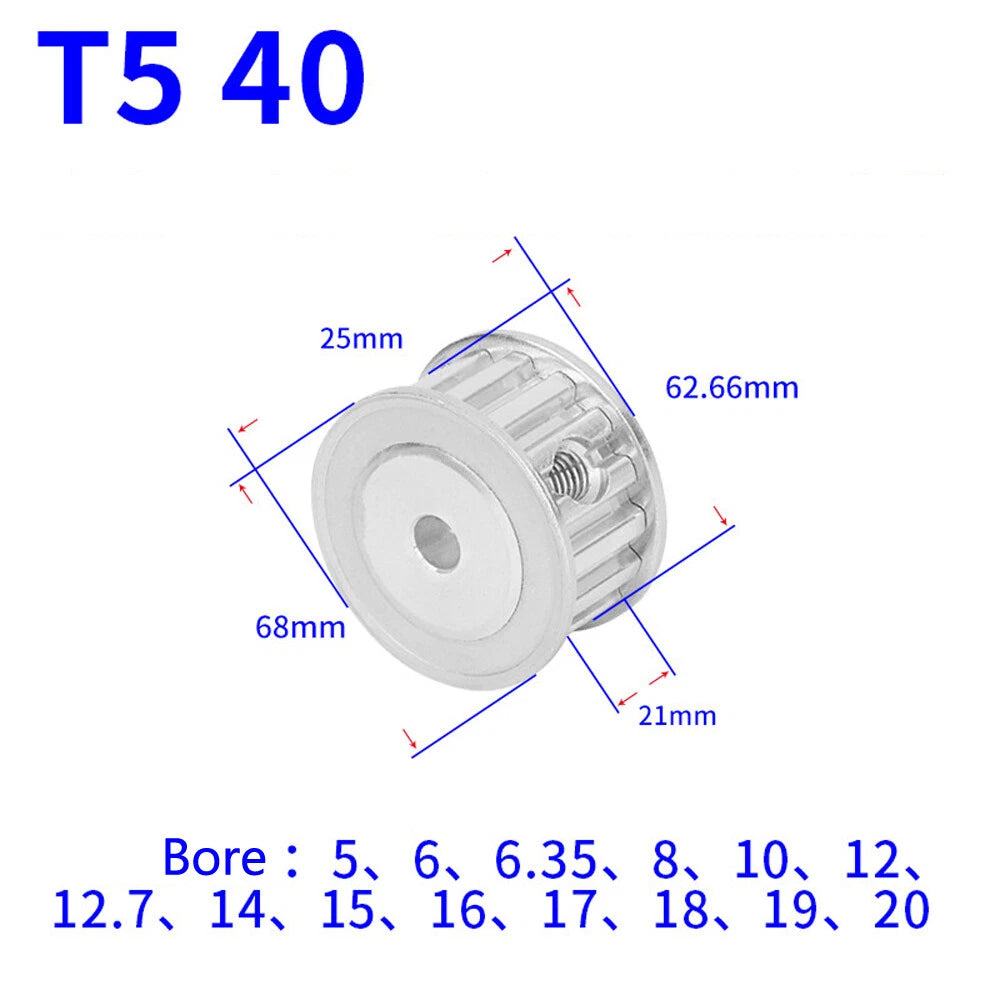
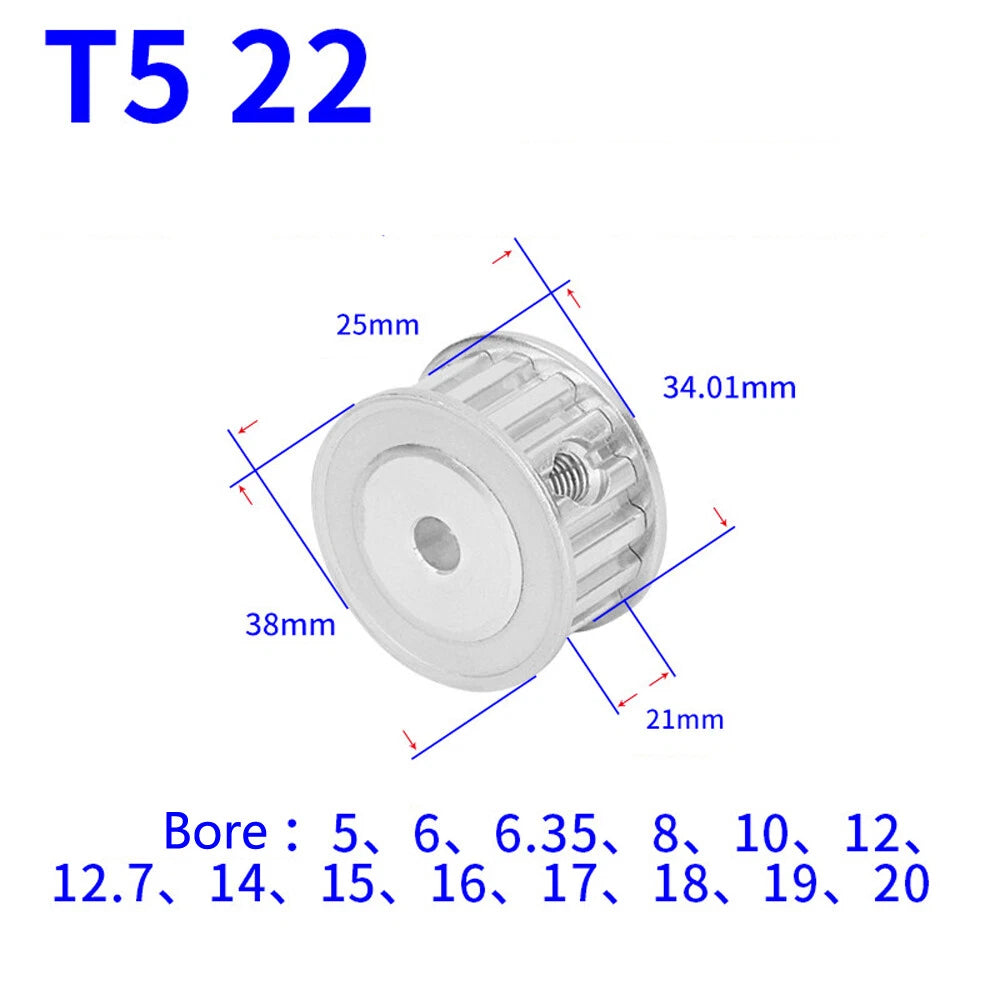
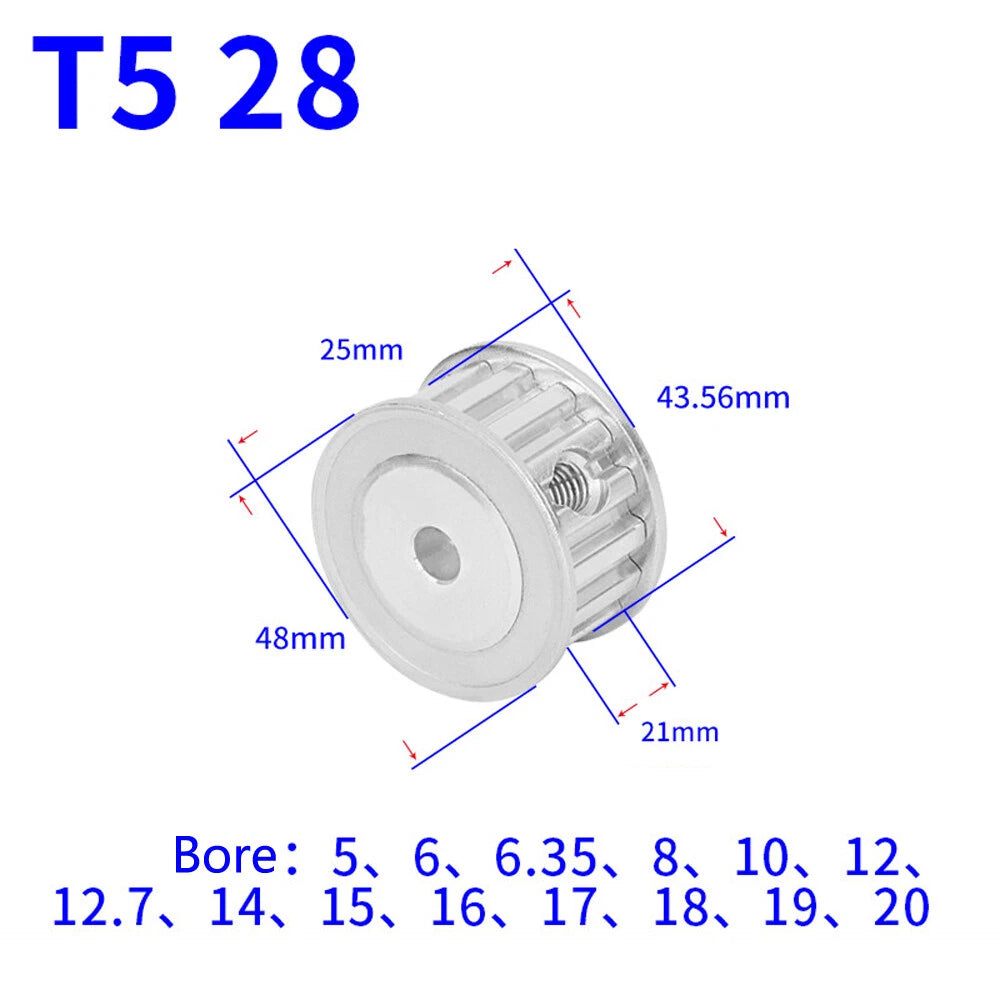
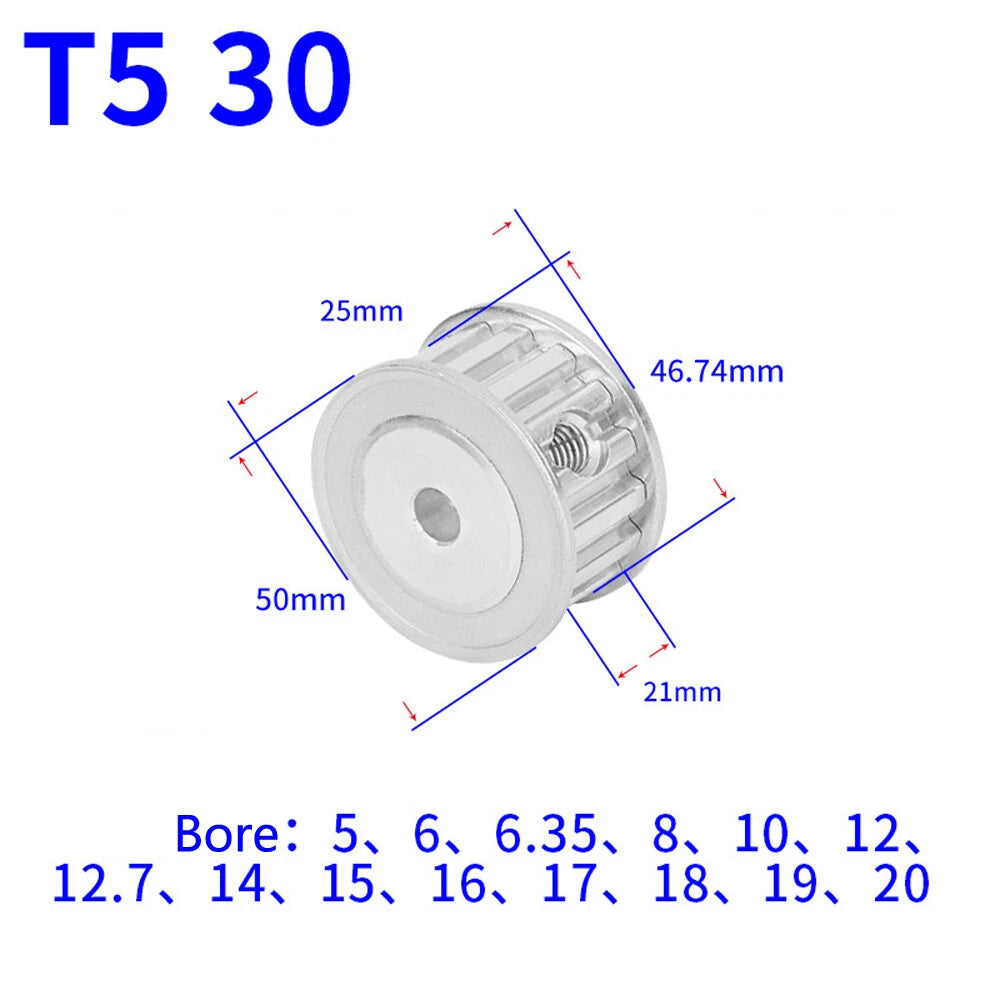
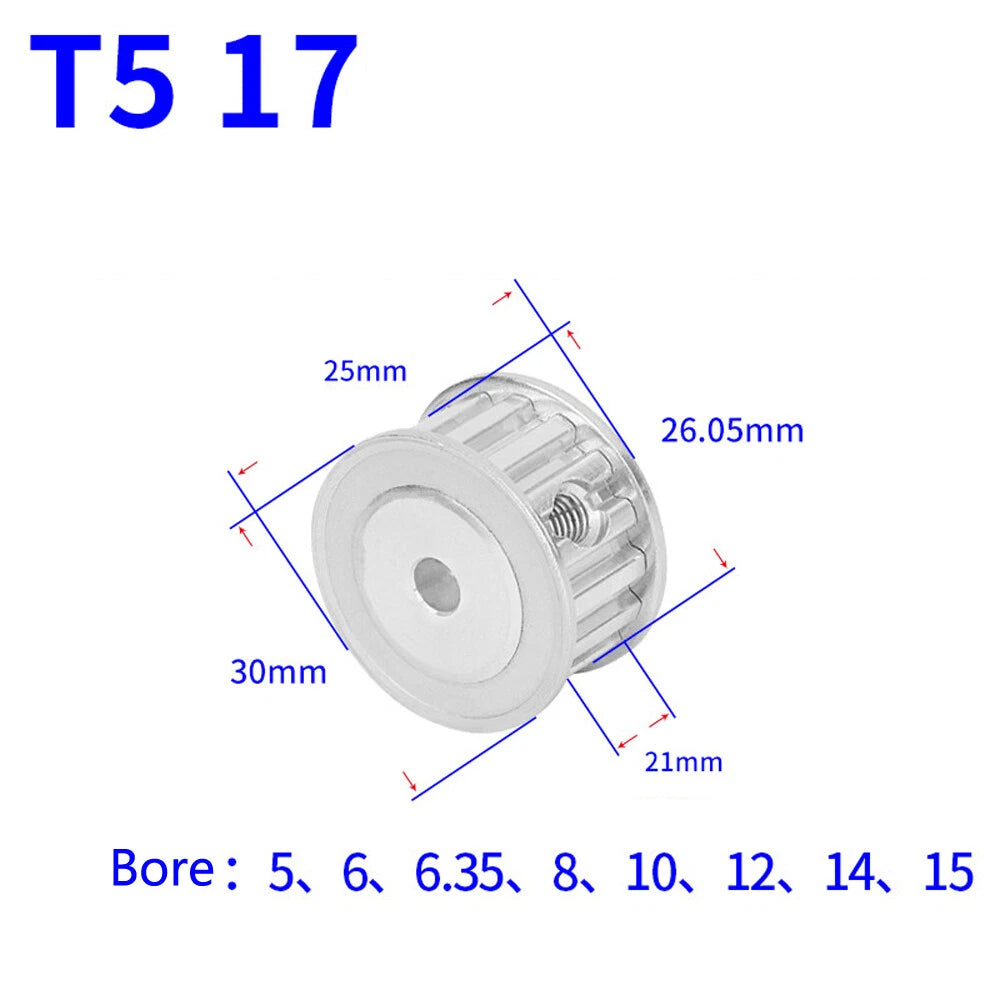
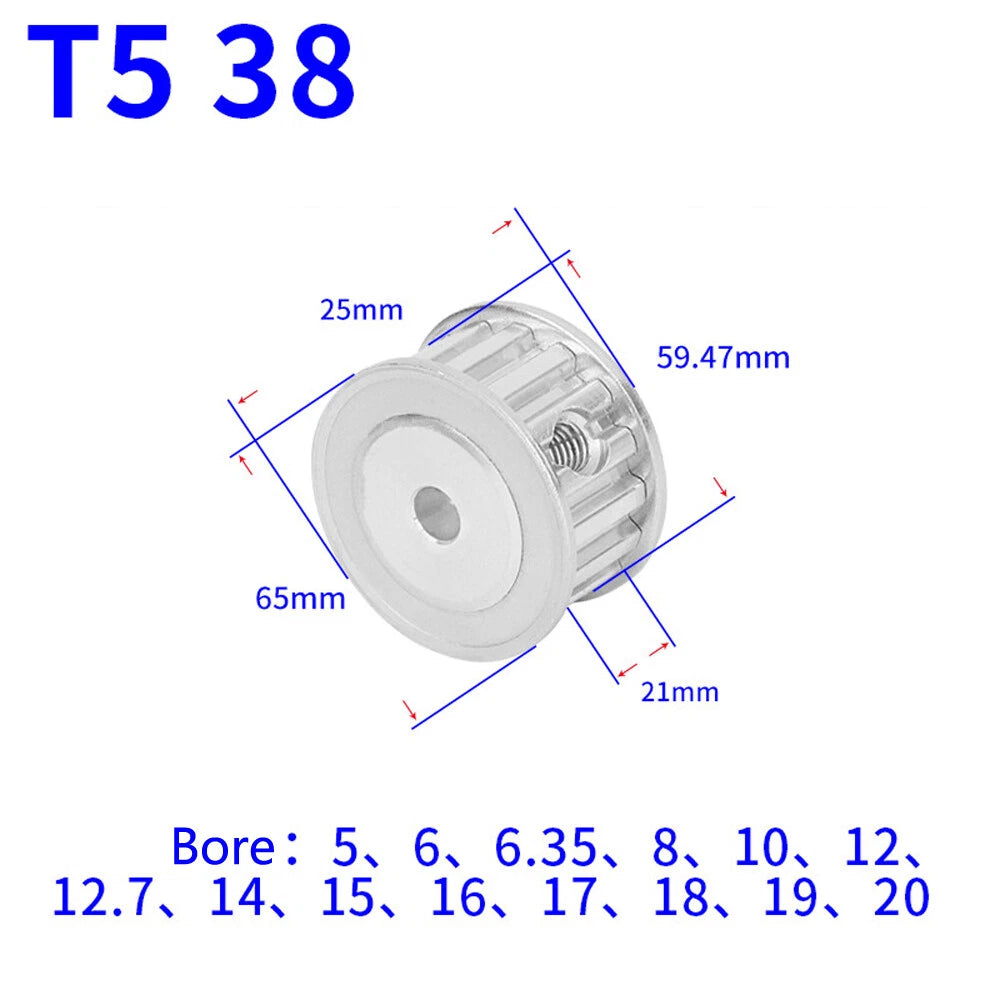
T5 12T-60T Timing Belt Pulley Pitch 5mm AF-type With Keyway Teeth Width 21mm

No reviews

Price:
Sale price$5.60 USD
Stock:
In stock (500 units), ready to be shipped

Payment & Security

Ach Direct Debit Amazon American Express Apple Pay Bancontact BLIK Diners Club Discover EPS Google Pay iDEAL Wero JCB Maestro Mastercard Multibanco MobilePay PayPal Przelewy24 Shop Pay Twint Union Pay USDC Visa

Your payment information is processed securely. We do not store credit card details nor have access to your credit card information.

Limited Offer — Spend More, Save More
Spend $55+
Save $5
Spend $100+
Save $10
Spend $200+
Save $25
HomeDIYer DIY Expert Support

DIY Expert Support

Get fitment advice & recommendations

Mon–Fri  8:30 AM – 8:00 PM
24-Hour Fast Ship
Arrives in 3–14 Days
Worldwide Shipping
30-Day Returns
1 tree planted with every purchase

Description

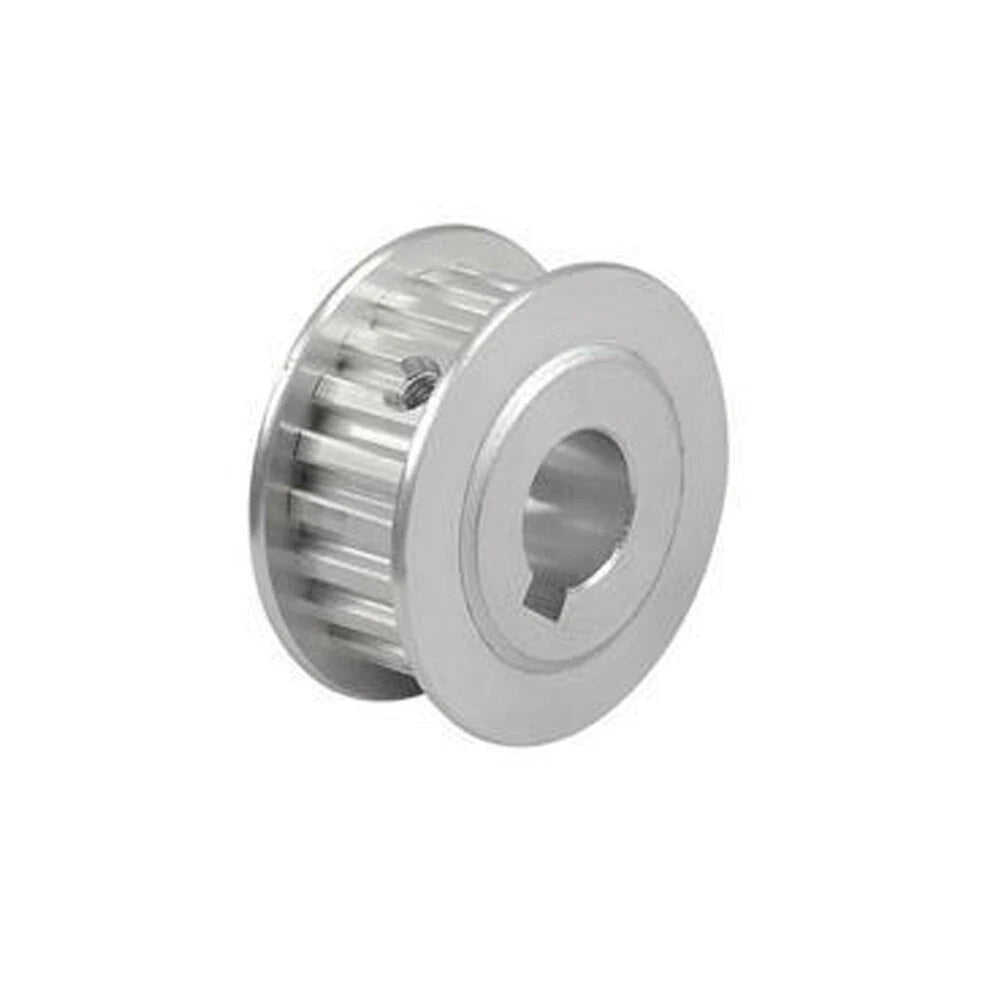
T5 Timing Belt Pulley — Precision AF-Type Drive for CNC, Robotics & Automation

When a slipping or misaligned pulley brings your CNC router, 3D printer, or conveyor build to a halt, you need a drop-in replacement that holds its position under load. Engineers, makers, and machine builders who demand repeatable positioning accuracy rely on T5 AF-type timing belt pulleys with a keyed bore to eliminate rotational slip and maintain synchronous motion.

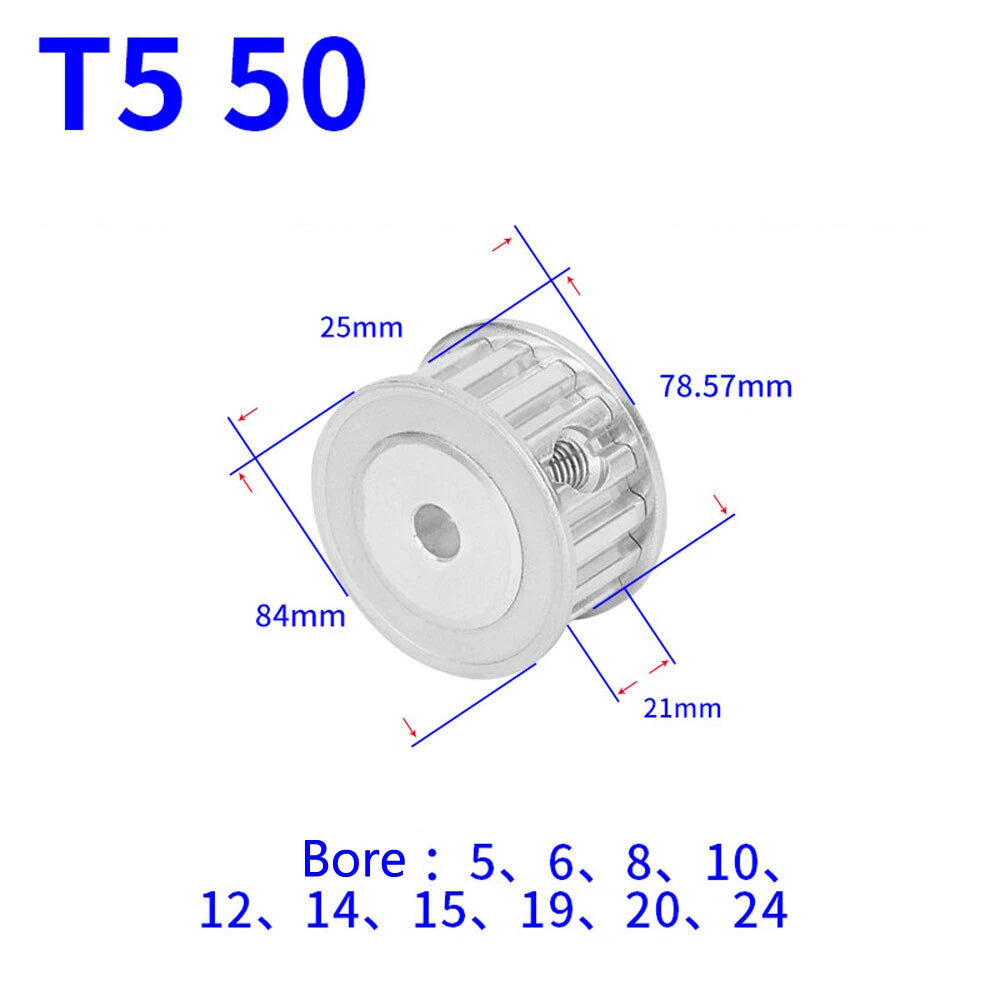
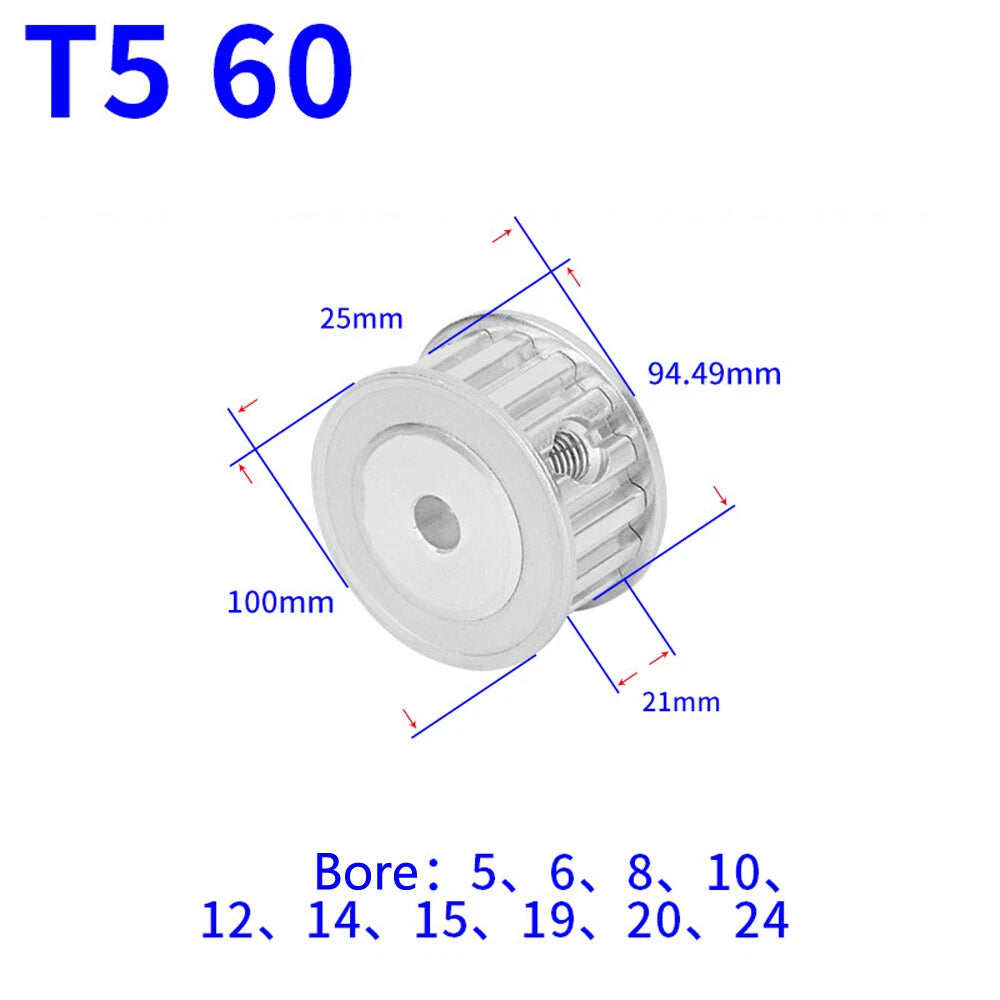
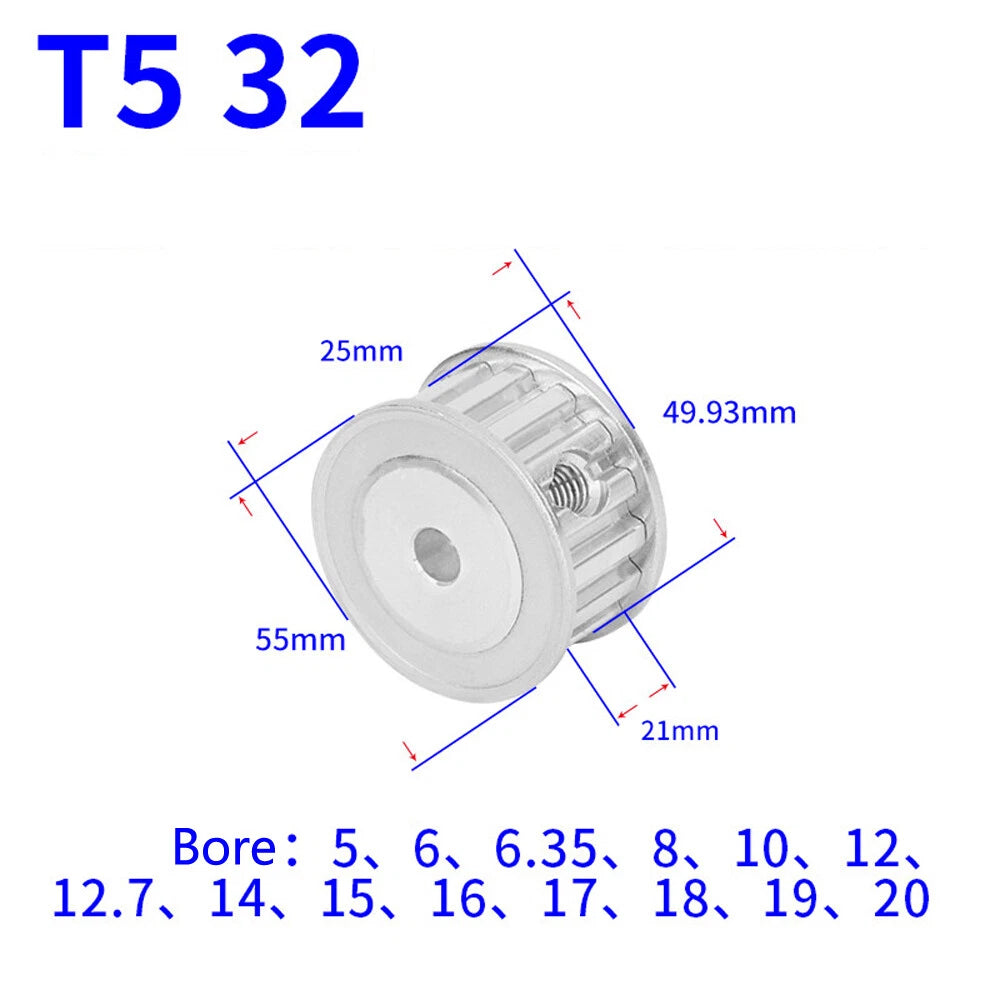
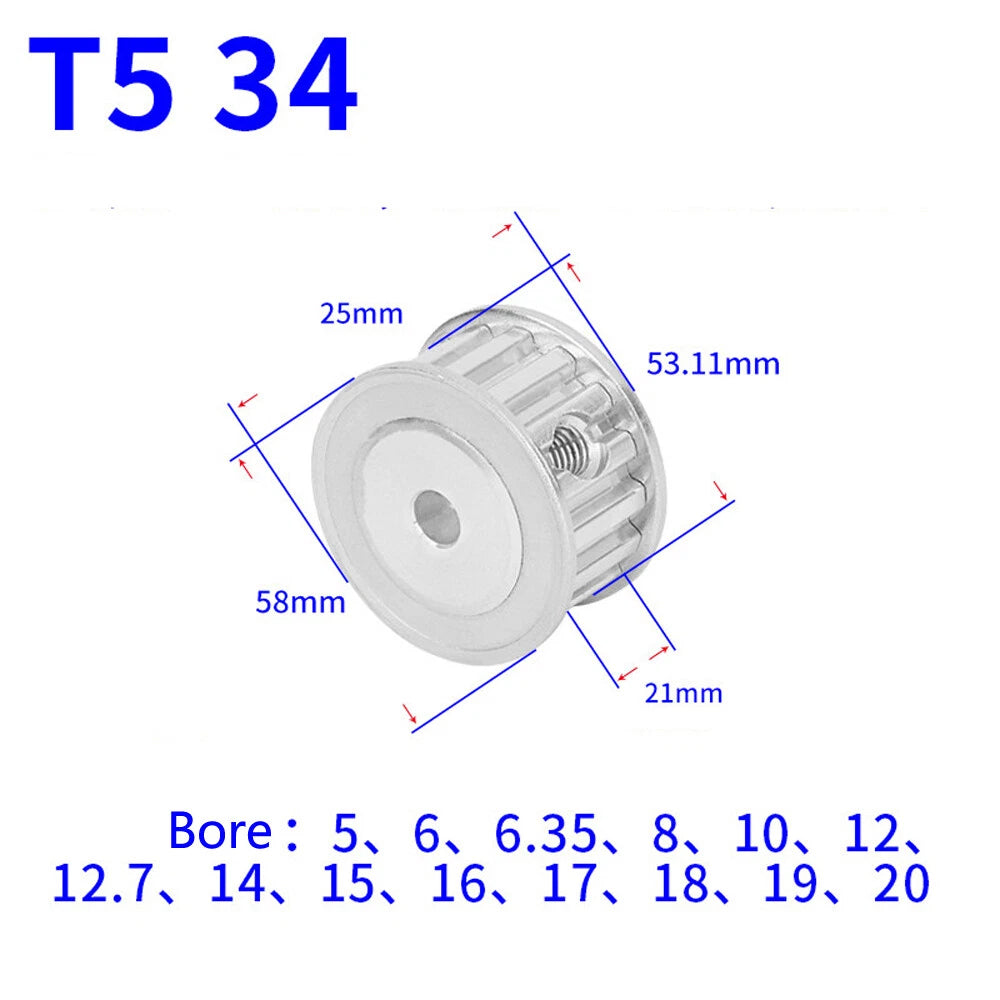
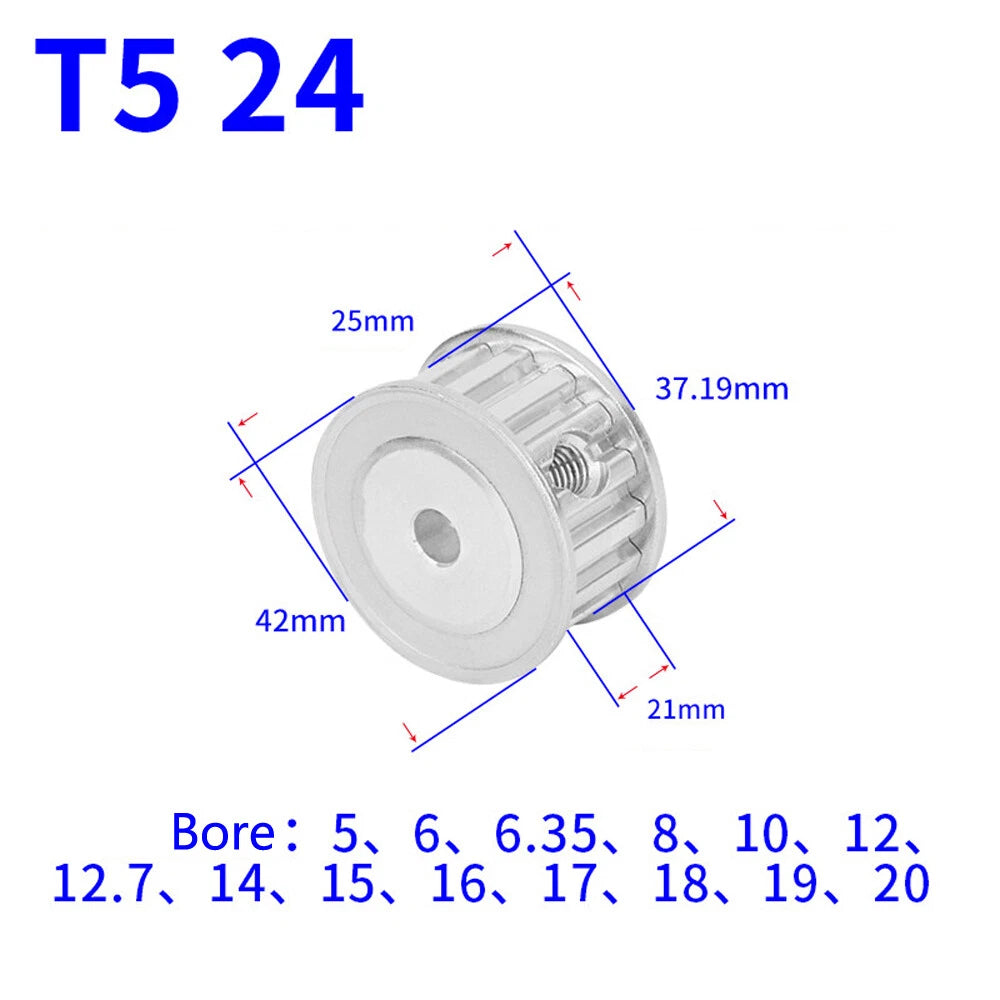
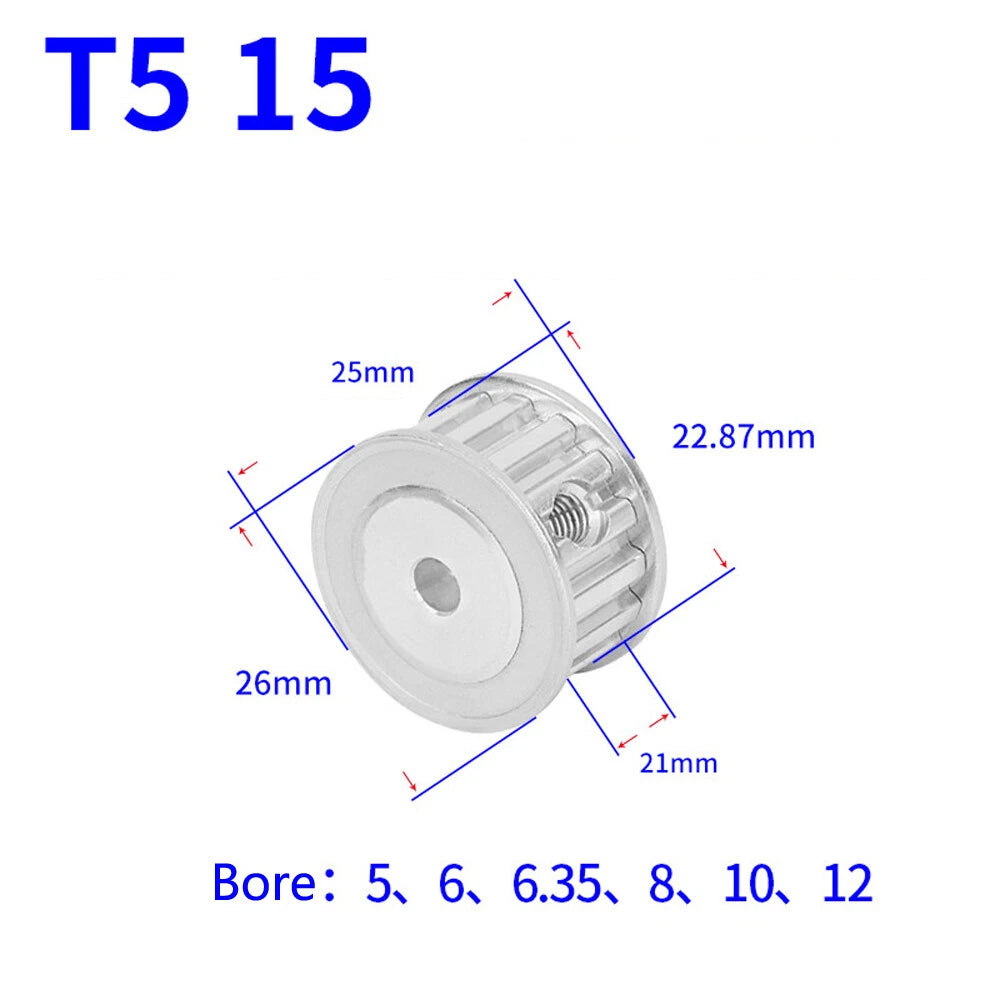
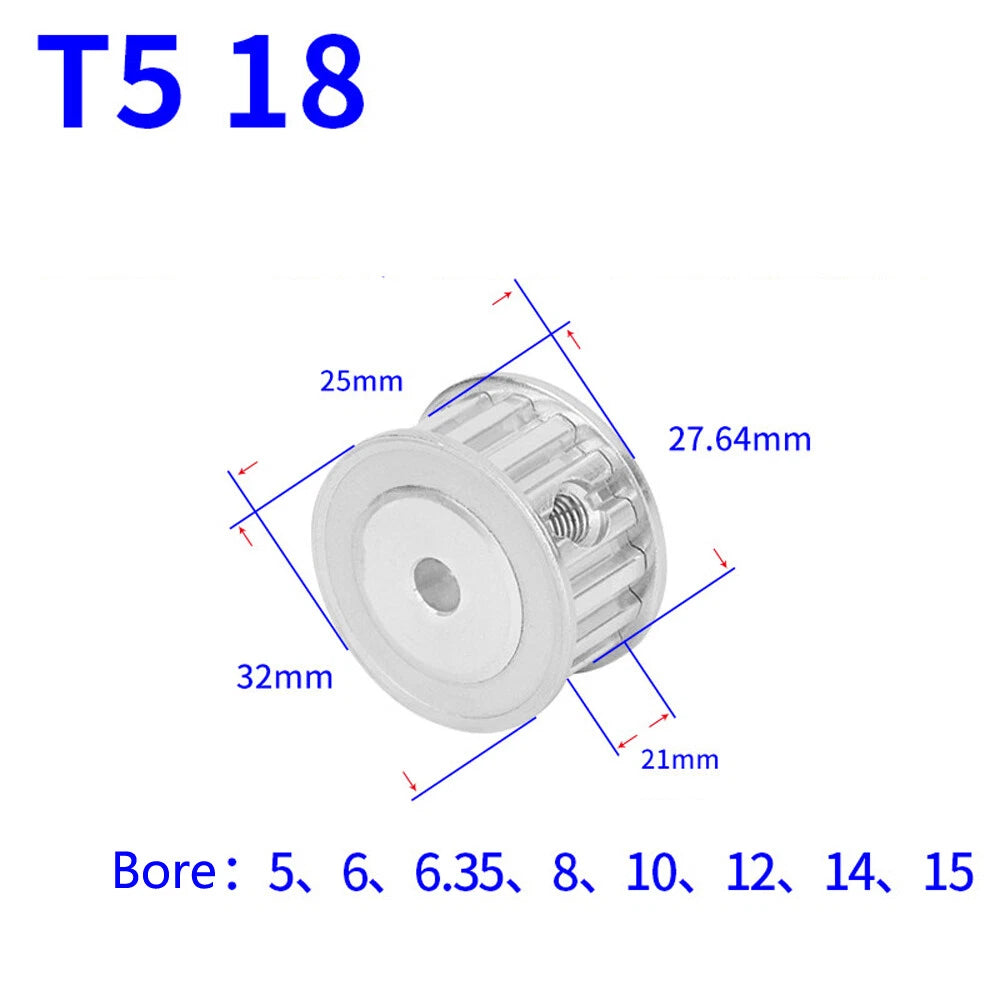
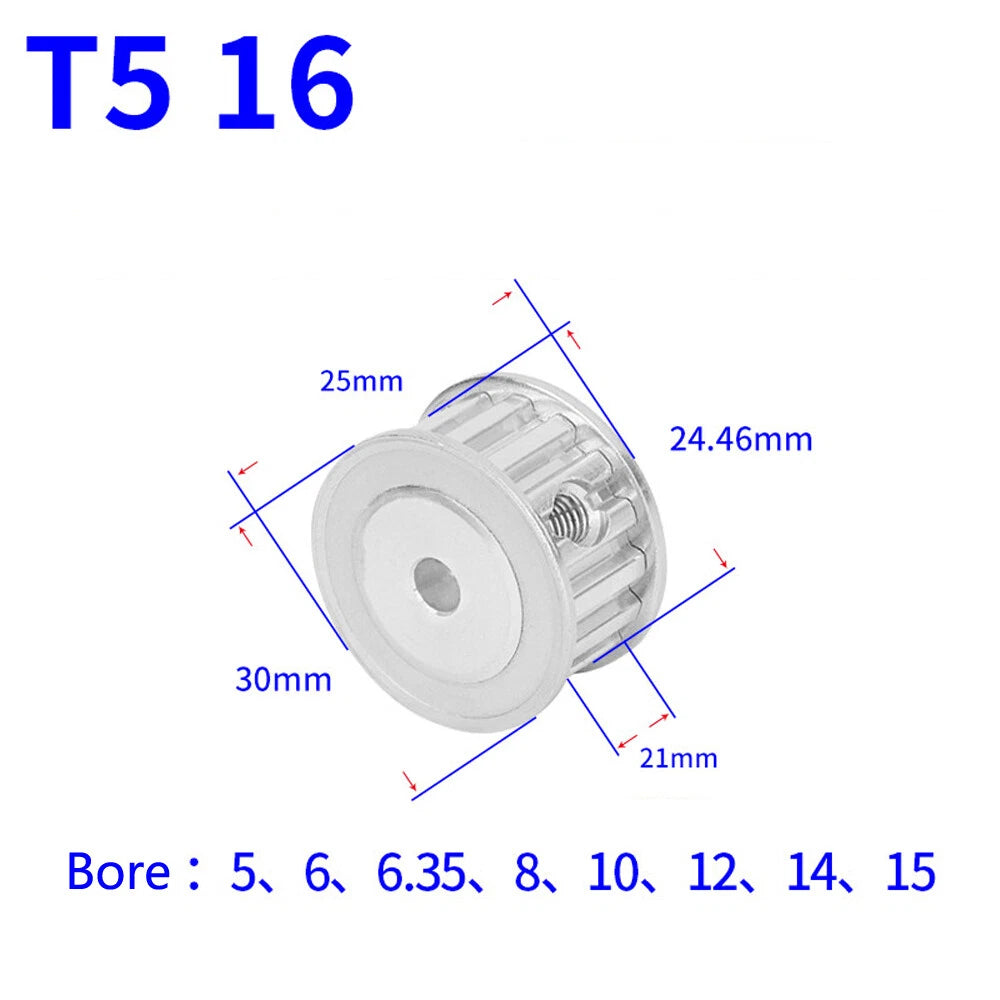
These T5 timing belt pulleys feature a 5 mm pitch tooth profile machined to AF-type geometry, a teeth width of 21 mm (0.83 in), and are available in tooth counts from 12 T to 60 T. Bore options range from 8 mm to 24 mm (0.31–0.94 in) with a matching keyway (3×1.4 mm up to 8×3.3 mm depending on bore size) to lock the pulley firmly to the shaft.

Typical use cases include open-loop stepper-driven CNC gantries requiring consistent belt tension, T5 belt drive systems in desktop 3D printers and laser engravers, and light-duty conveyor or pick-and-place automation where a keyed AF-type pulley prevents axial creep during direction reversals.

⚙️ Compatible with: Standard T5 timing belts (5 mm pitch) — open-ended or closed-loop. Verify belt width matches 21 mm pulley face width before ordering.

✅ Key Features of These T5 Timing Belt Pulleys

🔩 AF-Type Keyed Bore

Keyway slot machined to DIN 6885 proportions locks the pulley to the shaft, eliminating rotational slip under reversing or high-torque loads.

📐 5 mm T5 Tooth Pitch

Standardised T5 trapezoidal tooth profile ensures full mesh with any T5 timing belt, maintaining synchronous motion and predictable positioning.

🎯 Wide Tooth Count Range (12 T – 60 T)

Select the exact gear ratio your drive system needs — from compact 12-tooth pulleys for high-speed axes to 60-tooth pulleys for torque-multiplying stages.

🔧 Multiple Bore Sizes (8 – 24 mm)

Bore options from 8 mm to 24 mm cover common stepper motor shafts, servo shafts, and lead-screw couplings without custom machining.

📏 21 mm Consistent Teeth Width

Uniform 21 mm face width across all tooth counts simplifies belt alignment and allows mixing of different-tooth pulleys on the same belt run.

🏭 CNC-Machined Aluminum Body

Lightweight aluminum construction reduces rotational inertia for faster acceleration in motion-control applications while resisting corrosion in workshop environments.

📐 Technical Specifications — T5 AF-Type Timing Belt Pulley

Belt Type T5 (Trapezoidal, 5 mm pitch)
Pulley Type AF-type (with keyway)
Tooth Pitch 5 mm
Teeth Width 21 mm (0.83 in)
Number of Teeth 12 T – 60 T (see variant options)
Bore Diameter 8 – 24 mm (see variant options)
Keyway Dimensions 3×1.4 mm / 4×1.8 mm / 5×2.3 mm / 6×2.8 mm / 8×3.3 mm (see variant options)
Material Aluminum alloy
Quantity per Order 1 piece
Outer Diameter See variant options
Weight See variant options

❓ Frequently Asked Questions

How do I choose the right number of teeth for my drive system?

The tooth count determines the pitch diameter and, combined with your motor shaft speed, the linear belt velocity. For a given belt speed, a smaller tooth count (e.g., 12 T) produces a smaller pitch diameter and higher torque multiplication, while a larger count (e.g., 60 T) increases pitch diameter and belt speed. Match the tooth count ratio between driver and driven pulleys to achieve your target mechanical advantage or speed ratio.

What bore size should I select for a standard NEMA 17 stepper motor?

Most NEMA 17 stepper motors have a 5 mm output shaft. However, this pulley range starts at 8 mm bore. If your motor shaft is 5 mm, you will need a shaft adapter or a different pulley series. For NEMA 23 motors (typically 6.35 mm or 8 mm shafts), the 8 mm bore variant is a direct fit. Always measure your shaft diameter before ordering.

Is the keyway required, or can I use the pulley without a key?

The AF-type designation means the bore is machined with a keyway slot. You can install the pulley without a key by relying on a set screw alone for light-duty or low-torque applications, but for reliable synchronous motion under load it is strongly recommended to use the matching key to prevent rotational slip, especially during direction reversals.

Will this pulley work with any T5 timing belt?

Yes — the 5 mm T5 trapezoidal tooth profile is standardised, so these pulleys mesh with any T5 open-ended or closed-loop timing belt. The critical dimension to verify is belt width: the pulley face is 21 mm wide, so a belt width of 10 mm or 15 mm will run centrally on the face. Using a belt wider than 21 mm is not recommended as it will overhang the pulley flanges.

How corrosion-resistant is the aluminum pulley in a humid or outdoor environment?

The aluminum alloy body offers good natural oxidation resistance suitable for indoor workshop and light industrial environments. For prolonged exposure to moisture, salt spray, or outdoor conditions, applying a thin coat of dry lubricant or anodizing the surface is advisable. These pulleys are not rated for marine or chemically aggressive environments without additional surface treatment.

Can I use two different tooth-count pulleys from this range on the same belt run?

Yes. Because all variants share the same 5 mm T5 pitch and 21 mm face width, you can pair any two tooth counts from this range (e.g., a 20 T driver with a 40 T driven pulley) to achieve a 2:1 speed reduction. Ensure the centre distance between shafts is adjusted to maintain correct belt tension when changing the tooth count ratio.

What is the difference between AF-type and standard (non-keyed) pulleys?

Standard pulleys rely solely on a set screw pressing against the shaft to transmit torque, which can slip under high or reversing loads. AF-type pulleys add a machined keyway that accepts a standard parallel key, creating a positive mechanical lock between shaft and pulley. This makes AF-type pulleys the preferred choice for precision CNC axes, servo drives, and any application where positional accuracy must be maintained over many cycles.

🛒 Select your Number of Teeth, Bore, and Keyway size above, then add to cart.


You may also like

Recently viewed