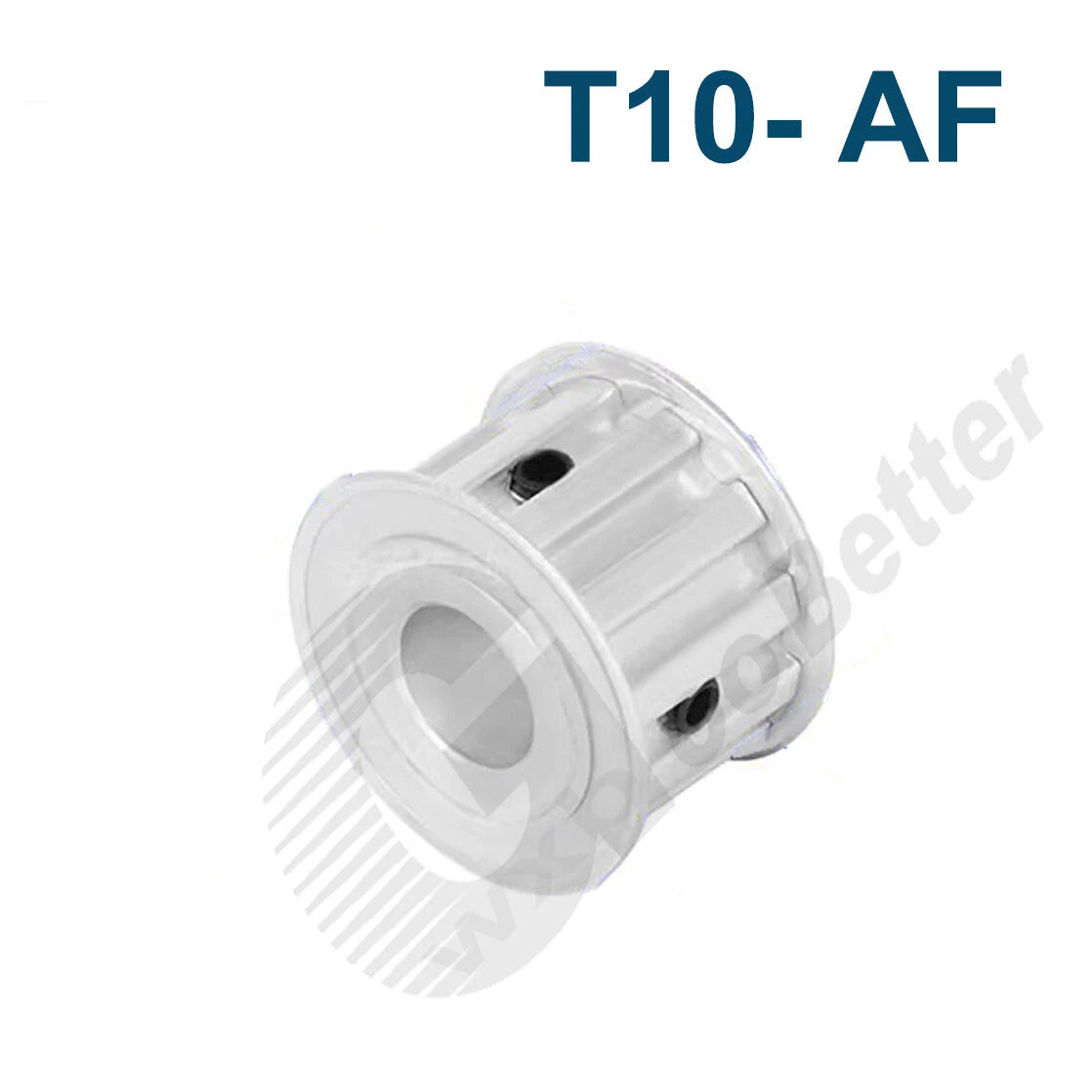
Timing Pulley T10 12T~20T for 20mm Belt Aluminum AF Shape Timing Pulley ID=8~30

No reviews

Price:
Sale price$11.55 USD
Stock:
In stock (500 units), ready to be shipped

Payment & Security

Ach Direct Debit Amazon American Express Apple Pay Bancontact BLIK Diners Club Discover EPS Google Pay iDEAL Wero JCB Maestro Mastercard Multibanco MobilePay PayPal Przelewy24 Shop Pay Twint Union Pay USDC Visa

Your payment information is processed securely. We do not store credit card details nor have access to your credit card information.

Limited Offer — Spend More, Save More
Spend $55+
Save $5
Spend $100+
Save $10
Spend $200+
Save $25
HomeDIYer DIY Expert Support

DIY Expert Support

Get fitment advice & recommendations

Mon–Fri  8:30 AM – 8:00 PM
24-Hour Fast Ship
Arrives in 3–14 Days
Worldwide Shipping
30-Day Returns
1 tree planted with every purchase

Description

T10 Timing Pulley — Aluminum AF-Shape Drive for CNC, Robotics & Linear Motion

When a motion system loses position accuracy or a belt skips under load, the culprit is often a pulley that cannot hold its bore-to-shaft fit or maintain consistent tooth engagement. Engineers and makers building CNC routers, robotic actuators, linear stages, and automated conveyor systems need a T10 timing pulley that combines a precise bore, a reliable keyway option, and a tooth profile matched to 20 mm T10 belts — without compromise.

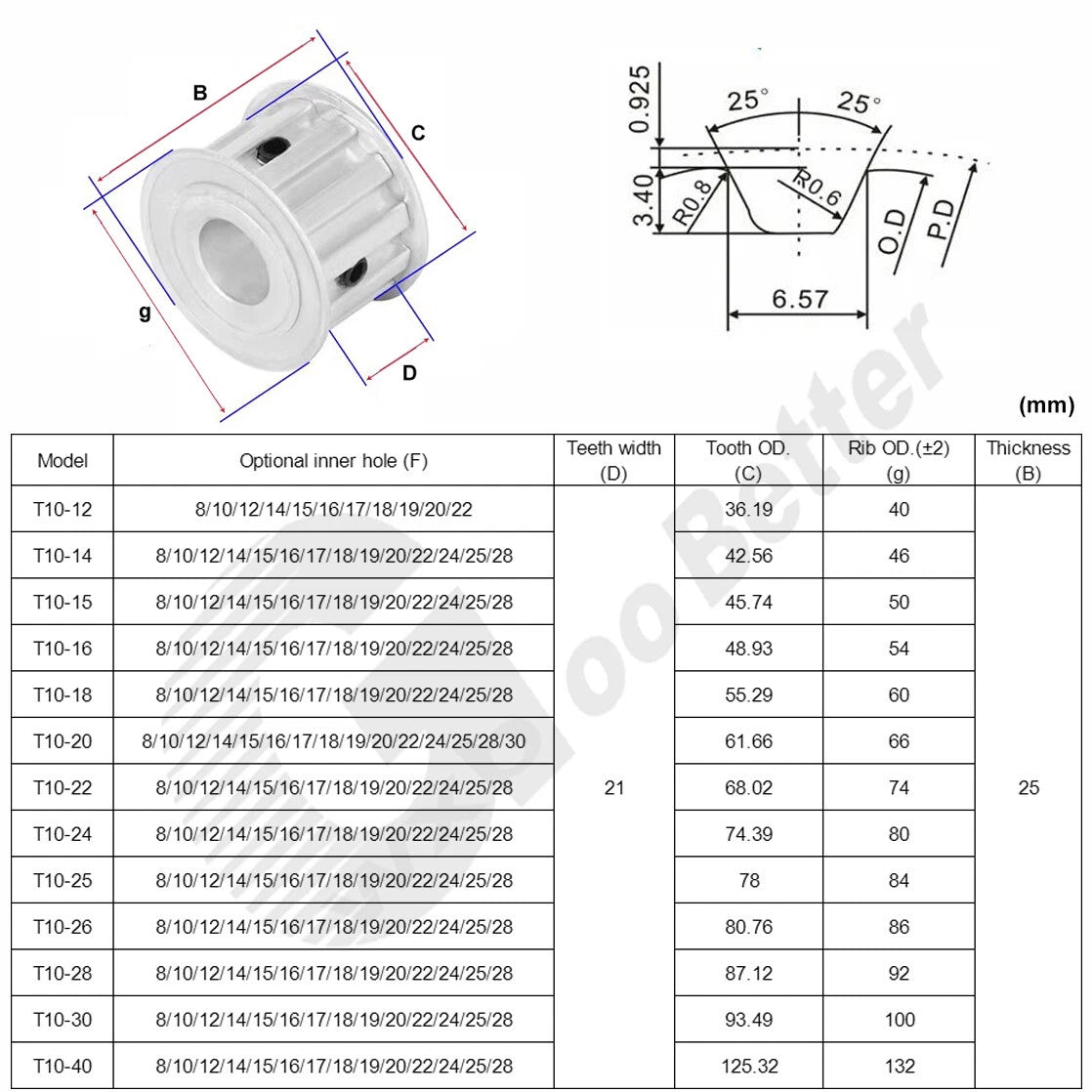
These T10 aluminum timing pulleys are machined in an AF (with flange) shape from aluminum alloy, keeping weight low while maintaining the rigidity needed for repetitive-cycle applications. The T10 tooth profile uses a 10 mm pitch trapezoidal geometry. Tooth counts span 12 T to 20 T, bore diameters range from 8 mm (≈0.31 in) to 30 mm (≈1.18 in), and keyway widths of 3 mm, 4 mm, 5 mm, 6 mm, and 8 mm are available alongside a no-keyway option for set-screw-only mounting. All variants are designed for use with 20 mm wide T10 synchronous belts.

Typical use cases include: replacing worn drive pulleys on CNC gantry X/Y axes where T10 belt pitch delivers coarser but higher-torque linear motion than GT2 systems; building compact robotic joint drives that require a keyed shaft connection for zero-slip torque transmission; and assembling automated linear stages or pick-and-place machines where a T10 aluminum timing pulley with a matched bore keeps the drive train aligned across thousands of cycles.

⚙️ Compatibility: Designed for 20 mm wide T10 synchronous belts (10 mm pitch, trapezoidal tooth). Verify your shaft diameter against the available bore options (8–30 mm) and select the keyway width that matches your shaft flat or key stock before ordering.

✅ Key Features of These T10 Timing Pulleys

🔩 T10 Trapezoidal Tooth Profile

10 mm pitch trapezoidal teeth provide positive, slip-free engagement with T10 belts — delivering higher torque capacity per tooth than finer-pitch profiles, suited to heavier CNC and robotic loads.

📐 Wide Tooth & Bore Selection

Six tooth counts (12 T to 20 T) and fifteen bore sizes (8 mm to 30 mm) cover the most common shaft diameters in stepper, servo, and spindle drive applications.

🔑 Optional Keyway for Zero-Slip Torque Transfer

Choose from 3 mm, 4 mm, 5 mm, 6 mm, or 8 mm keyway widths — or select the no-keyway variant for set-screw mounting. Keyed variants eliminate rotational slip under sustained or shock loads.

🏗️ Aluminum Alloy AF-Shape Body

The AF (flanged) shape keeps the belt tracking on the pulley face without additional guides. Aluminum alloy construction reduces rotational inertia, benefiting high-acceleration motion profiles.

📏 20 mm Belt Width Compatibility

All variants are sized for 20 mm wide T10 belts, a common width in CNC and industrial automation, allowing direct replacement or system expansion without sourcing a different belt series.

🔄 Broad Application Range

Suited for CNC routers, laser engravers, robotic joints, linear actuators, conveyor prototypes, and any synchronous drive system using T10 belts where reliable, repeatable positioning is required.

📐 Technical Specifications — T10 Aluminum Timing Pulley

Belt Type T10 (10 mm pitch, trapezoidal tooth)
Tooth Count Options 12T / 14T / 15T / 16T / 18T / 20T
Bore Diameter Range 8 mm – 30 mm (see variant options)
Compatible Belt Width 20 mm
Keyway Width Options Without keyway / 3 mm / 4 mm / 5 mm / 6 mm / 8 mm
Shape AF (with flange)
Material Aluminum alloy
Outer Diameter See variant options
Hub Length See variant options
Weight See variant options

❓ Frequently Asked Questions

How do I choose the right tooth count (12T to 20T) for my application?

Tooth count determines the pulley's pitch diameter and the linear travel per motor revolution. Fewer teeth (e.g., 12T) give a smaller pitch diameter and finer resolution per revolution; more teeth (e.g., 20T) increase belt wrap, reduce tooth load, and raise linear speed per revolution. For most CNC gantry and robotic joint applications, 20T is a common starting point. Match the tooth count to your required travel-per-revolution and available belt loop length.

Which bore size should I select for my motor or drive shaft?

Measure your shaft diameter with calipers before ordering. Common stepper motor shaft diameters are 8 mm and 10 mm. Servo and spindle shafts often run 12 mm, 14 mm, 16 mm, or larger. Select the bore that matches your shaft exactly — the keyway or set screw compensates for minor fit variation but is not a substitute for the correct bore size.

Do I need a keyway, and which keyway width should I choose?

A keyway provides a positive mechanical lock between the shaft and pulley, preventing rotational slip under sustained torque or shock loads. If your shaft has a machined key slot, select the matching keyway width (3 mm, 4 mm, 5 mm, 6 mm, or 8 mm). If your shaft has only a flat or no key feature, choose the no-keyway variant and use the set screw against the shaft flat. For high-torque or reversing-load applications, a keyed connection is strongly recommended.

Is this pulley compatible with GT2, HTD 5M, or other belt profiles?

No. These pulleys use the T10 trapezoidal tooth profile (10 mm pitch), which is not interchangeable with GT2 (2 mm pitch curvilinear), HTD 5M (5 mm pitch curvilinear), or other belt series. Always pair T10 pulleys with T10 belts to ensure correct tooth engagement and avoid premature belt wear or skipping.

How strong is the aluminum alloy body for high-torque or continuous-duty use?

Aluminum alloy provides a good strength-to-weight ratio suitable for the torque levels typical of NEMA 17, NEMA 23, and light servo drives paired with 20 mm T10 belts. For very high-torque or shock-load applications, verify the belt's dynamic load rating against your system requirements and consider a keyed bore variant to maximize torque transfer without relying solely on set-screw friction.

Will the aluminum pulley corrode in humid or outdoor environments?

Aluminum alloy naturally forms a thin oxide layer that provides moderate corrosion resistance in typical indoor environments. For humid, mildly corrosive, or outdoor-adjacent environments, an anodized or coated finish offers additional protection. These pulleys are not recommended for direct immersion or exposure to strong acids or alkalis without additional surface treatment.

What does the AF shape mean, and why does it matter?

AF stands for "with flange" — the pulley has raised flanges on one or both sides of the tooth face that act as belt guides, keeping the 20 mm T10 belt centered on the pulley during operation. This reduces the need for additional belt-guide hardware and helps maintain belt alignment in systems where the belt path is not perfectly straight.

🛒 Select your Number of Teeth, Bore Dia., and Keyway width above, then add to cart.


You may also like

Recently viewed