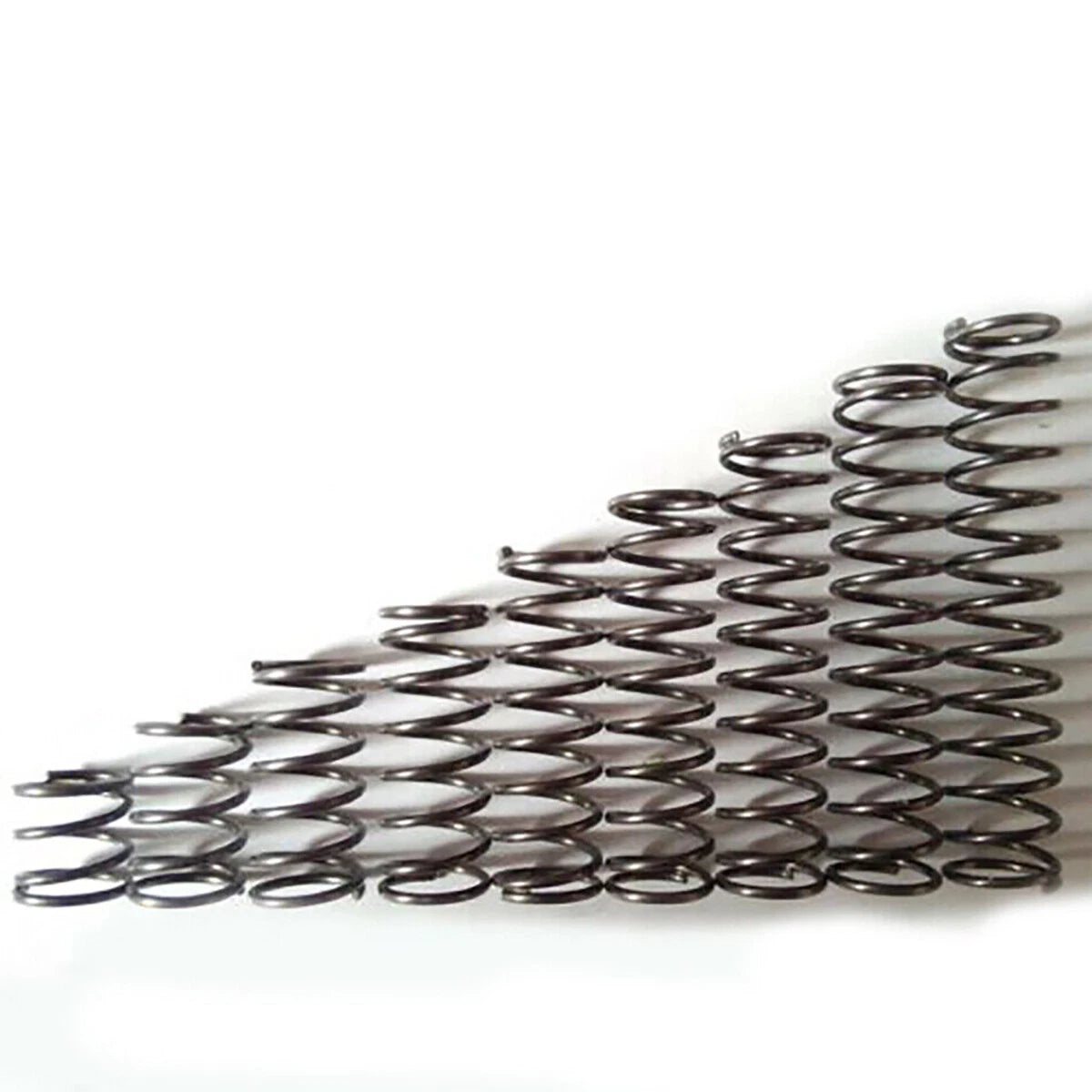
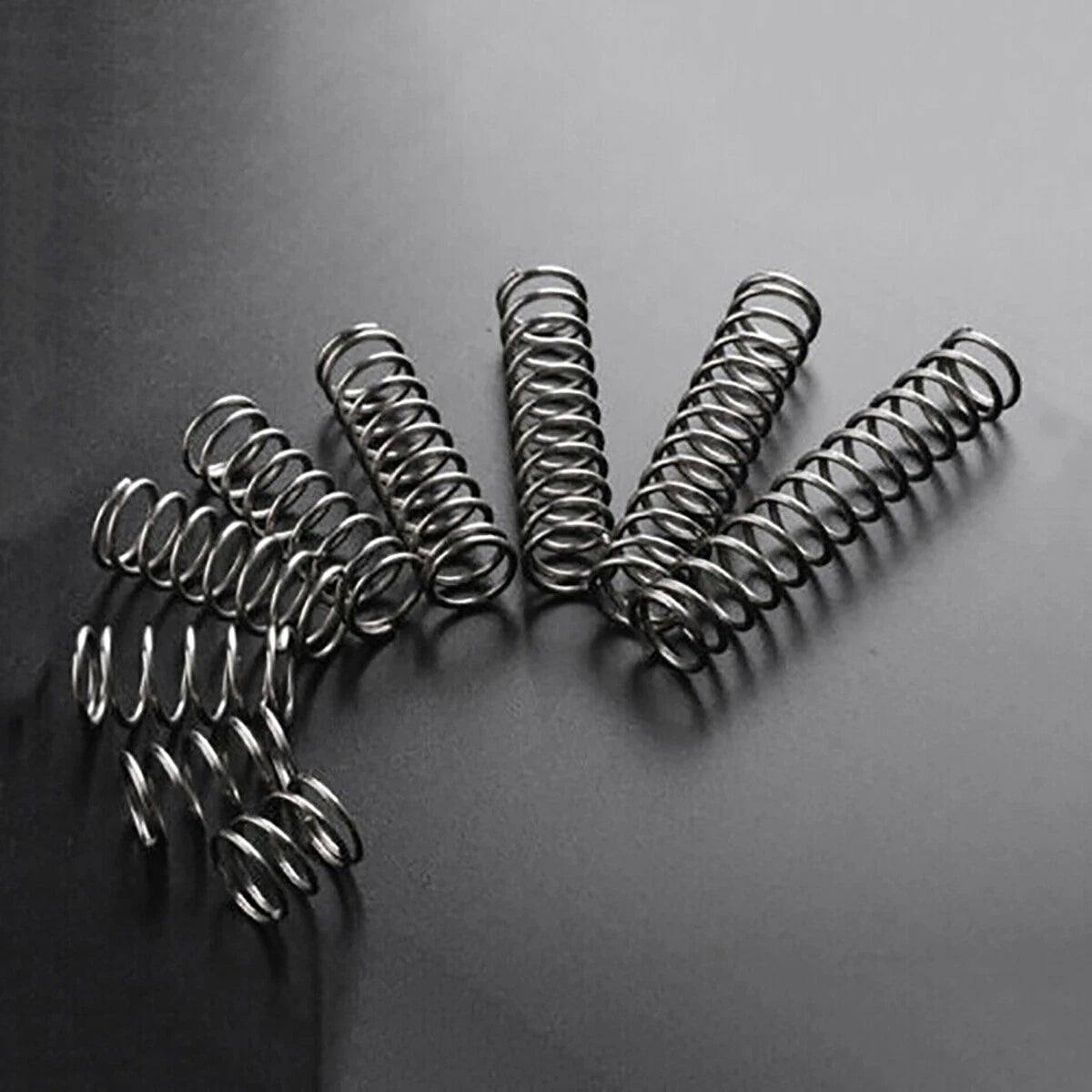
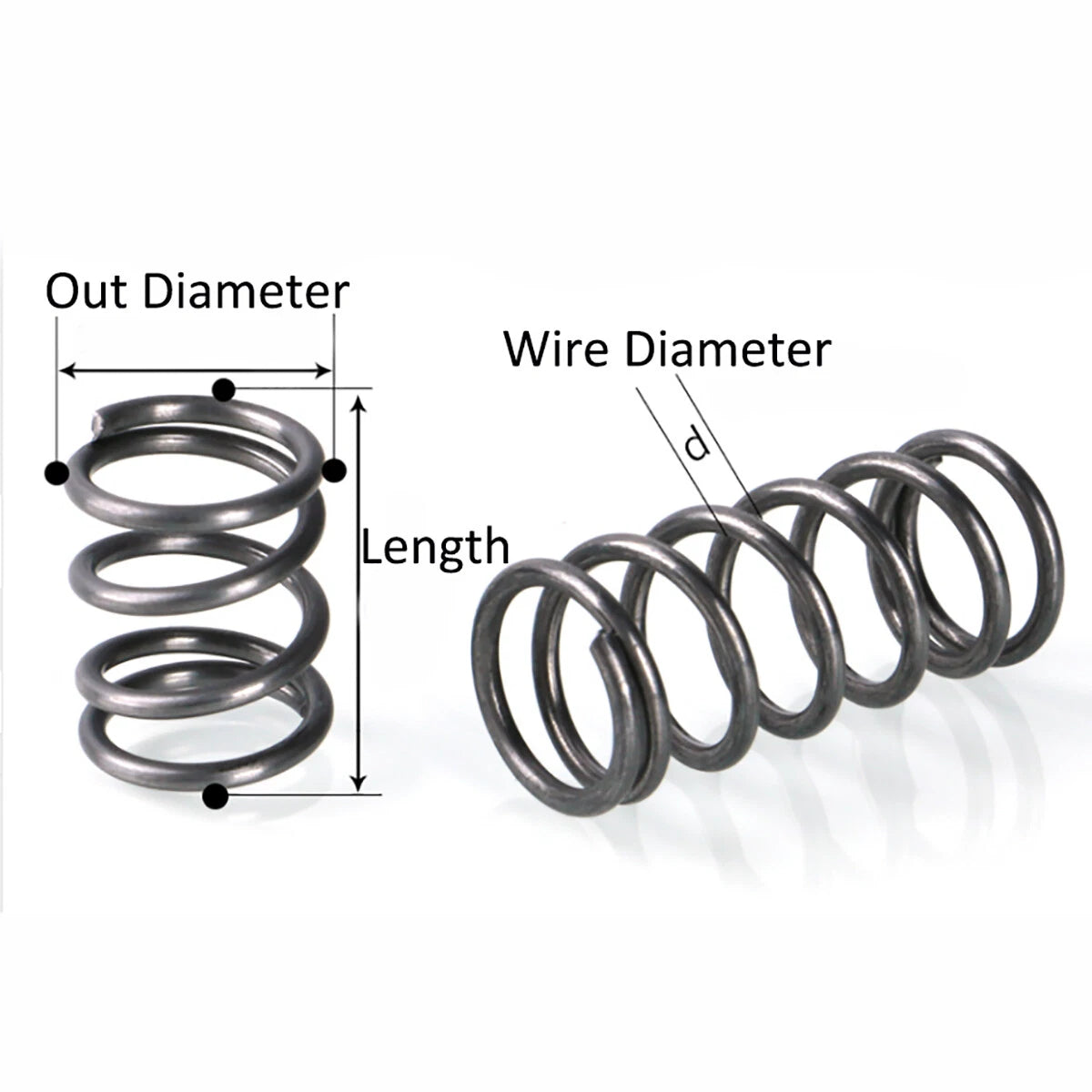
Wire Diameter 0.5mm-0.6mm OD 3mm-10mm Small Spring Compression Pressure Spring

No reviews

Price:
Sale price$3.20 USD
Stock:
In stock (500 units), ready to be shipped

Payment & Security

Ach Direct Debit Amazon American Express Apple Pay Bancontact BLIK Diners Club Discover EPS Google Pay iDEAL Wero JCB Maestro Mastercard Multibanco MobilePay PayPal Przelewy24 Shop Pay Twint Union Pay USDC Visa

Your payment information is processed securely. We do not store credit card details nor have access to your credit card information.

Limited Offer — Spend More, Save More
Spend $55+
Save $5
Spend $100+
Save $10
Spend $200+
Save $25
HomeDIYer DIY Expert Support

DIY Expert Support

Get fitment advice & recommendations

Mon–Fri  8:30 AM – 8:00 PM
24-Hour Fast Ship
Arrives in 3–14 Days
Worldwide Shipping
30-Day Returns
1 tree planted with every purchase

Description

Small Compression Springs — Precision Wire Dia 0.5–0.6mm, OD 3–12mm for Tight-Space Applications

When your project demands a reliable return force in a confined space, finding a compression spring that fits without compromise is the real challenge. Engineers, hobbyists, and repair technicians working on miniature mechanisms, precision instruments, or consumer electronics know the frustration of sourcing springs that are either too stiff, too long, or simply the wrong diameter. These small compression pressure springs are engineered for exactly those demanding, tight-tolerance scenarios.

Each spring is wound from round steel wire with a diameter of either 0.5 mm or 0.6 mm (approximately 0.020–0.024 in). The outer diameter (OD) spans 3 mm to 12 mm (roughly 0.12–0.47 in), and free lengths range from 5 mm to 100 mm (0.20–3.94 in), giving you a broad matrix of sizes to match your exact bore and travel requirements. The coils are closely wound with consistent pitch, and both ends are typically flat-ground or closed to provide stable seating.

Typical use cases include pen and stylus click mechanisms requiring a small compression spring for retraction, miniature valve and switch assemblies in instrumentation where a low-force pressure spring maintains contact, and DIY electronics enclosures or battery contacts where a tiny coil spring ensures reliable electrical connection under vibration.

⚙️ Compatibility: Suitable for bores from 3 mm to 12 mm OD clearance. Verify inner diameter (ID) and free length against your assembly before ordering. Select wire diameter and OD to match your load and deflection requirements.

✅ Key Features of These Small Compression Pressure Springs

📐 Wide Size Matrix

Wire diameters of 0.5 mm and 0.6 mm combined with ODs from 3 mm to 12 mm and free lengths from 5 mm to 100 mm — choose the exact combination your design calls for.

🔩 Consistent Coil Geometry

Uniform pitch and closed ends ensure stable seating and repeatable spring force across the full compression stroke, reducing assembly variation.

Reliable Return Force

Designed to deliver consistent push-back in click mechanisms, valve seats, and contact assemblies where a dependable compression spring is critical to function.

🛡️ Corrosion-Resistant Finish

Surface treatment helps resist oxidation in typical indoor environments, extending service life in electronics and instrument housings.

📦 Convenient Pack Quantities

Available in packs of 5 or 10 pieces — stock up for prototyping runs or keep spares on hand for maintenance without over-ordering.

🔬 Miniature-Scale Precision

Sub-millimetre wire diameters and small ODs make these springs ideal for miniature mechanisms where standard hardware-store springs are simply too large.

📐 Technical Specifications — Small Compression Springs

Spring Type Compression (pressure) spring
Wire Diameter 0.5 mm or 0.6 mm (approx. 0.020–0.024 in)
Outer Diameter (OD) 3 mm – 12 mm (approx. 0.12–0.47 in)
Free Length 5 mm – 100 mm (approx. 0.20–3.94 in)
End Type See variant options
Material Steel wire (surface treated)
Spring Rate See variant options
Max Load See variant options
Pack Quantity 5 pcs or 10 pcs (select above)
Application Electronics, instruments, DIY mechanisms, miniature assemblies

❓ Frequently Asked Questions

How do I choose the right size compression spring for my project?

Start with three measurements from your assembly: the bore diameter (to determine the maximum OD), the shaft or guide diameter (to determine the minimum ID — typically OD minus twice the wire diameter), and the available travel (to determine the required free length and solid height). Select a wire diameter that gives you the spring rate and load capacity your application needs. If you are unsure, order a small pack of two or three candidate sizes to test fit before committing to a larger quantity.

What is the difference between 0.5 mm and 0.6 mm wire diameter springs?

A thicker wire diameter (0.6 mm) produces a stiffer spring with a higher spring rate and greater load capacity for the same OD and free length. The 0.5 mm wire springs are softer and deflect more easily under the same load, making them suitable for lighter-duty applications such as pen mechanisms or delicate contact assemblies. Choose 0.6 mm wire when you need more force; choose 0.5 mm wire when you need a gentler, more compliant return.

Are these springs corrosion-resistant enough for outdoor or humid environments?

These springs are surface-treated to resist light oxidation in typical indoor environments such as electronics enclosures and instrument housings. For prolonged exposure to moisture, salt spray, or outdoor conditions, we recommend evaluating a stainless steel alternative or applying an additional protective coating. Contact us to confirm suitability for your specific environment before ordering.

Can I use these springs in a battery contact or electrical connection application?

Yes. Small compression springs are widely used in battery contacts and spring-loaded electrical connectors because they maintain consistent contact pressure even under vibration. Ensure the spring OD and free length match your contact housing dimensions, and verify that the surface finish is compatible with your conductivity requirements. For critical electrical applications, test a sample before full deployment.

What does the size notation (e.g., 0.5 × 3 × 10 mm) mean?

The three numbers represent: wire diameter × outer diameter × free length, all in millimetres. For example, 0.5 × 3 × 10 mm means a spring wound from 0.5 mm wire, with an outer diameter of 3 mm, and a free (uncompressed) length of 10 mm. Use these three dimensions to match the spring to your bore, guide, and travel requirements.

How many springs do I need to order, and which pack size should I choose?

For prototyping or single-unit repairs, the 5-piece pack is usually sufficient and lets you test fit without excess stock. For small production runs, maintenance kits, or if you anticipate needing replacements, the 10-piece pack offers better value per spring. Both pack sizes are available for every size combination — simply select your preferred quantity in the QTY(PCS) option above.

Are these springs compatible with standard spring guides and bores?

These springs are designed to work with standard cylindrical bores and guide rods. The OD range of 3–12 mm covers a wide variety of miniature mechanism housings. To avoid binding, the bore should be at least 0.1–0.2 mm larger than the spring OD, and any guide rod should be at least 0.1–0.2 mm smaller than the spring ID. Always verify clearances with a sample spring before finalising your design.

🛒 Select your wire diameter, OD, free length, and quantity above, then add to cart.


You may also like

Recently viewed