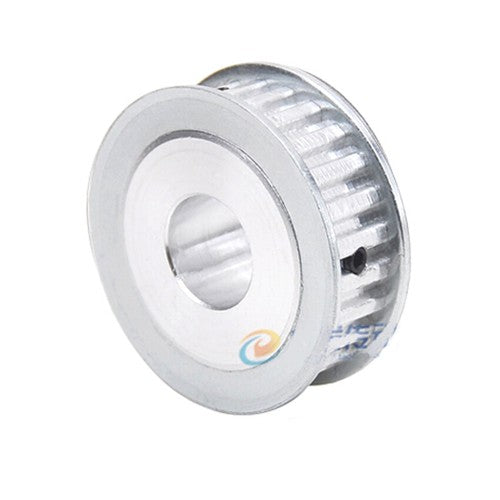
XL10T-40T Timing Belt Pulley Synchronous Wheel, Bore 3-25mm Tooth Width 11/16mm

No reviews

Price:
Sale price$4.15 USD
Stock:
In stock (500 units), ready to be shipped

Payment & Security

Ach Direct Debit Amazon American Express Apple Pay Bancontact BLIK Diners Club Discover EPS Google Pay iDEAL Wero JCB Maestro Mastercard Multibanco MobilePay PayPal Przelewy24 Shop Pay Twint Union Pay USDC Visa

Your payment information is processed securely. We do not store credit card details nor have access to your credit card information.

Limited Offer — Spend More, Save More
Spend $55+
Save $5
Spend $100+
Save $10
Spend $200+
Save $25
HomeDIYer DIY Expert Support

DIY Expert Support

Get fitment advice & recommendations

Mon–Fri  8:30 AM – 8:00 PM
24-Hour Fast Ship
Arrives in 3–14 Days
Worldwide Shipping
30-Day Returns
1 tree planted with every purchase

Description

XL Timing Belt Pulley 10T–40T — Precise Synchronous Drive for CNC, Robotics & Maker Projects

When your CNC router skips steps or your 3D printer loses position mid-print, the culprit is often a mismatched or worn timing pulley. Engineers, robotics builders, and DIY makers who demand repeatable, slip-free motion need a synchronous wheel they can trust across a wide range of shaft sizes and tooth counts — without sourcing from multiple suppliers.

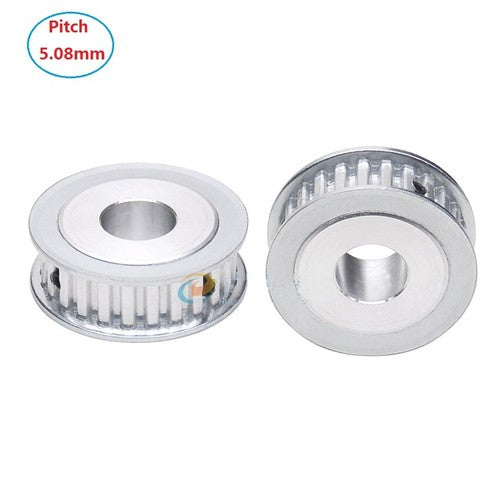
These XL-pitch timing belt pulleys are machined from aluminum alloy with a natural or anodized finish. The XL tooth profile (5.080 mm / 0.200 in pitch) is the industry-standard for light-to-medium duty synchronous drives. Tooth counts span 10T through 40T, tooth widths are available in 11 mm (0.43 in) or 16 mm (0.63 in), and bore diameters range from 3 mm to 25 mm (0.118 in – 0.984 in) to suit metric and imperial shafts alike.

Typical use cases include XL belt drive systems for CNC router X/Y axes, stepper-motor driven extruder geartrains in FDM 3D printers, and lightweight robotic arm joint drives where a low-backlash synchronous wheel is required. The broad tooth-count selection also makes these pulleys suitable for gear-ratio tuning in custom timing belt transmission designs.

⚙️ Compatibility: Designed for standard XL-pitch (5.080 mm / 0.200 in) timing belts with 11 mm or 16 mm belt widths. Verify bore diameter and tooth width match your belt and shaft before ordering.

✅ Key Features of These XL Timing Belt Pulleys

🦷 Wide Tooth Count Range

Available from 10T to 40T, enabling flexible gear-ratio selection for speed reduction or torque multiplication in synchronous drive systems.

📏 Dual Tooth Width Options

Choose 11 mm or 16 mm tooth width to match your XL belt width, ensuring full tooth engagement and even load distribution.

🔩 Broad Bore Selection

Bore diameters from 3 mm to 25 mm cover common metric and imperial shaft sizes (3 / 3.175 / 4 / 5 / 6 / 6.35 / 7 / 8 / 10 / 12 / 12.7 / 14 / 15 / 16 / 17 / 18 / 19 / 20 / 22 / 25 mm).

🏗️ Aluminum Alloy Construction

Lightweight yet rigid aluminum body keeps rotational inertia low — ideal for servo and stepper motor applications where rapid direction changes are frequent.

🔄 Standard XL Pitch Profile

5.080 mm (0.200 in) XL tooth pitch is universally compatible with off-the-shelf XL timing belts, simplifying sourcing and replacement.

🛠️ Set-Screw Ready Hub

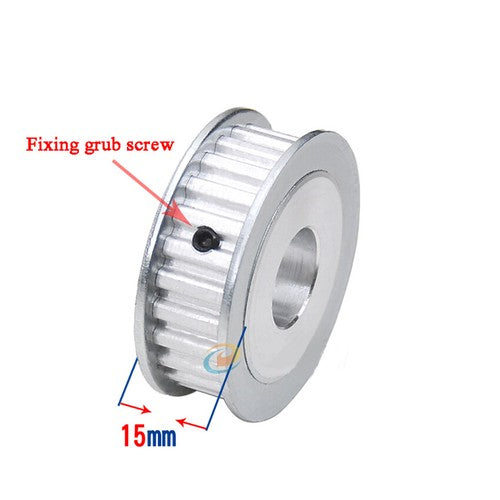
Hub includes a set-screw flat or through-hole for secure shaft fixation — no additional machining required for most standard shaft diameters.

📐 Technical Specifications — XL Timing Belt Pulley

Belt Pitch XL — 5.080 mm (0.200 in)
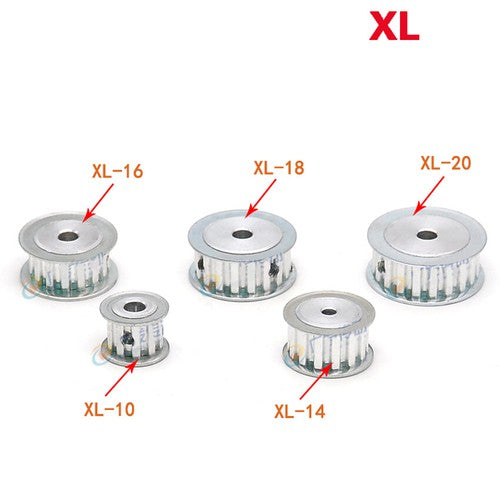
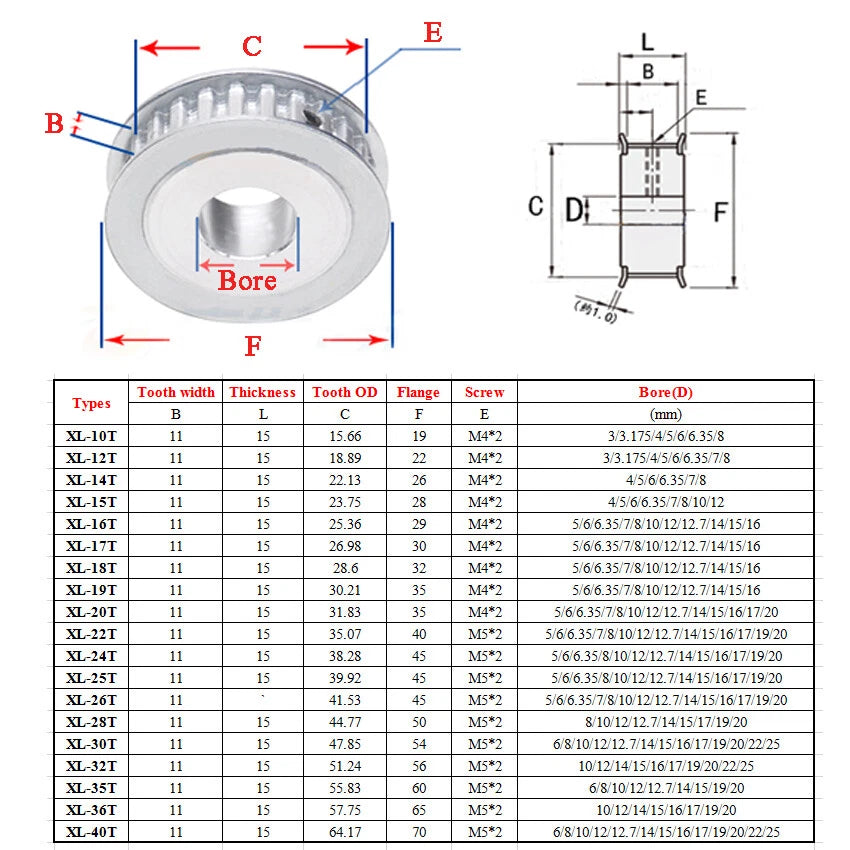
Tooth Count (Types) 10T, 12T, 14T, 15T, 16T, 17T, 18T, 19T, 20T, 22T, 24T, 25T, 26T, 28T, 30T, 32T, 35T, 36T, 40T
Tooth Width 11 mm or 16 mm (see variant options)
Bore Diameter 3 – 25 mm (see variant options)
Material Aluminum alloy
Finish See variant options
Pitch Diameter See variant options
Flange See variant options
Quantity per Order 1 piece

❓ Frequently Asked Questions

How do I choose the right tooth count for my application?

The tooth count determines the pitch diameter and, combined with the mating pulley's tooth count, sets your drive ratio. Divide the driven pulley's tooth count by the driving pulley's tooth count to get the speed reduction ratio. For example, a 10T driver paired with a 20T driven pulley gives a 2:1 reduction. Select tooth counts that achieve your target ratio while keeping the center distance practical for your belt length.

Which tooth width should I choose — 11 mm or 16 mm?

Match the tooth width to your XL timing belt width. An 11 mm pulley is used with 3/8 in (9.5 mm) or 1/2 in (12.7 mm) wide XL belts where the belt rides within the flanges, while a 16 mm pulley suits wider XL belts up to approximately 5/8 in (15.9 mm). Using a pulley narrower than your belt will cause the belt to overhang and wear unevenly.

How do I select the correct bore diameter?

Measure your motor or drive shaft diameter with a caliper. Choose the bore that matches exactly — a bore that is too large will cause runout and vibration even with a set screw. Common stepper motor shaft sizes are 5 mm and 6.35 mm (1/4 in); servo motors often use 6 mm or 8 mm shafts. If your shaft is between listed sizes, select the next larger bore and use a shaft collar or keyway adapter.

Are these pulleys compatible with standard XL timing belts from other brands?

Yes. The XL tooth profile (5.080 mm pitch, 50° included angle) is an industry-standard defined by the Rubber Manufacturers Association (RMA). These pulleys are dimensionally compatible with any XL-pitch timing belt of the matching width, regardless of brand, as long as the belt width does not exceed the pulley's tooth width.

How strong are aluminum timing pulleys compared to steel?

Aluminum alloy pulleys are well-suited for light-to-medium duty synchronous drives typical in CNC routers, 3D printers, and robotics. They offer a favorable strength-to-weight ratio and resist corrosion without surface treatment. For heavy industrial loads or high-torque applications exceeding the aluminum's yield strength, steel pulleys would be more appropriate. For most maker and automation projects, aluminum is the standard choice.

Do these pulleys require a key or keyway?

These pulleys use a set-screw (grub screw) for shaft fixation, which is sufficient for most light-to-medium duty applications. A keyway is not included. If your application involves high torque reversals or shock loads, consider adding a flat on the shaft to improve the set-screw's grip, or consult a mechanical engineer for a keyed solution.

Can I use these pulleys for a 3D printer or CNC router build?

Yes — XL-pitch timing belt pulleys are widely used in DIY CNC routers, laser cutters, and FDM 3D printers. For typical CoreXY or Cartesian 3D printer motion systems, 20T pulleys with a 5 mm bore are a common choice. For CNC router rack-and-pinion or belt-drive axes, higher tooth counts (25T–40T) are often selected to balance speed and torque. Confirm your belt pitch is XL (5.080 mm) before ordering, as GT2 (2 mm pitch) pulleys are not interchangeable.

🛒 Select your tooth count, tooth width, and bore diameter above, then add to cart.


You may also like

Recently viewed