The chain is fine...but I ordered the wrong size. Nine links of the chain I ordered equals six of the size I wanted. My error...
How can I straighten out the springs? I can't use them coil uo as is.
Your payment information is processed securely. We do not store credit card details nor have access to your credit card information.
Get fitment advice & recommendations
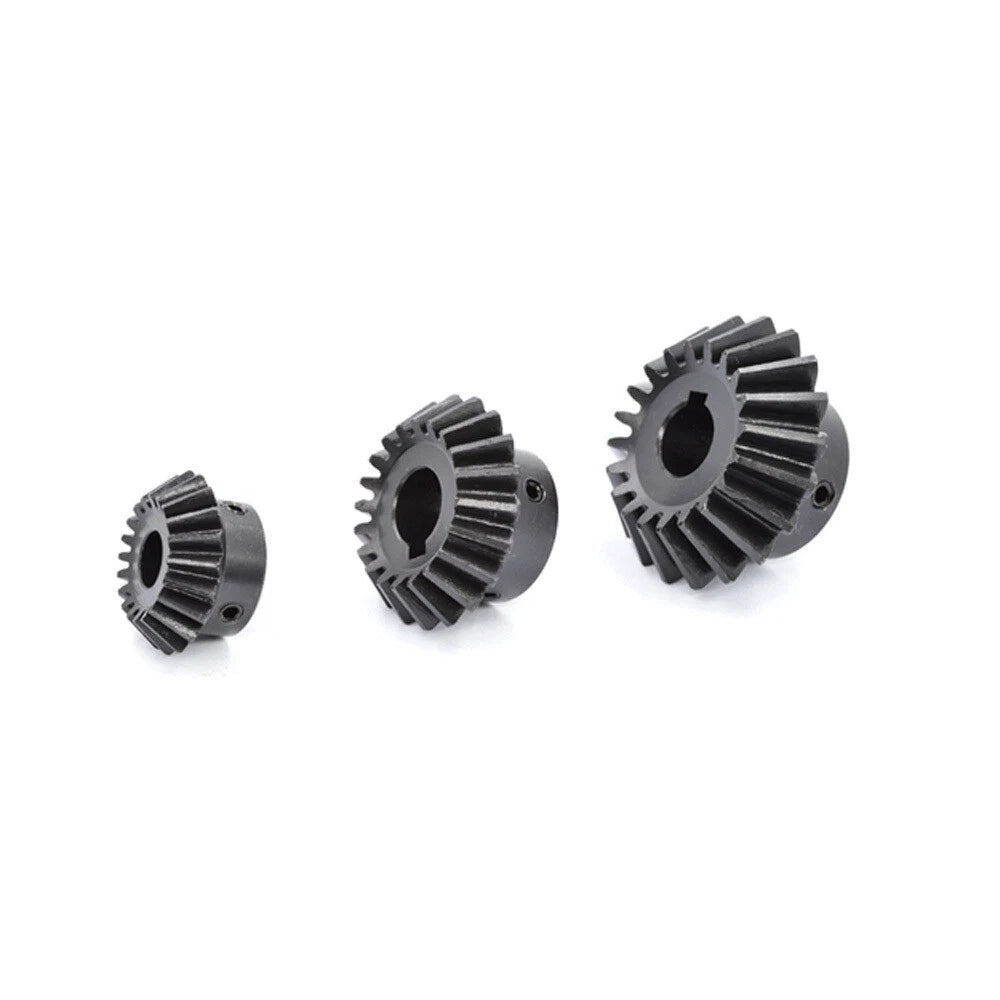
When your drivetrain demands a clean 90° power transfer and your shaft alignment leaves no room for error, a mismatched bevel gear set can stall an entire project. Makers, robotics builders, and CNC hobbyists who need reliable torque redirection between perpendicular shafts will find these 1 and 1.5 modulus bevel gears a direct solution.
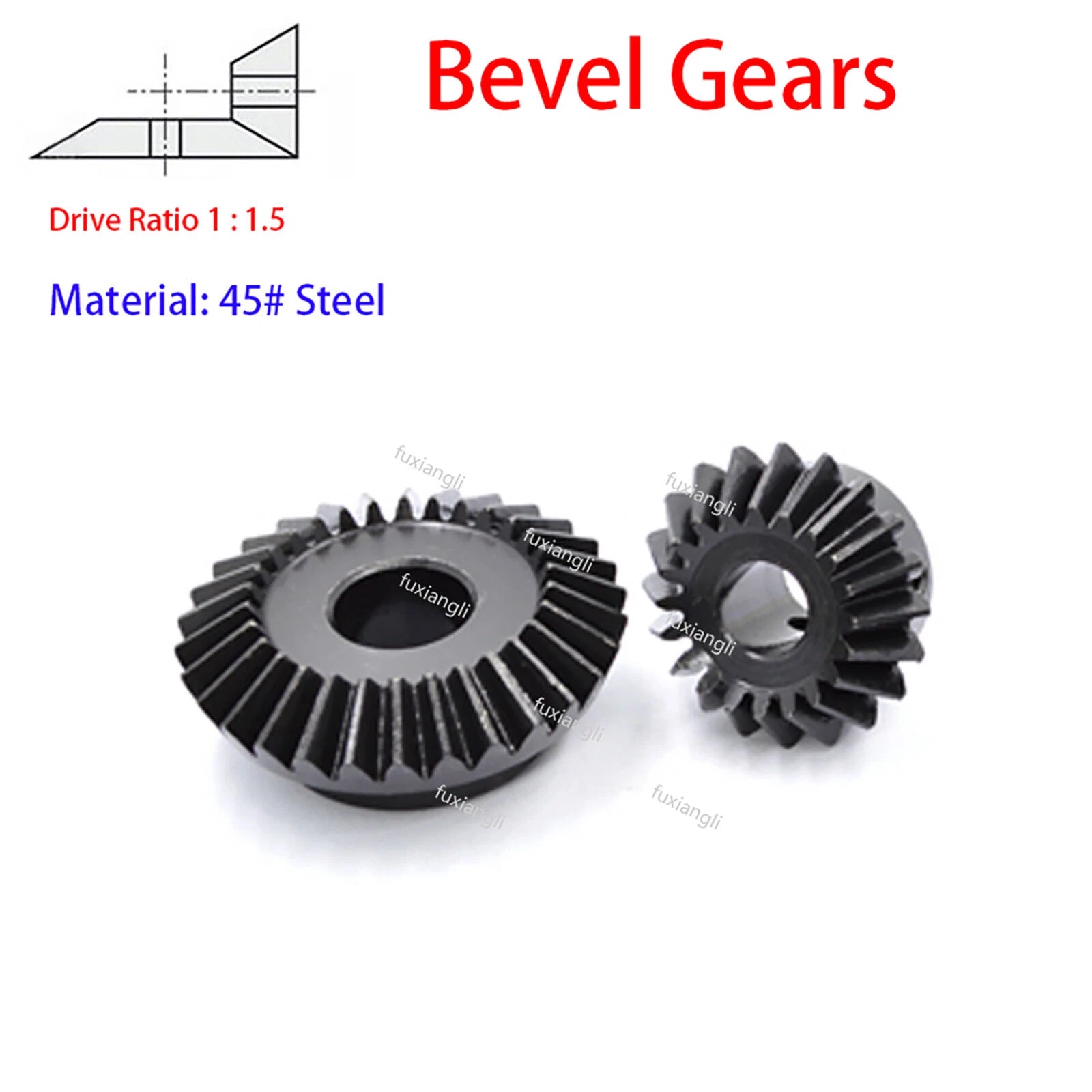
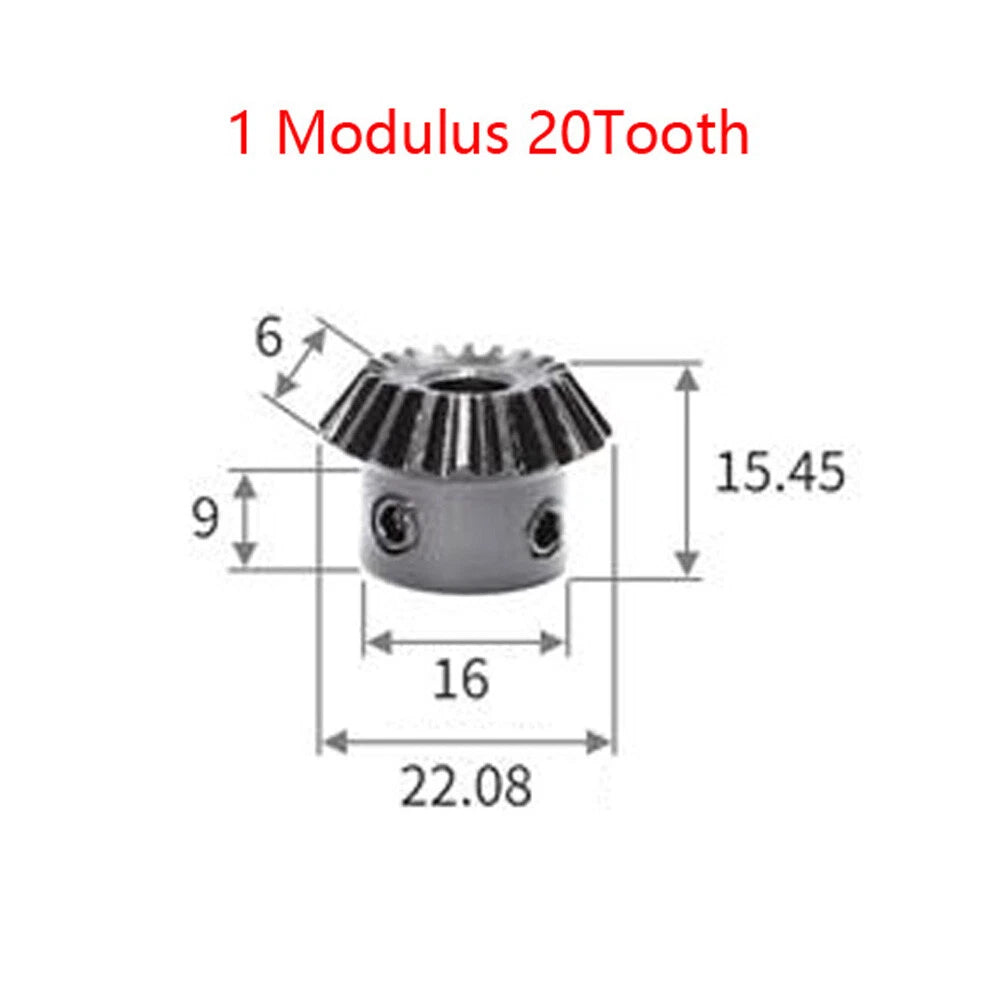
Each set consists of a matched bevel gear pair machined to a 1:1.5 tooth ratio (20T driver / 30T driven), available in module 1 and module 1.5. Gears are manufactured from steel with a natural metallic finish. Bore diameters range from 6 mm (0.24 in) to 15 mm (0.59 in) to accommodate common motor and shaft sizes. Tooth count options are 20-tooth and 30-tooth per gear.
Typical use cases include DIY robotic arm joints requiring a 90° axis change, compact CNC router Z-axis drives where a bevel gear set for motor transmission replaces a flexible coupling, and small-scale automation rigs using a 1.5 modulus 30-tooth bevel gear to step down speed while redirecting output direction.
Engineered for perpendicular shaft engagement, enabling clean directional power transfer without additional linkage hardware in your transmission assembly.
Sold as a coordinated 20T/30T set within each modulus, so the tooth profile, pressure angle, and pitch are pre-matched — no guesswork on compatibility between driver and driven gear.
Available bore diameters of 6, 8, 10, 12, 14, and 15 mm cover the most common hobby motor shafts and CNC spindle outputs, reducing the need for custom adapters.
Module 1 suits lighter-load, higher-speed applications; Module 1.5 handles greater torque loads with a larger tooth profile — choose based on your motor output and load requirements.
Machined from steel stock, these bevel gears resist deformation under cyclic loading, making them suitable for continuous-duty robotics and automation rigs where plastic gears would wear prematurely.
Order individual pieces to replace a worn gear or stock up for multi-axis builds — quantity options let you buy exactly what your project requires without over-ordering.
| Product Type | Bevel Gear Pair (Driver + Driven) |
|---|---|
| Modulus Options | Module 1 / Module 1.5 |
| Tooth Count | 20T (driver) / 30T (driven) |
| Gear Ratio | 1:1.5 |
| Mesh Angle | 90° |
| Bore Diameter | 6 mm / 8 mm / 10 mm / 12 mm / 14 mm / 15 mm |
| Material | Steel |
| Finish | Natural metallic (uncoated) |
| Pressure Angle | See variant options |
| Face Width | See variant options |
| Outer Diameter (approx.) | See variant options |
| Weight (per piece) | See variant options |
Module 1 gears have smaller teeth and are suited for lighter loads and higher rotational speeds — common in small robotics and hobby servo applications. Module 1.5 gears have a larger tooth profile that distributes load over a greater contact area, making them the better choice when your motor produces higher torque or when the gear set will run under sustained load. If you are unsure, calculate your tangential force and compare it against the gear's rated load capacity for the chosen modulus.
No. Bevel gears must be matched within the same modulus. Mixing Module 1 and Module 1.5 gears will result in incorrect tooth engagement, excessive backlash, rapid wear, and potential gear failure. Always order both the driver and driven gear from the same modulus group.
Measure your motor output shaft diameter with a caliper before ordering. Available bore sizes are 6, 8, 10, 12, 14, and 15 mm. The bore should match your shaft diameter exactly — a loose fit will cause runout and vibration, while an undersized bore cannot be installed without machining. If your shaft falls between sizes, select the next size up and use a keyway or set screw to secure the gear.
These gears are machined from steel, which provides significantly greater fatigue strength than plastic or zinc alloy alternatives. For continuous-duty applications, ensure adequate lubrication (light gear grease applied to the tooth faces), proper shaft alignment within the 90° mesh angle, and that the applied torque does not exceed the gear's rated capacity for the selected modulus. Intermittent-duty robotics and CNC applications are well within the design intent of these gears.
Standard installation requires a shaft with the correct diameter, a set screw or keyway arrangement to secure the gear axially, and a gear housing or bracket that maintains the 90° shaft relationship. No specialized tooling beyond a hex key (for set screws) and a caliper (for alignment verification) is typically needed for hobby and light industrial builds.
In a 1:1.5 bevel gear set, the 20-tooth gear is conventionally the driver (input) and the 30-tooth gear is the driven (output). This configuration reduces output speed by a factor of 1.5 while increasing output torque proportionally (minus friction losses). If you need to reverse the ratio — increasing speed and reducing torque — you can mount the 30-tooth gear on the input shaft, though this is less common in motor transmission applications.
A light application of lithium-based or molybdenum disulfide (MoS₂) gear grease on the tooth contact faces is recommended before first use. Reapply periodically based on duty cycle — more frequent lubrication for high-speed or high-load applications. Avoid oil-based lubricants in open-gear configurations as they tend to fling off at speed and attract debris.