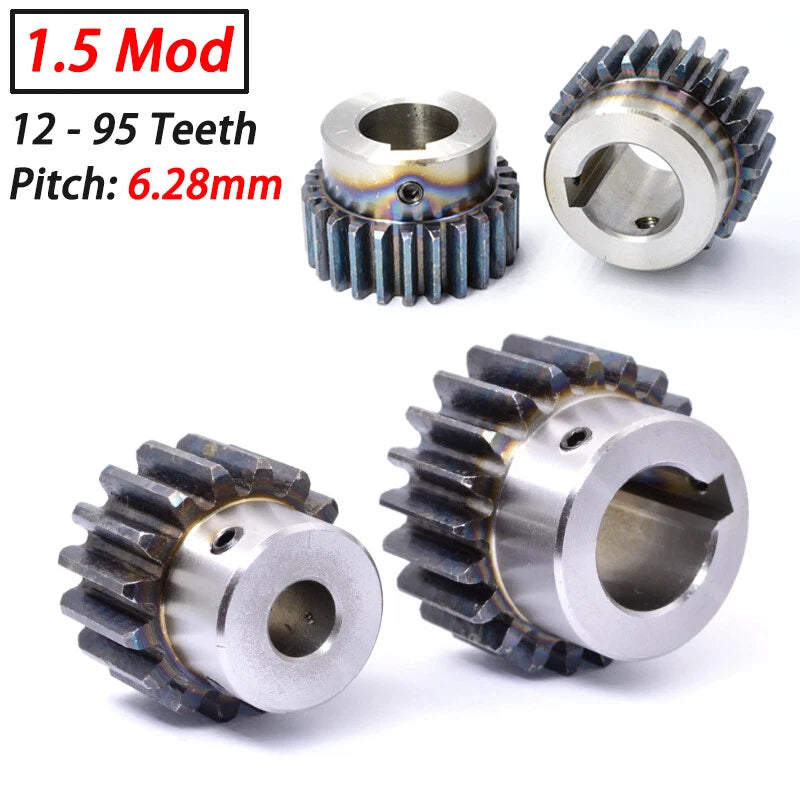
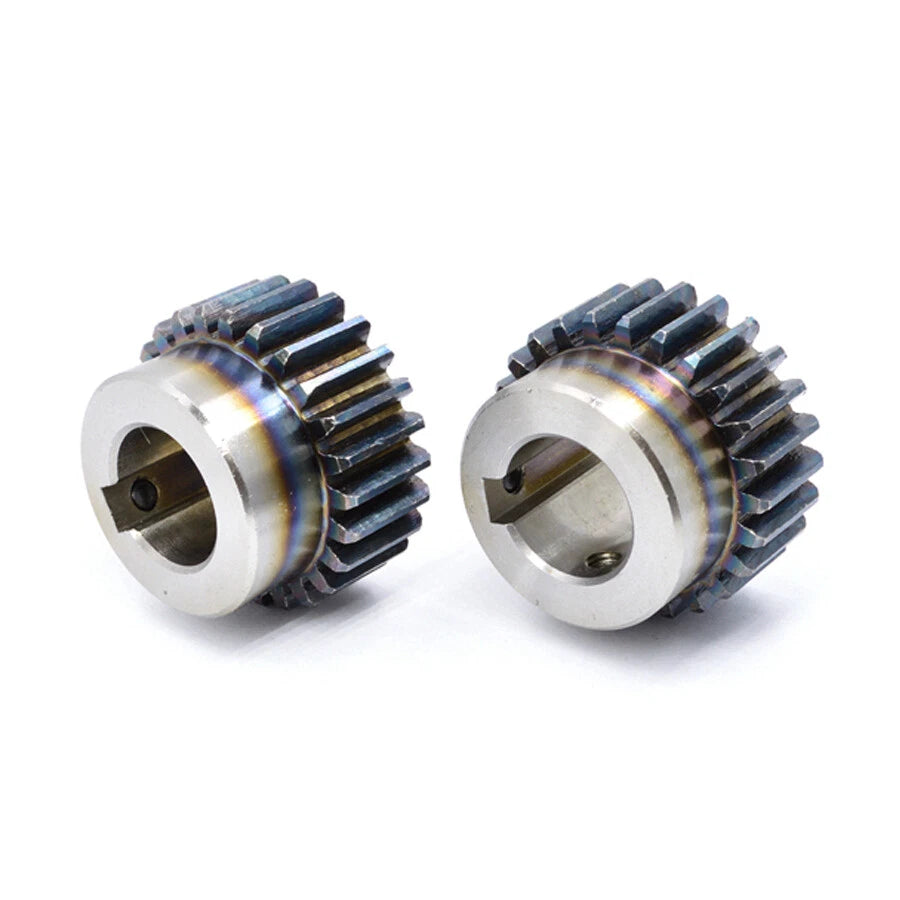
1.5 Mod 45# Steel Spur Gear 10-27T Bore 6-18mm Pinion Gear with Step Motor Gear

No reviews

Price:
Sale price$12.78 USD
Stock:
In stock (500 units), ready to be shipped

Payment & Security

Ach Direct Debit Amazon American Express Apple Pay Bancontact BLIK Diners Club Discover EPS Google Pay iDEAL Wero JCB Maestro Mastercard Multibanco MobilePay PayPal Przelewy24 Shop Pay Twint Union Pay USDC Visa

Your payment information is processed securely. We do not store credit card details nor have access to your credit card information.

Limited Offer — Spend More, Save More
Spend $55+
Save $5
Spend $100+
Save $10
Spend $200+
Save $25
HomeDIYer DIY Expert Support

DIY Expert Support

Get fitment advice & recommendations

Mon–Fri  8:30 AM – 8:00 PM
24-Hour Fast Ship
Arrives in 3–14 Days
Worldwide Shipping
30-Day Returns
1 tree planted with every purchase

Description

1.5 Mod 45# Steel Spur Gear — Precision Pinion Gear for Stepper Motors & DIY Drives

When a slipping or undersized gear brings your CNC router, 3D printer, or automation project to a halt, you need a replacement you can trust. These 1.5 Module 45# carbon steel spur gears are engineered for makers, robotics builders, and mechanical engineers who demand accurate tooth profiles and reliable bore fits without custom machining.

Each gear is machined from 45# medium-carbon steel, offering a good balance of hardness and machinability. The range covers 12 to 27 teeth (12T–27T) with an outer diameter that scales proportionally per the 1.5 Mod standard (typically 21 mm–43.5 mm / 0.83"–1.71"). Bore options span 6 mm to 18 mm (0.24"–0.71"), with select variants featuring a precision-cut keyway (4 mm or 5 mm / 6 mm) for positive torque transmission without set-screw slippage.

These spur gears are well-suited for stepper motor pinion drives in CNC machines, gear reduction stages in conveyor and feeder systems, and shaft-to-shaft power transmission in robotics and automation rigs — anywhere a compact, metric-pitch gear is needed for a long-tail search like "1.5 mod steel spur gear with keyway" or "45 steel pinion gear bore 12mm."

⚙️ Compatible with 1.5 Module gear systems — pairs with 1.5 Mod racks, worm gears, and mating spur gears. Verify bore diameter and keyway requirement before ordering.

✅ Key Features of These 1.5 Mod Steel Spur Gears

  • 🔩 45# Carbon Steel Construction — Machined from medium-carbon 45# steel for a reliable combination of surface hardness and core toughness, suitable for moderate-load mechanical drives.
  • 📐 1.5 Module Tooth Profile — Standard metric 1.5 Mod pitch ensures accurate meshing with any compatible 1.5 Mod rack or mating gear, minimising backlash in precision motion systems.
  • 🎯 Wide Tooth Count Selection (12T–27T) — Choose from 12 to 27 teeth to dial in your gear ratio. Smaller tooth counts deliver higher speed; larger counts provide more torque multiplication.
  • 🔧 Multiple Bore Sizes (6–18 mm) — Bore options from 6 mm to 18 mm cover the most common stepper motor and servo shaft diameters, reducing the need for custom boring.
  • 🗝️ Optional Keyway Variants — Select bore sizes include a precision-cut keyway (4 mm or 5 mm / 6 mm) for positive key-and-keyway torque transmission, eliminating shaft slippage under load.
  • 🏭 Broad Application Range — Suitable for CNC pinion drives, stepper motor gearboxes, conveyor feed systems, and robotics joints where a compact metric spur gear is required.

📐 Technical Specifications — 1.5 Mod Spur Gear

Module (Mod) 1.5
Material 45# Carbon Steel
Number of Teeth 12T – 27T (see variant options)
Bore Diameter 6 mm – 18 mm (see variant options)
Keyway 4 mm or 5 mm / 6 mm (keyway variants only; see variant options)
Outer Diameter (OD) Approx. 21 mm – 43.5 mm (scales with tooth count at 1.5 Mod)
Pressure Angle 20°
Tooth Profile Involute, metric standard
Finish See variant options
Hub / Face Width See variant options
Compatible Pitch 1.5 Module (metric)

❓ Frequently Asked Questions

How do I choose the right number of teeth for my application?

The tooth count determines your gear ratio. Divide the driven gear's tooth count by the driving gear's tooth count to get the ratio. For example, a 12T pinion driving a 24T gear gives a 2:1 reduction — the output shaft turns at half the speed but with twice the torque. Use a smaller tooth count (12T–15T) for higher speed, and a larger count (20T–27T) when you need more torque output.

What bore size should I select for my stepper motor shaft?

Measure your motor shaft diameter with a calliper before ordering. Common NEMA 17 stepper shafts are 5 mm, NEMA 23 shafts are typically 6.35 mm or 8 mm, and NEMA 34 shafts are often 12.7 mm or 14 mm. Select the bore that matches your shaft — a bore that is too large will cause runout and vibration. If your shaft has a flat or key, choose a keyway variant for a positive fit.

Do I need a keyway variant, or will a plain bore work?

For light-duty or low-torque applications (e.g., 3D printer extruder drives), a plain bore secured with a set screw is usually sufficient. For higher-torque applications — CNC axis drives, conveyor feeds, or any system with reversing loads — a keyway variant is strongly recommended. The key prevents the gear from rotating on the shaft under shock loads, which a set screw alone cannot reliably prevent.

Is 45# steel strong enough for my drive system?

45# carbon steel (roughly equivalent to AISI 1045) has a tensile strength of approximately 600–800 MPa in the normalised condition, making it suitable for moderate-load mechanical drives such as CNC routers, light conveyor systems, and robotics joints. For very high-load or high-speed industrial applications, consider whether a hardened or alloy steel gear would be more appropriate for your specific torque and duty-cycle requirements.

Will this gear mesh correctly with my existing 1.5 Mod rack or gear?

Yes — as long as your existing rack or mating gear is also 1.5 Module with a 20° pressure angle (the most common metric standard), these gears will mesh correctly. Module and pressure angle must match between mating gears; tooth count only affects the gear ratio, not compatibility. If you are unsure of your existing gear's module, measure the outer diameter (mm) and divide by (number of teeth + 2) — the result should be close to 1.5.

What corrosion resistance can I expect from these gears?

45# carbon steel is not inherently corrosion-resistant. In dry indoor environments (CNC enclosures, electronics bays, robotics frames) the gears will perform well without additional treatment. If your application involves moisture, coolant mist, or outdoor exposure, apply a light machine oil or grease to the tooth faces, or consider a protective coating. For wet or chemically aggressive environments, a stainless steel or engineering plastic gear may be a better long-term choice.

How do I calculate the centre distance between two meshing 1.5 Mod gears?

Centre distance (C) = Module × (Teeth on Gear 1 + Teeth on Gear 2) ÷ 2. For example, a 12T pinion meshing with a 24T gear: C = 1.5 × (12 + 24) ÷ 2 = 1.5 × 18 = 27 mm. Use this formula to set your shaft spacing accurately and avoid binding or excessive backlash.

🛒 Select your Modulus, Number of Teeth, and Bore Diameter above, then add to cart.

You may also like

Recently viewed