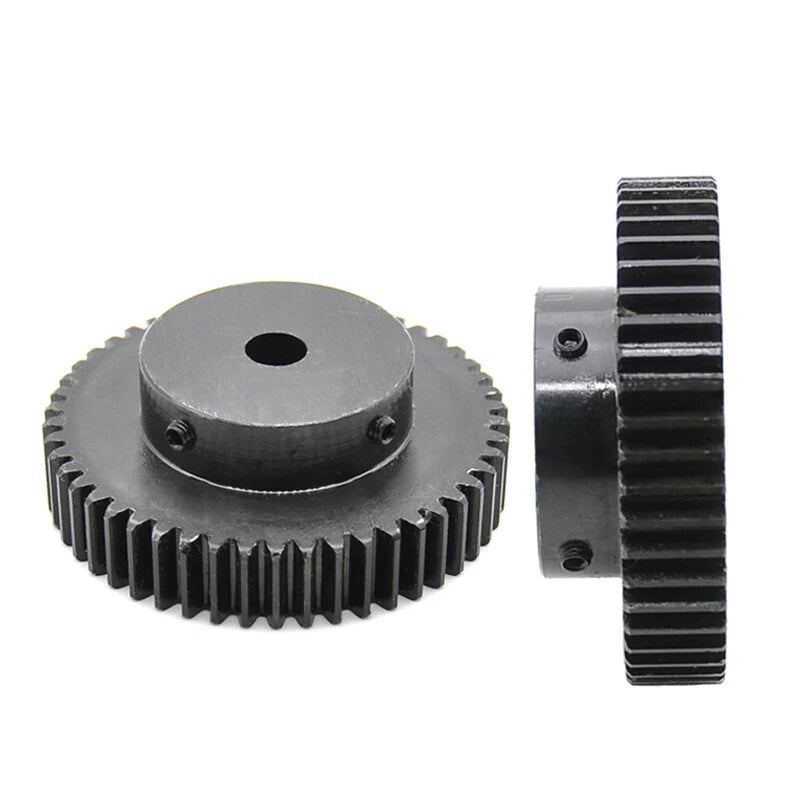
1.5 Mod 70 Teeth Spur Gears Transmission Gear With Step 45# Steel Blackening

No reviews

Price:
Sale price$154.03 USD
Stock:
In stock (500 units), ready to be shipped

Payment & Security

Ach Direct Debit Amazon American Express Apple Pay Bancontact BLIK Diners Club Discover EPS Google Pay iDEAL Wero JCB Maestro Mastercard Multibanco MobilePay PayPal Przelewy24 Shop Pay Twint Union Pay USDC Visa

Your payment information is processed securely. We do not store credit card details nor have access to your credit card information.

Limited Offer — Spend More, Save More
Spend $55+
Save $5
Spend $100+
Save $10
Spend $200+
Save $25
HomeDIYer DIY Expert Support

DIY Expert Support

Get fitment advice & recommendations

Mon–Fri  8:30 AM – 8:00 PM
24-Hour Fast Ship
Arrives in 3–14 Days
Worldwide Shipping
30-Day Returns
1 tree planted with every purchase

Description

1.5 Mod 70-Tooth Spur Gear with Step Hub — Reliable Transmission for DIY Automation Builds

When your motion-control project demands a gear that fits precisely, holds torque without slipping, and resists wear over thousands of cycles, a poorly dimensioned or soft-metal gear becomes the weakest link in the drivetrain. Makers, hobbyists, and small-workshop engineers building CNC machines, conveyor systems, or custom automation rigs need a 1.5 Mod 70-tooth spur gear they can trust to stay true under load.

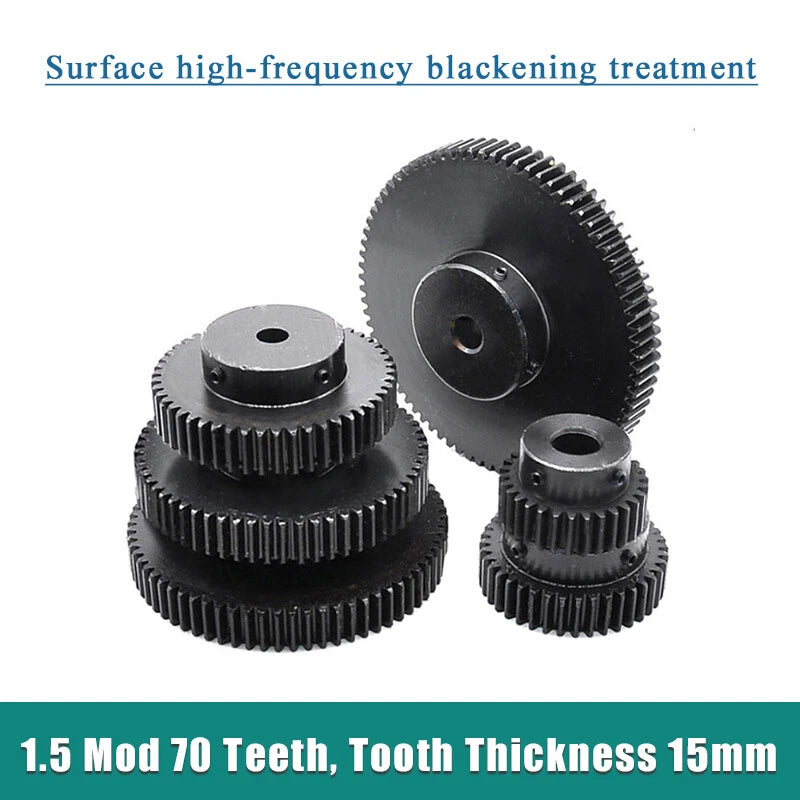
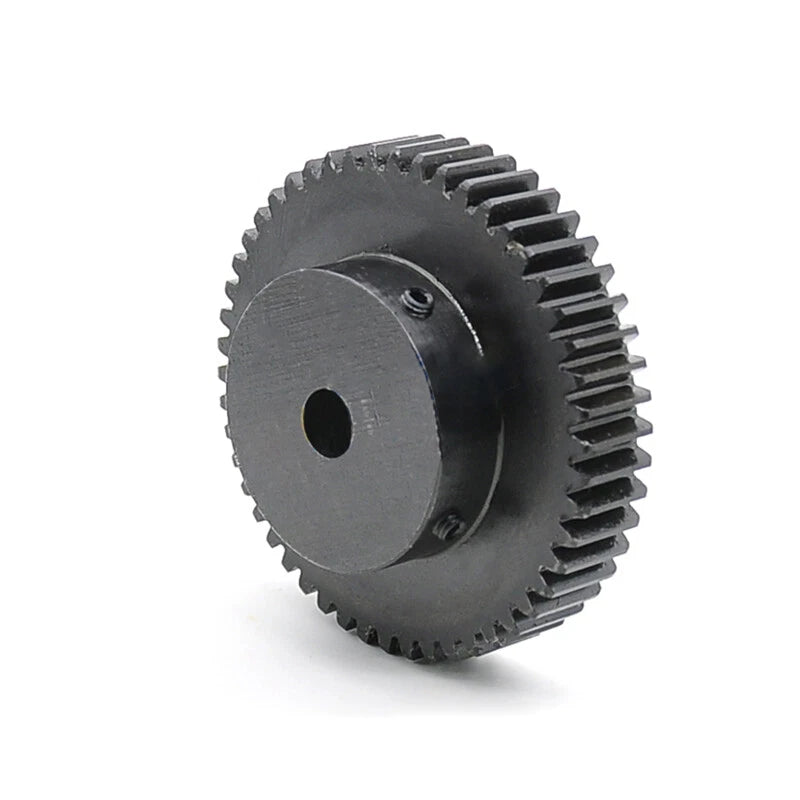
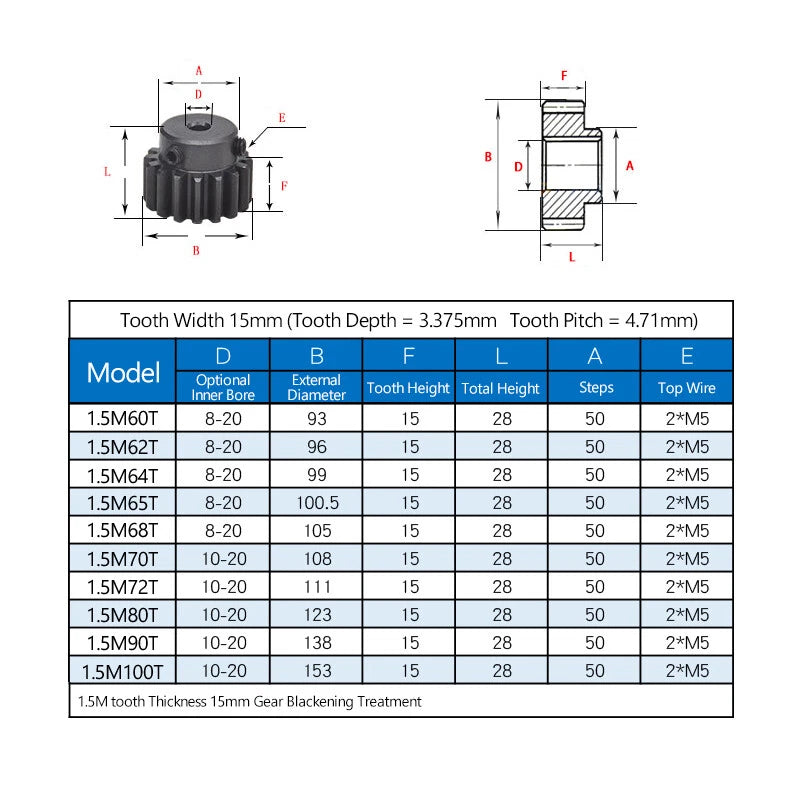
This 1.5 Module 70-tooth spur gear is machined from 45# medium-carbon steel and finished with a blackening (black oxide) surface treatment for corrosion resistance and reduced light reflection. The stepped hub design (Step 50, Tooth Thickness 15 mm) provides a positive axial shoulder for secure shaft positioning. Available bore diameters range from 10 mm (≈0.39 in) to 25 mm (≈0.98 in), covering the most common shaft sizes used in DIY and light-industrial drives.

Typical use cases include: open-loop stepper-motor geartrains for desktop CNC routers and laser engravers; rack-and-pinion linear drives on 3D printer gantries and pick-and-place fixtures; and speed-reduction stages in small conveyor or rotary-indexing systems where a 1.5 Mod 70-tooth spur gear pairs with a matching pinion for a clean, low-backlash mesh.

⚙️ Compatibility: Meshes with any 1.5 Module (Mod 1.5) spur or helical gear of the same module. Verify bore diameter matches your shaft before ordering.

✅ Key Features of These 1.5 Mod 70-Tooth Spur Gears

  • 🔩45# Steel Construction — Medium-carbon steel body delivers the toughness needed for sustained torque transmission in mechanical drives without the brittleness of cast alternatives.
  • Blackening Surface Treatment — Black oxide finish adds a layer of corrosion resistance and reduces surface friction at the tooth flanks, extending service life in lightly oiled or dry-run environments.
  • 📐Stepped Hub Design — The integrated step (Step 50, Tooth Thickness 15 mm) creates a positive axial stop, making shaft alignment repeatable and eliminating the need for additional spacers in most assemblies.
  • 🎯Multiple Bore Options — Choose from 10, 12, 15, 16, 17, 19, 20, or 25 mm bore diameters to match your motor or drive shaft directly, minimizing adapter hardware.
  • 🔄Standard 1.5 Module Tooth Profile — Conforms to the ISO/DIN Module 1.5 standard, ensuring interchangeability with off-the-shelf pinions, racks, and mating gears from any compliant supplier.
  • 🏗️Versatile Drivetrain Applications — Suited for CNC gantries, rotary indexers, conveyor drives, and custom automation rigs where a 70-tooth count provides a useful reduction ratio when paired with a smaller pinion.

📐 Technical Specifications — 1.5 Mod Spur Gear

Module (Mod) 1.5
Number of Teeth 70
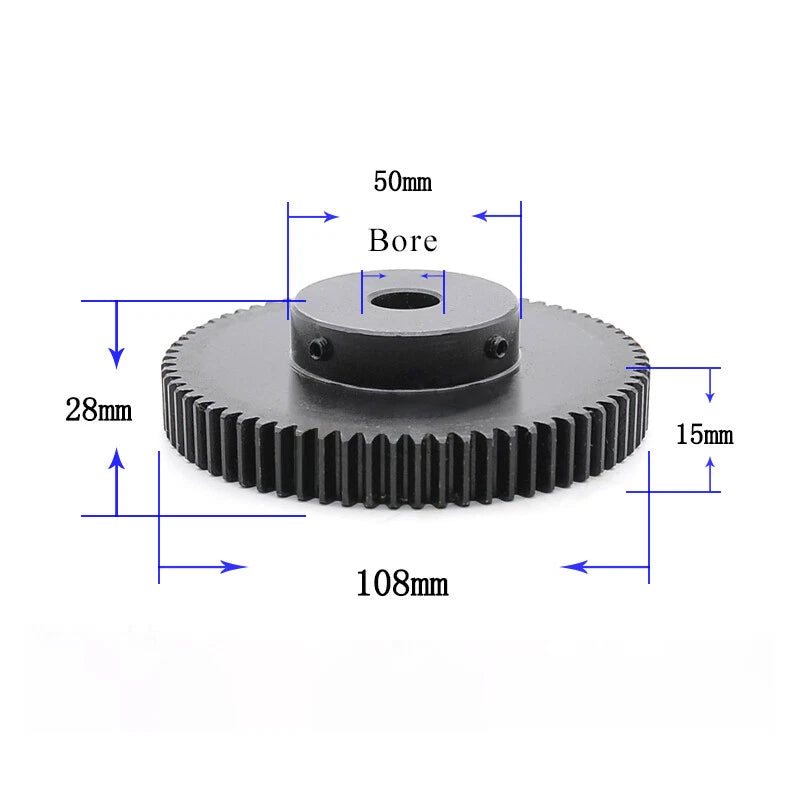
Tooth Thickness 15 mm
Step (Hub Length) 50 mm
Pitch Diameter 105 mm (≈4.13 in)
Outer Diameter (approx.) 108 mm (≈4.25 in)
Bore Diameter See variant options (10 / 12 / 15 / 16 / 17 / 19 / 20 / 25 mm)
Material 45# Medium-Carbon Steel
Surface Treatment Blackening (Black Oxide)
Pressure Angle 20°
Gear Type Spur Gear (straight tooth)
Packing Quantity 1 pc per order
Weight See variant options

❓ Frequently Asked Questions

How do I choose the right bore diameter for my shaft?

Measure your motor or drive shaft diameter with a caliper. Select the bore option that matches exactly — for example, a 20 mm shaft requires the 20 mm bore variant. If your shaft is slightly undersized, a keyway and set-screw arrangement can compensate, but the bore should never be larger than the shaft diameter.

What does "1.5 Module" mean, and will this gear mesh with my existing gears?

Module (Mod) is the ISO standard unit describing tooth size — specifically the pitch diameter divided by the number of teeth. Two gears mesh correctly only when they share the same module and pressure angle. This gear is Mod 1.5 with a 20° pressure angle, so it will mesh with any other Mod 1.5 / 20° spur or helical gear, regardless of tooth count.

How strong is this gear, and what torque can it handle?

The 45# steel body provides a tensile strength of approximately 600–800 MPa depending on heat treatment. Allowable torque depends on operating speed, lubrication, and duty cycle. For light-to-medium DIY automation loads (stepper motors up to a few Nm), this gear is well within its design envelope. For heavy industrial loads, consult a gear-strength calculation using AGMA or ISO 6336 standards.

Does the blackening finish protect against rust in humid environments?

Black oxide provides mild corrosion resistance and is best suited for indoor or lightly controlled environments. For high-humidity or outdoor applications, apply a light coat of machine oil or grease to the gear surface periodically. The finish is not a substitute for stainless steel or zinc plating in harsh wet conditions.

What is the purpose of the stepped hub, and do I need it?

The step (shoulder) on the hub acts as a built-in axial locator — it seats against a bearing face or housing wall so the gear sits at a precise position along the shaft without needing a separate spacer. If your design already uses shaft collars or other locating features, the step simply adds redundancy. It does not interfere with standard mounting.

What pinion tooth count should I pair with this 70-tooth gear for a specific reduction ratio?

Divide 70 by your desired ratio to find the pinion tooth count. For example: a 7:1 reduction needs a 10-tooth pinion; a 3.5:1 reduction needs a 20-tooth pinion. All mating pinions must be Mod 1.5 with a 20° pressure angle. Center distance = (70 + pinion teeth) × 1.5 / 2 mm.

Is lubrication required, and what type is recommended?

Lubrication is strongly recommended for continuous-duty operation. A light machine oil (ISO VG 46–68) or open-gear grease applied to the tooth flanks will significantly reduce wear and noise. For intermittent or low-speed hobby use, a thin film of white lithium grease is a practical choice.

🛒 Select your bore diameter and model above, then add to cart.

You may also like

Recently viewed