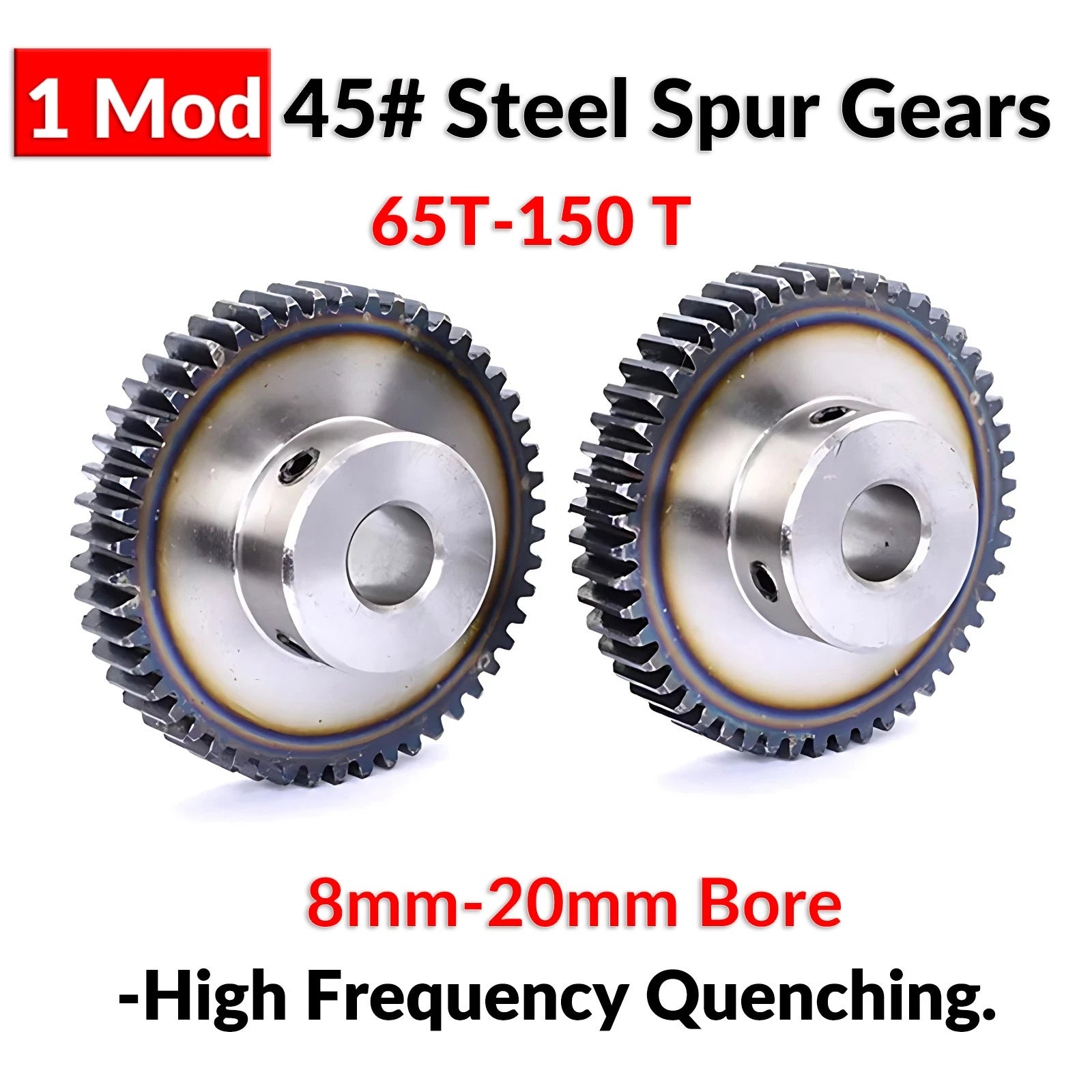
1 Mod 45# Steel Spur Gears — Precision Hardened Pinion Gears for CNC & Automation
When your motion-control build demands reliable, repeatable torque transfer, undersized or soft gears become the weakest link. Engineers, makers, and automation integrators working on CNC routers, robotic arms, and drive systems need spur gears that hold tight tolerances under continuous load — these 1 Mod 45# steel pinion spur gears are built for exactly that.
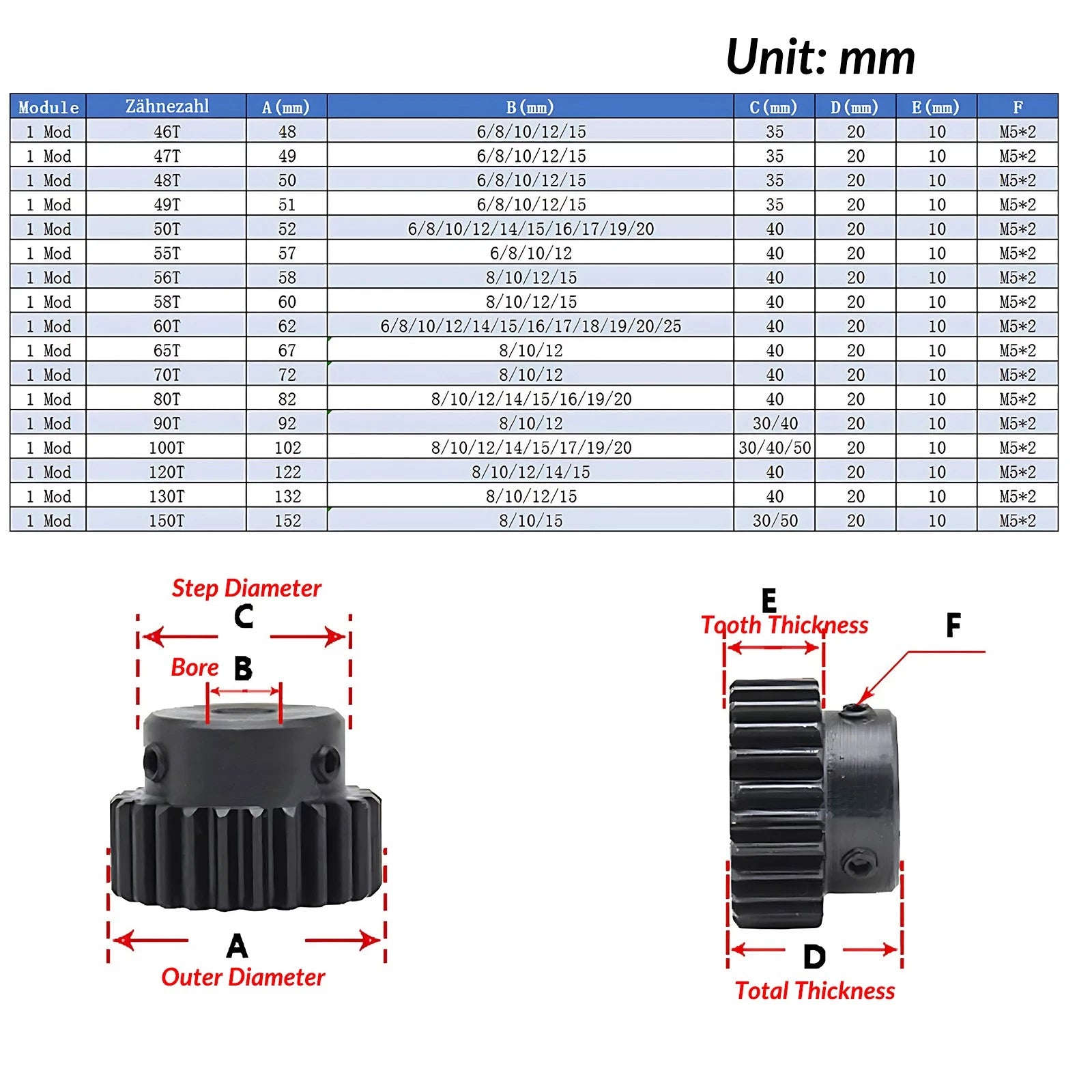
Each gear is machined from 45# medium-carbon steel and surface-hardened for wear resistance. The module is 1M (1 mm/tooth), with tooth counts ranging from 65T to 150T and bore diameters from 8 mm (0.31 in) to 20 mm (0.79 in). Step hub diameters are available in 40 mm and 50 mm. A radial set screw is included on every variant for secure shaft locking without keyways.
Typical use cases include CNC rack-and-pinion axis drives, stepper/servo motor output shafts in 3D printer gantries, rotary indexing tables for light machining, and gear-reduction stages in DIY robotic joints — all applications where a 1 mod steel spur gear with a precise bore fit is non-negotiable.
⚙️
Compatibility: Meshes with any standard Module 1 (1M) rack, pinion, or mating spur gear. Verify bore diameter and step hub clearance against your shaft and housing before ordering.
✅ Key Features of These 1 Mod 45# Steel Spur Gears
🔩
45# Medium-Carbon Steel Construction — Machined from 45# steel for a balance of machinability and tensile strength, suitable for moderate-to-high torque drive applications.
🔥
Surface-Hardened Teeth — Heat-treated tooth flanks resist wear and pitting under continuous mesh contact, extending service life in repetitive-cycle automation.
📐
Module 1 (1M) Standard Pitch — Fully interchangeable with any M1 rack or mating gear; no custom tooling required for integration into standard metric drive trains.
🎯
Wide Bore & Tooth-Count Selection — Eight tooth counts (65T–150T) and bore diameters from 8 mm to 20 mm cover most stepper and servo shaft sizes used in CNC and robotics.
🔐
Included Set Screw for Shaft Lock — Each gear ships with a radial set screw, enabling keyway-free shaft retention and quick repositioning during prototyping.
🏭
Step Hub Design — The 40 mm or 50 mm step hub provides a positive axial reference face, simplifying alignment in multi-gear assemblies and gearbox housings.
📐 Technical Specifications — 1 Mod Spur Gears
| Module |
1M (1 mm per tooth) |
| Material |
45# Medium-Carbon Steel |
| Surface Treatment |
Hardened (heat-treated tooth flanks) |
| Tooth Count Options |
65T, 70T, 72T, 80T, 100T, 120T, 130T, 150T |
| Bore Diameter Options |
8 mm, 10 mm, 12 mm, 14 mm, 15 mm, 16 mm, 17 mm, 19 mm, 20 mm, 22 mm |
| Step Hub Diameter |
40 mm or 50 mm (see variant options) |
| Pressure Angle |
20° (standard metric) |
| Pitch Diameter Range |
65 mm – 150 mm (equals tooth count × module) |
| Shaft Retention |
Radial set screw (included) |
| Quantity per Order |
1 piece |
| Weight |
See variant options |
❓ Frequently Asked Questions
How do I choose the right tooth count for my application?
The tooth count determines the pitch diameter (tooth count × module = pitch diameter in mm). For a 1M gear, a 65T gear has a 65 mm pitch diameter and a 150T gear has a 150 mm pitch diameter. Choose based on your required gear ratio and available center distance. Pair this gear with a smaller pinion to achieve speed reduction, or with a rack for linear motion.
Which bore diameter should I select for my motor shaft?
Match the bore diameter to your shaft's outer diameter. Common stepper motor shafts are 5 mm, 6.35 mm, or 8 mm; servo output shafts are often 8–20 mm. If your shaft is slightly smaller than the bore, the included set screw will secure it. Do not select a bore smaller than your shaft diameter.
Will this gear mesh with my existing Module 1 rack or pinion?
Yes. All gears in this listing follow the standard Module 1 metric tooth profile with a 20° pressure angle. They will mesh correctly with any M1-compatible rack, pinion, or spur gear from any manufacturer that adheres to the same standard.
How strong are these gears — can they handle my torque load?
45# steel has a tensile strength of approximately 600–700 MPa in the normalized condition, with surface hardening further improving tooth-flank wear resistance. Actual load capacity depends on tooth count, face width, speed, and lubrication. For high-cycle or heavy-load applications, consult a gear-strength calculation (e.g., AGMA or ISO 6336) using the pitch diameter and face width of your selected variant.
Are these gears corrosion-resistant for outdoor or humid environments?
45# carbon steel is not inherently corrosion-resistant. For outdoor or high-humidity environments, apply a light machine oil or grease to the tooth flanks and bore, or consider a protective coating. If corrosion resistance is a primary requirement, look for stainless steel or plastic gear alternatives.
What is the difference between the 40 mm and 50 mm step hub options?
The step hub diameter refers to the outer diameter of the raised hub section that sits against your housing or bearing face. A 40 mm hub suits compact gearbox designs, while a 50 mm hub provides a larger axial reference surface for heavier assemblies. Check your housing bore or bearing inner race before selecting.
Do I need any special tools to install the set screw?
The set screw uses a standard hex (Allen) socket head. A metric hex key (typically 2–3 mm depending on screw size) is all that is required. Tighten firmly against the shaft flat or surface to prevent rotation under load.
🛒 Select your Number of Teeth, Bore Diameter, and Step Diameter above, then add to cart.