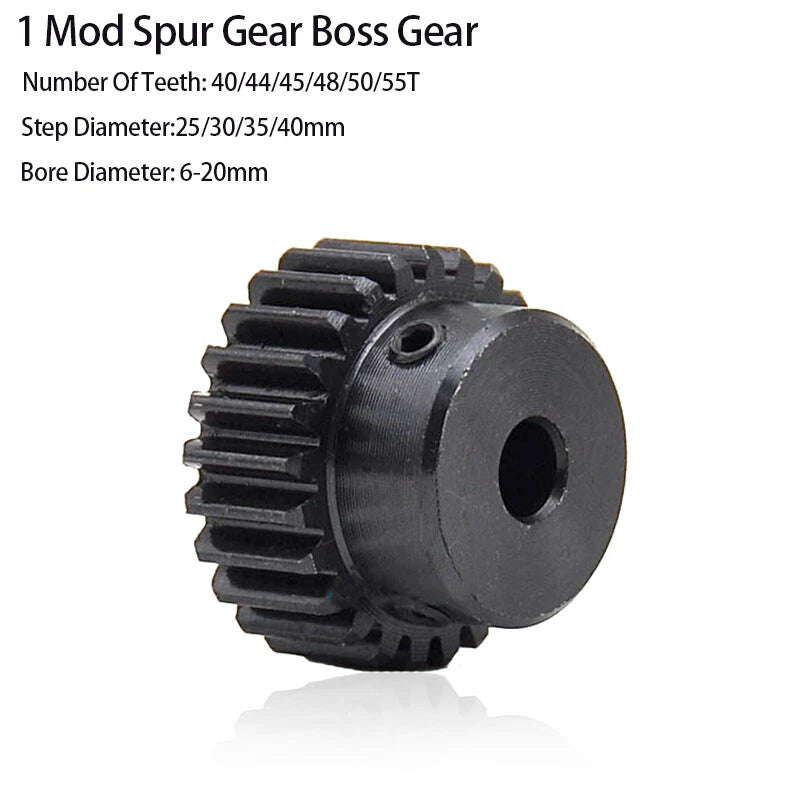
1 Mod Spur Gear in 45# Steel — Precision Transmission for Motor & DIY Drives
When your stepper motor project stalls because of a sloppy, undersized gear, the entire build suffers. Engineers, makers, and hobbyists who need reliable, repeatable torque transfer in CNC routers, 3D printer extruders, robotic arms, and custom drive trains rely on a gear that holds tight tolerances and resists wear over thousands of cycles. These 1 Mod spur gears are machined for exactly that audience.
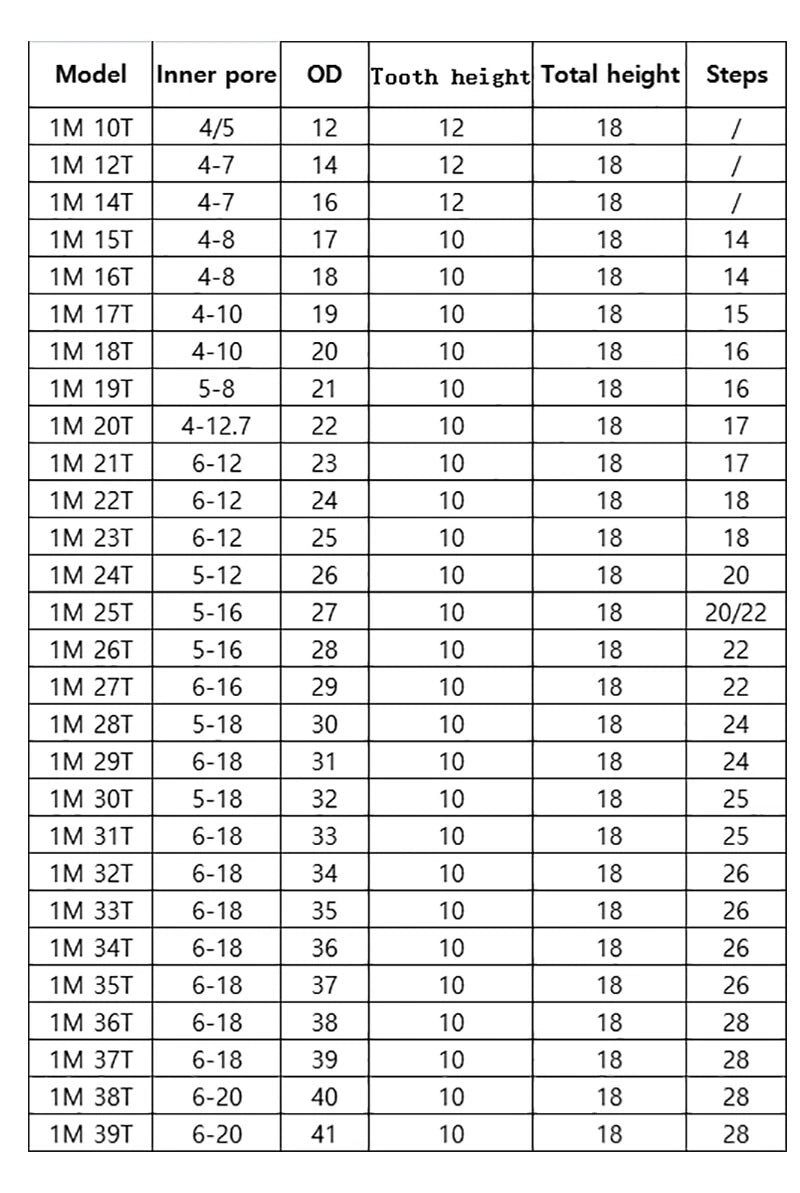
Each gear is cut from 45# medium-carbon steel, offering a balance of machinability and surface hardness suited to moderate-to-high load applications. The module is 1 (metric), with tooth counts ranging from 40T to 55T and bore diameters from 6 mm (0.24 in) to 20 mm (0.79 in). The stepped hub design — available in 25 mm, 30 mm, 35 mm, and 40 mm step diameters — provides a positive axial register against a shaft shoulder or housing face, simplifying alignment during assembly. Overall gear thickness is typically 10–12 mm depending on tooth count.
Typical use cases include stepper motor output stages in desktop CNC machines, gear-reduction stages in conveyor and indexing fixtures, and replacement transmission gears in light-duty automation equipment. Long-tail search terms that describe this product well: "module 1 steel spur gear for NEMA 17", "40 tooth metric spur gear 8mm bore", and "bulk spur gear set for robotics".
⚙️
Compatibility: Module 1 (metric) tooth profile. Meshes with any other Module 1 spur or rack gear. Verify bore diameter and step diameter match your shaft and housing before ordering.
✅ Key Features of These 1 Mod Spur Gears
🔩
45# Medium-Carbon Steel Construction
Machined from 45# steel for a reliable combination of tensile strength and machinability, suitable for moderate-load transmission applications in motors and automation equipment.
📐
Module 1 Metric Tooth Profile
Standard Module 1 pitch ensures direct mesh compatibility with any other M1 spur gear, rack, or pinion — no custom tooling or adapters required.
🎯
Wide Bore Range: 6 mm – 20 mm
Available bore diameters cover 6 mm, 6.35 mm, 7 mm, 8 mm, 10 mm, 12 mm, 12.7 mm, 14 mm, 15 mm, 16 mm, 17 mm, 19 mm, and 20 mm — matching common stepper, servo, and DC motor shaft sizes.
🪜
Stepped Hub for Positive Axial Location
The integrated step hub (25–40 mm step diameter options) registers against a shaft shoulder or housing face, reducing axial float and simplifying assembly alignment.
🦷
Tooth Count Options: 40T, 44T, 45T, 48T, 50T, 55T
Six tooth-count options let you dial in the gear ratio you need for your drive stage without custom ordering — from compact 40T pinions to larger 55T reduction gears.
📦
Flexible Pack Quantities: 1, 3, 5, or 10 Pieces
Order a single gear for prototyping or a 10-piece set for production runs and spares inventory — all at consistent per-unit quality.
📐 Technical Specifications — 1 Mod Spur Gear
| Module |
1 (Metric) |
| Material |
45# Medium-Carbon Steel |
| Tooth Count Options |
40T, 44T, 45T, 48T, 50T, 55T |
| Bore Diameter Options |
6, 6.35, 7, 8, 10, 12, 12.7, 14, 15, 16, 17, 19, 20 mm |
| Step Diameter Options |
25, 30, 35, 40 mm |
| Gear Face Width |
See variant options |
| Pressure Angle |
20° |
| Surface Finish |
See variant options |
| Pack Quantity |
1, 3, 5, or 10 pieces |
| Keyway / Set Screw |
Contact us to confirm |
❓ Frequently Asked Questions
How do I choose the right tooth count for my application?
The gear ratio between two meshing gears equals the ratio of their tooth counts. For example, pairing a 40T gear with a 20T pinion gives a 2:1 reduction. Choose a higher tooth count (e.g., 50T or 55T) on the output side when you need to reduce speed and increase torque, and a lower count on the motor side. Always confirm that both gears share the same module (M1 in this case) to ensure proper mesh.
What bore diameter should I select for my stepper motor shaft?
Match the bore diameter to your motor shaft diameter. Common stepper motor shaft sizes are 5 mm (NEMA 17 standard), 6.35 mm (1/4 inch), 8 mm (NEMA 23), and 10 mm (larger NEMA 23/34 frames). If your shaft is 5 mm, you may need to bore out a 6 mm gear slightly — or use a set screw and shaft adapter. Contact us if you need confirmation on a specific shaft size.
How strong are these gears under load?
45# steel has a typical tensile strength of approximately 600–700 MPa and yield strength around 355 MPa, making it suitable for moderate-load transmission in CNC, robotics, and light automation. For very high-torque or high-speed applications (above ~3,000 RPM continuous), consider heat-treated or alloy steel alternatives. These gears are designed for general-purpose DIY and maker use cases.
Are these gears corrosion-resistant?
45# carbon steel is not inherently corrosion-resistant. For indoor, dry environments this is generally not an issue. If your application involves moisture, humidity, or outdoor exposure, we recommend applying a light machine oil or grease coating after installation, or considering a stainless steel or zinc-plated alternative for your environment.
What does the "step diameter" option mean, and which should I choose?
The step diameter refers to the outer diameter of the hub shoulder that protrudes from the gear face. This stepped hub registers against a housing bore or shaft collar to provide axial location — preventing the gear from sliding along the shaft during operation. Choose a step diameter that matches your housing bore or that is slightly smaller than your mounting pocket. Common pairings: 25–30 mm steps for compact motor mounts, 35–40 mm steps for larger housings.
Can I order these gears in bulk for production or repair stock?
Yes. Each variant is available in packs of 1, 3, 5, or 10 pieces. The 10-piece option offers the best per-unit value and is well-suited for production runs, maintenance kits, or classroom/lab inventory. All pieces in a pack are identical in tooth count, bore diameter, and step diameter as selected.
Will this gear mesh with a Module 1 rack or worm gear?
These gears will mesh correctly with any Module 1 spur gear or Module 1 rack. They are not designed to mesh with worm gears, bevel gears, or helical gears, which have different tooth geometries. Always verify that the mating component is also Module 1 before ordering.
🛒 Select your tooth count, bore diameter, and pack quantity above, then add to cart.