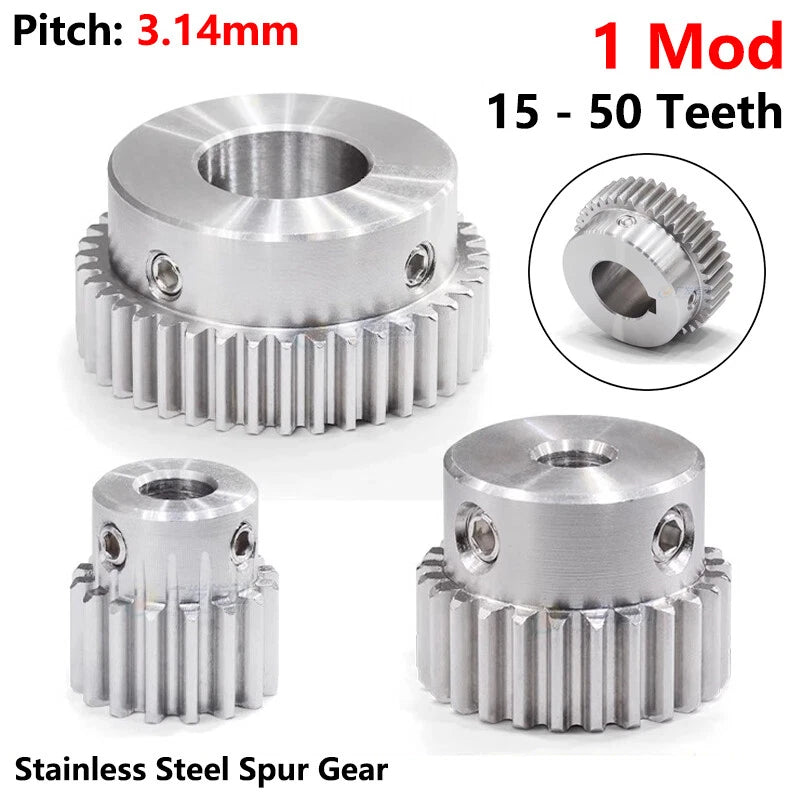
1 Mod Stainless Steel Spur Gear — Precision Pinion Gears for CNC, Robotics & Stepper Motor Drives
When a stripped or mismatched gear brings your CNC router, 3D printer, or automation rig to a halt, you need a replacement you can trust to run true. These 1 Mod stainless steel spur gears are engineered for makers, robotics builders, and small-machine operators who demand consistent tooth geometry and corrosion resistance in a compact pinion format.
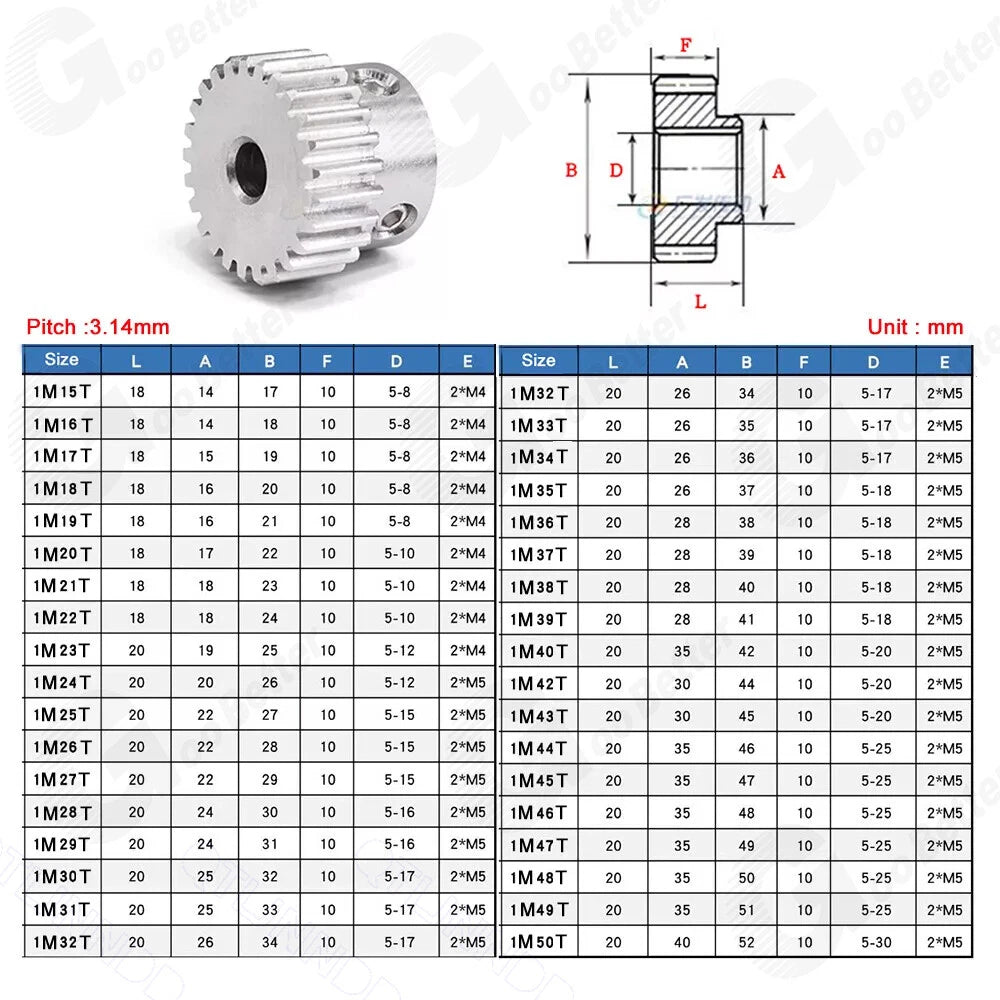
Each gear is machined from 304-grade stainless steel and follows a Module 1 (1 Mod) tooth profile — the internationally recognised standard for metric spur gears. The range covers 15 to 50 teeth, with outer diameters scaling from approximately 17 mm (0.67 in) for 15T up to approximately 52 mm (2.05 in) for 50T. Bore options span 5 mm to 20 mm, including keyway variants (e.g. 8/3×1.4 mm, 10/4×1.8 mm, 12/4×1.8 mm, 14/5×2.3 mm, 15/5×2.3 mm, 16/5×2.3 mm, 18/6×2.8 mm) for positive shaft engagement without set-screw slip.
Typical use cases include stepper motor pinion drives in desktop CNC machines, rack-and-pinion linear actuators for 3D printer gantries, gear-reduction stages in robotics joints, and replacement gears in light industrial conveyor or indexing systems. The stainless construction makes these gears well-suited for environments with occasional moisture exposure, such as laser-cutter enclosures or food-adjacent automation fixtures.
⚙️
Compatibility: Module 1 metric spur gear standard — meshes with any M1 rack, pinion, or mating gear. Verify bore diameter and keyway dimensions against your shaft before ordering.
✅ Key Features of These 1 Mod Stainless Steel Spur Gears
🦾 Stainless Steel Construction
Machined from 304-grade stainless steel for corrosion resistance and long service life in demanding environments.
📐 Module 1 Tooth Profile
Conforms to the international M1 metric standard, ensuring accurate mesh with any compatible M1 rack or mating gear.
🔩 Wide Bore Selection
Available in plain bores from 5 mm to 20 mm, plus keyway variants (3×1.4 mm, 4×1.8 mm, 5×2.3 mm, 6×2.8 mm) for positive shaft locking.
🎯 15 to 50 Tooth Range
Covers a broad gear-ratio spectrum in a single product family — from compact 15T pinions to larger 50T drive gears.
⚡ Stepper Motor Ready
Bore sizes and tooth counts are selected to match common NEMA 17 and NEMA 23 stepper motor shaft diameters used in CNC and 3D printing.
📦 Sold Individually or in Sets
Choose 1 Pcs per variant to source exactly the tooth count and bore you need without over-ordering.
📐 Technical Specifications — 1 Mod Spur Gear
| Module |
1 (M1) |
| Tooth Count Range |
15T – 50T |
| Pressure Angle |
20° |
| Material |
304 Stainless Steel |
| Bore Diameter Range |
5 mm – 20 mm (plain & keyway) |
| Outer Diameter (approx.) |
17 mm (15T) – 52 mm (50T) |
| Face Width |
See variant options |
| Hub Diameter |
See variant options |
| Keyway Sizes Available |
3×1.4 mm / 4×1.8 mm / 5×2.3 mm / 6×2.8 mm |
| Finish |
Natural stainless (uncoated) |
| Packing Quantity |
1 Pcs per order |
❓ Frequently Asked Questions
How do I choose the right tooth count for my application?
The tooth count determines your gear ratio. Divide the driven gear teeth by the driving gear teeth to get the ratio. For a 2:1 reduction, pair a 30T gear with a 15T pinion. For direct drive or 1:1 coupling, use matching tooth counts on both shafts. If you are replacing an existing gear, count the teeth on the worn part or measure the pitch diameter (OD minus 2 × module = pitch diameter in mm for M1 gears).
What bore size should I order for a NEMA 17 stepper motor?
Standard NEMA 17 stepper motors have a 5 mm output shaft. Select the Bore 5 mm variant. NEMA 23 motors typically use an 8 mm shaft — choose Bore 8 mm. Always verify your motor's datasheet before ordering, as some manufacturers use non-standard shaft diameters.
Do I need a keyway variant, and what do the keyway dimensions mean?
Keyway variants (e.g. 8/3×1.4 mm) include a machined slot in the bore that accepts a matching key on the shaft, preventing rotational slip under load. The notation means: bore diameter / key width × key depth. Use a keyway variant when transmitting significant torque or when set-screw retention alone is insufficient. Plain bore variants are suitable for light-duty or positioning applications where a set screw is adequate.
Are these gears compatible with standard M1 racks and other M1 gears?
Yes. All gears in this range follow the Module 1 (M1) metric standard with a 20° pressure angle, which is the most common metric spur gear specification. They will mesh correctly with any M1-rated rack, pinion, or mating spur gear from any manufacturer that adheres to the same standard. Do not mix with imperial diametral pitch (DP) gears — they are not interchangeable.
How corrosion-resistant is 304 stainless steel for my environment?
304 stainless steel offers good resistance to oxidation, mild acids, and intermittent moisture exposure. It is suitable for indoor CNC enclosures, laser cutter environments, and light food-adjacent automation. For continuous immersion in saltwater or strong chloride environments, 316 stainless would be preferred. These gears are not coated, so the natural passive oxide layer provides the corrosion protection.
What is the difference between a plain bore and a stepped bore (e.g. 8/3×1.4 mm)?
A plain bore is a smooth cylindrical hole sized to slip over a shaft and is typically secured with a set screw or press fit. A stepped bore (keyway bore) has an additional rectangular slot machined into the bore wall. A matching key inserted between the shaft keyway and the gear keyway transmits torque mechanically, which is more reliable than a set screw alone under reversing or high-torque loads. Choose the keyway variant if your shaft already has a keyway cut into it.
Can I use these gears in a rack-and-pinion linear motion system?
Yes. Any gear in this range will mesh with a standard M1 rack. For linear motion, the travel per revolution equals π × module × tooth count (in mm). For example, a 20T gear produces approximately 62.8 mm of linear travel per full shaft revolution. Pair with an M1 steel or aluminium rack for a complete linear drive system.
🛒 Select your tooth count and bore diameter above, then add to cart.