10A Sprocket Wheel 10T~39T & Steel Simplex OR Duplex Strand Chain Roller Chain

No reviews

Price:
Sale price$8.57 USD
Stock:
In stock (500 units), ready to be shipped

Payment & Security

Ach Direct Debit Amazon American Express Apple Pay Bancontact BLIK Diners Club Discover EPS Google Pay iDEAL Wero JCB Maestro Mastercard Multibanco MobilePay PayPal Przelewy24 Shop Pay Twint Union Pay USDC Visa

Your payment information is processed securely. We do not store credit card details nor have access to your credit card information.

Limited Offer — Spend More, Save More
Spend $55+
Save $5
Spend $100+
Save $10
Spend $200+
Save $25
HomeDIYer DIY Expert Support

DIY Expert Support

Get fitment advice & recommendations

Mon–Fri  8:30 AM – 8:00 PM
24-Hour Fast Ship
Arrives in 3–14 Days
Worldwide Shipping
30-Day Returns
1 tree planted with every purchase

Description

10A Sprocket Wheels & Roller Chains — Reliable Power Transmission for ANSI 16A Drives

When a worn sprocket or a snapped roller chain brings your conveyor, agricultural equipment, or industrial drive to a halt, finding an exact-fit 10A sprocket wheel or matching chain quickly is critical. This listing is designed for engineers, maintenance technicians, and serious DIYers who need a verified ANSI 10A (ISO 16A) sprocket or chain without guesswork — available in tooth counts from 10T to 39T and multiple chain configurations.

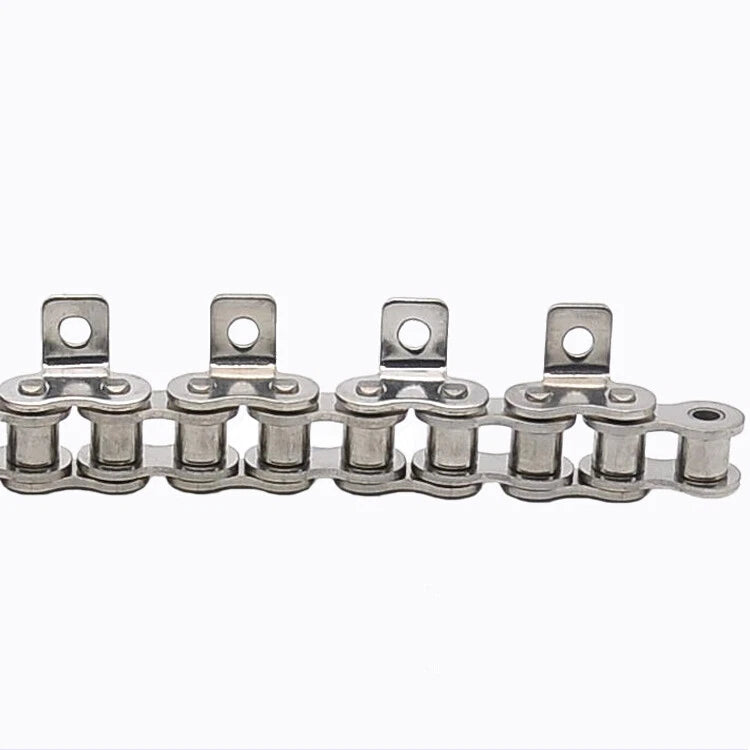
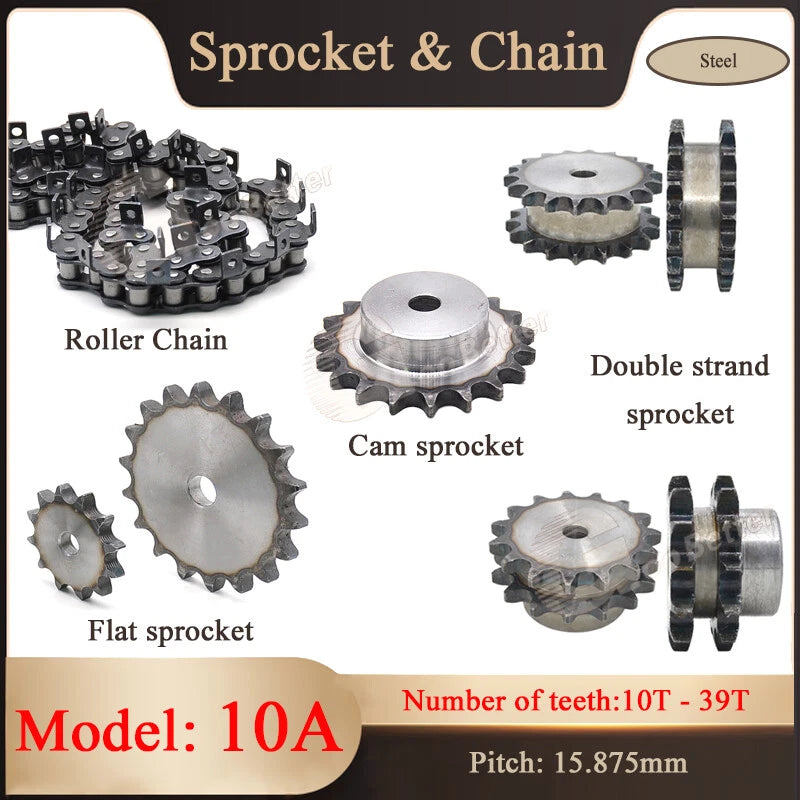
The sprocket range covers Flat Sprockets, Cam Sprockets, A-Type Double Strand Sprockets, and B-Type Double Strand Sprockets, all machined to suit 10A (5/8" pitch) roller chain. Chain options include Single Curved Plate, Single Straight Plate, Double Strand, Double Curved Plate, Extended Pin Single Strand, and stainless steel variants (201 & 304 grade) — supplied in standard lengths of approximately 1.524 m (5 ft) or 1.5 m (4.9 ft) depending on configuration. Bore and hub dimensions vary by tooth count; see variant options for confirmed measurements.

Typical use cases include replacement sprockets for 10A chain conveyor systems, cam-driven indexing mechanisms requiring precise tooth engagement, duplex strand drives on agricultural machinery such as combine feeders and baler drives, and corrosion-resistant 304 stainless roller chain for food-processing or washdown environments.

⚙️ Compatibility: Designed for ANSI 10A / ISO 16A roller chain with 5/8" (15.875 mm) pitch. Verify bore diameter and hub style against your shaft before ordering.

✅ Key Features of These 10A Sprocket Wheels & Roller Chains

🔩 Wide Type & Tooth Count Selection

Choose from Flat, Cam, A-Double Strand, or B-Double Strand sprockets in 10T through 39T — plus five chain styles — all in a single listing for convenient mix-and-match ordering.

📐 ANSI 10A / ISO 16A Standard Pitch

All sprockets and chains conform to the 5/8" (15.875 mm) pitch standard, ensuring dimensional interchangeability with existing 10A drive components on your equipment.

🦾 Carbon Steel & Stainless Steel Options

Carbon steel variants deliver solid tensile strength for general industrial drives; 201 and 304 stainless steel chain options resist oxidation in humid, wet, or mildly corrosive environments.

Duplex Strand Capacity

A-Type and B-Type double strand sprockets, plus the Double Strand Chain option, allow higher torque transmission in compact drive layouts without upsizing to a larger chain pitch.

📌 Extended Pin & Curved Plate Variants

Extended pin chain supports attachment plates or cross-bars for conveyor flights; curved plate chain offers improved articulation and reduced noise in high-speed or directional-change applications.

🔄 Direct Drop-In Replacement

Sprocket tooth profiles and chain roller diameters are machined to ANSI tolerances, making these direct replacements for OEM 10A components on conveyors, agricultural equipment, and general machinery.

📐 Technical Specifications — 10A Roller Chain Sprockets & Chain

Chain Standard ANSI 10A / ISO 16A
Chain Pitch 15.875 mm (5/8")
Sprocket Tooth Range 10T – 39T
Sprocket Types Flat, Cam, A-Double Strand, B-Double Strand
Chain Types Single Curved Plate, Single Straight Plate, Double Strand, Double Curved Plate, Extended Pin Single Strand
Chain Material Carbon Steel; 201 Stainless Steel; 304 Stainless Steel (see variant options)
Chain Length Approx. 1.524 m (5 ft) or 1.5 m (4.9 ft) — see variant options
Sprocket Bore Diameter See variant options
Hub Style See variant options
Finish See variant options
Roller Diameter See variant options
Inner Width See variant options

❓ Frequently Asked Questions

How do I know which tooth count (10T–39T) to choose for my drive?

Match the tooth count to your existing sprocket or calculate the required speed ratio: divide the driver sprocket teeth by the driven sprocket teeth to get the reduction ratio. For most light-to-medium industrial drives, a tooth count between 17T and 25T on the driven sprocket provides a good balance of speed, load capacity, and chain wrap angle. If you are replacing a worn sprocket, count the teeth on the old one or check your equipment's parts manual for the OEM specification.

What is the difference between a Flat Sprocket and a Cam Sprocket?

A Flat Sprocket has a uniform hub face and is used in standard single or double strand drives where the chain runs in a straight line. A Cam Sprocket features an offset or profiled hub designed for cam-driven mechanisms — such as indexing tables or timing drives — where the sprocket must engage the chain at a specific angular position. If your application is a straightforward power transmission drive, a Flat Sprocket is typically the correct choice.

When should I choose a Double Strand (A-Type or B-Type) sprocket over a single strand sprocket?

Double strand sprockets are used when the torque load exceeds the capacity of a single strand 10A chain, or when you need to transmit power to two parallel chain runs simultaneously. A-Type and B-Type refer to hub and flange geometry differences that affect how the sprocket mounts to the shaft and aligns with the chain. Check your drive's torque requirements against the rated working load of the chain, and consult your equipment manual to confirm which hub style fits your shaft and keyway.

Are the stainless steel chain options (201 and 304) suitable for food-processing or washdown environments?

304 stainless steel chain offers good corrosion resistance to water, mild acids, and cleaning agents commonly used in food-processing and washdown environments, making it a widely accepted choice for those applications. 201 stainless steel provides moderate corrosion resistance at a lower cost and is suitable for humid or mildly corrosive conditions but is less resistant than 304 in chloride-rich environments. For direct food-contact or aggressive chemical exposure, verify compliance with your local food-safety regulations before installation.

What is the difference between Single Curved Plate and Single Straight Plate chain?

Single Straight Plate chain uses flat, rectangular side plates and is the standard configuration for most industrial power transmission drives — it offers maximum tensile strength for a given pitch. Single Curved Plate chain uses side plates with a curved (bent) profile that allows slightly more articulation between links, which can reduce noise and vibration in high-speed applications or drives with small-diameter sprockets. For general replacement purposes, match the plate style to your existing chain.

What is Extended Pin chain used for, and how does it differ from standard chain?

Extended Pin chain has pins that protrude beyond the outer side plates on one or both sides, providing attachment points for conveyor flights, cross-bars, pusher dogs, or other carrier attachments. It is functionally identical to standard roller chain in terms of pitch and load capacity, but the extended pins allow you to bolt on conveyor accessories without modifying the chain. If your application is purely power transmission with no attachments, standard single strand chain is the appropriate choice.

How do I verify the bore diameter before ordering a sprocket?

Measure your drive shaft diameter with a vernier caliper or micrometer. The sprocket bore must match or be slightly larger than the shaft diameter (to allow for a key or interference fit). Bore dimensions vary by tooth count and sprocket type — select your variant above and refer to the variant detail page, or contact us to confirm the bore diameter for your specific model before placing your order.

🛒 Select your Products Type and Model above, then add to cart.


You may also like

Recently viewed