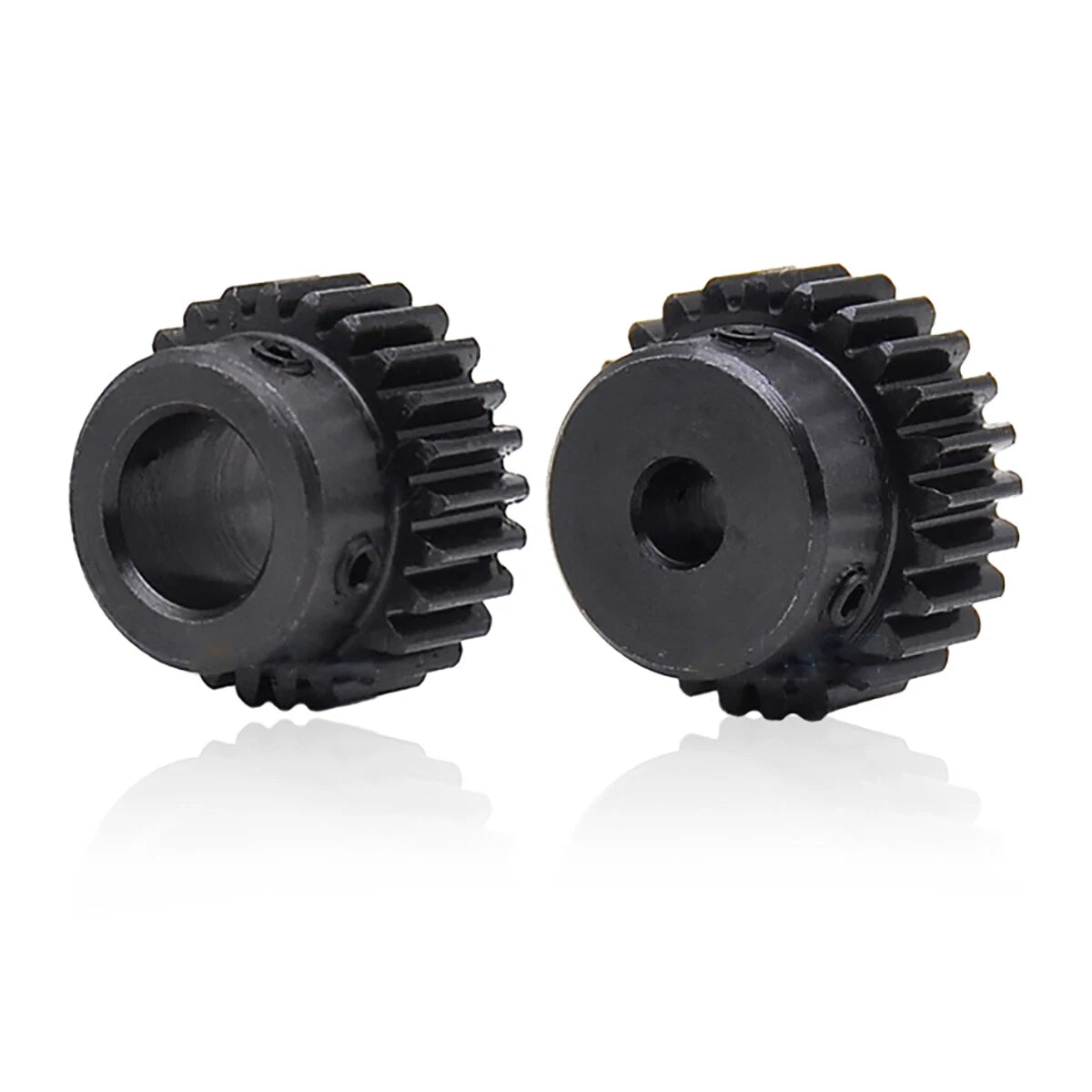
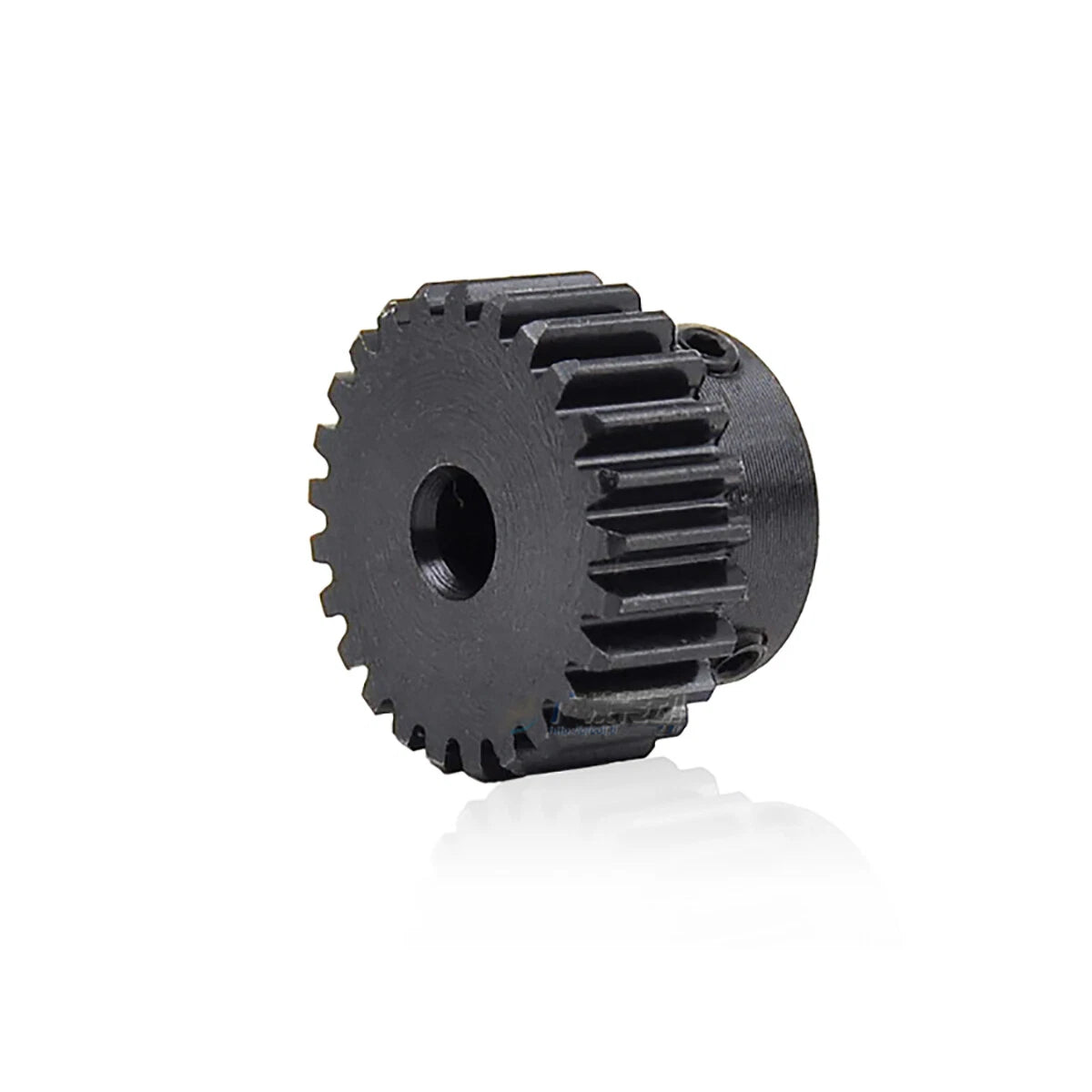
1M Mod Metal Spur Pinion Gears — Precision Transmission for Motors & Drives
When a stripped or mismatched pinion gear brings your build to a halt, finding the right module, tooth count, and bore in one place shouldn't be a second project. Whether you're a robotics engineer, RC hobbyist, CNC builder, or automation technician, these Module 1 metal spur pinion gears are stocked across a wide selection of specs so you can get the exact fit without compromise.
Each gear is machined from metal (typically steel or brass alloy) with a Module 1 (1M) tooth profile. The tooth count spans 10T through 35T, and bore options range from 4 mm (approx. 0.16 in) to 17 mm (approx. 0.67 in), including standard round bores and D-bore (flat-shaft) configurations. Overall gear diameter scales with tooth count — typically 12 mm to 37 mm outer diameter across the range.
Typical use cases include DC motor pinion replacement in RC cars and trucks, servo output gear stages in robotic arms, lead-screw drive gears in desktop CNC routers, and stepper motor transmission gears in 3D printer extruder assemblies. Long-tail applications such as "module 1 pinion gear for 775 motor" and "1M spur gear 5mm bore" are covered across the variant matrix.
⚙️
Compatibility: Module 1 (1M) tooth profile — meshes with any Module 1 rack, spur, or helical gear. Verify bore diameter and shaft flat dimensions before ordering D-bore variants.
✅ Key Features of These 1M Mod Spur Pinion Gears
🔩
Wide Tooth Count Range (10T–35T)
Cover a broad gear ratio spectrum in a single product listing — from fast-spinning low-torque 10T pinions to slower high-torque 35T gears, all in Module 1.
📐
Multiple Bore Options (4–17mm Round & D-Bore)
Round bores from 4 mm to 17 mm and D-bore (flat-shaft) variants including 5×4.5 mm, 6×5 mm, 8×7 mm, 10×9 mm, and more — for secure shaft engagement without set screws slipping.
🏗️
Metal Construction for Durability
Machined from metal alloy (typically steel or brass) to withstand continuous rotational loads, shock transmission, and elevated operating temperatures compared to plastic alternatives.
🎯
Module 1 Standard Profile
Fully compatible with any Module 1 mating gear, rack, or gearbox. The standardised tooth form ensures smooth meshing and consistent backlash across the range.
🔄
Step-Bore Variants Available
Select tooth counts include step-bore options (e.g. 5 mm bore with 17 mm step, 6 mm bore with 20 mm step) for flush motor-face mounting without additional spacers.
📦
Single-Piece Per Order (Qty ×1)
Each variant is sold individually, letting you order exactly the quantity you need — whether one replacement pinion or a matched set for a multi-axis build.
📐 Technical Specifications — Module 1 Spur Pinion Gears
| Module |
1M (Module 1) |
| Tooth Count Range |
10T – 35T |
| Bore Diameter Range |
4 mm – 17 mm (round); D-bore options available |
| Outer Diameter (approx.) |
12 mm – 37 mm (scales with tooth count) |
| Material |
Metal alloy (steel or brass — see variant options) |
| Tooth Profile |
Module 1 standard spur |
| Bore Type |
Round bore / D-bore (flat-shaft) — see variant options |
| Step Bore |
Available on select variants (Step 17 mm / Step 20 mm) |
| Pressure Angle |
See variant options |
| Face Width |
See variant options |
| Quantity per Order |
1 piece |
| Finish |
See variant options |
❓ Frequently Asked Questions
How do I choose the right tooth count for my application?
Tooth count determines your gear ratio. Divide the driven gear's tooth count by the pinion's tooth count to get the ratio. A 10T pinion paired with a 30T gear gives a 3:1 reduction — lower speed, higher torque. A 30T pinion with a 30T gear gives 1:1 — same speed, same torque. Match the tooth count to your required output speed and torque, not just the shaft bore.
What is the difference between a round bore and a D-bore (flat-shaft) variant?
A round bore is a plain cylindrical hole — typically secured with a set screw or press fit. A D-bore has one flat machined into the bore wall that matches a D-shaped motor shaft, providing a positive mechanical key that prevents rotation under load without relying solely on a set screw. If your motor shaft has a flat, always choose the matching D-bore variant for a secure, slip-free connection.
Will this gear mesh with my existing Module 1 rack or gear?
Yes — all gears in this listing use the Module 1 (1M) tooth profile, which is an internationally standardised system. Any Module 1 spur gear, helical gear, or rack will mesh correctly regardless of brand, provided the pressure angle also matches (typically 20°). Do not attempt to mesh Module 1 gears with Module 0.8, Module 1.25, or other module sizes.
How strong are these gears under continuous load?
Metal alloy construction (steel or brass depending on variant) provides significantly greater load capacity and fatigue resistance than nylon or acetal plastic gears of the same module. Exact load ratings depend on the specific alloy, face width, and operating speed of your chosen variant. For high-shock or continuous-duty applications, confirm the material specification for your selected variant before ordering.
What does the "Step Bore" option mean?
A step bore gear has a larger-diameter counterbore on one face — for example, a 5 mm through-bore with a 17 mm step. This allows the gear to sit flush against a motor face plate or bearing housing without a separate spacer, keeping your drivetrain compact. Step bore variants are listed with their bore diameter and step diameter in the variant name (e.g. "5mm(Step 17mm)").
Can I use these pinion gears in an RC car or truck drivetrain?
Module 1 pinion gears are widely used in 1/10 and 1/8 scale RC vehicles with 540, 550, and 775-size motors. Verify that your spur gear is also Module 1 and that the bore matches your motor shaft diameter. D-bore variants are recommended for brushless motor shafts with a flat to prevent slipping under high-torque acceleration.
How do I confirm the correct bore size before ordering?
Measure your motor or drive shaft diameter with a digital caliper. For round bores, the bore should match the shaft diameter with a light interference or sliding fit. For D-bore variants, measure both the shaft diameter and the flat-to-round distance (the "D" dimension) and match it to the listed D-bore spec (e.g. 6×5 mm means 6 mm outer diameter bore, 5 mm flat-to-round). When in doubt, contact us to confirm before ordering.
🛒 Select your Module (Mod) and Bore Size above, then add to cart.