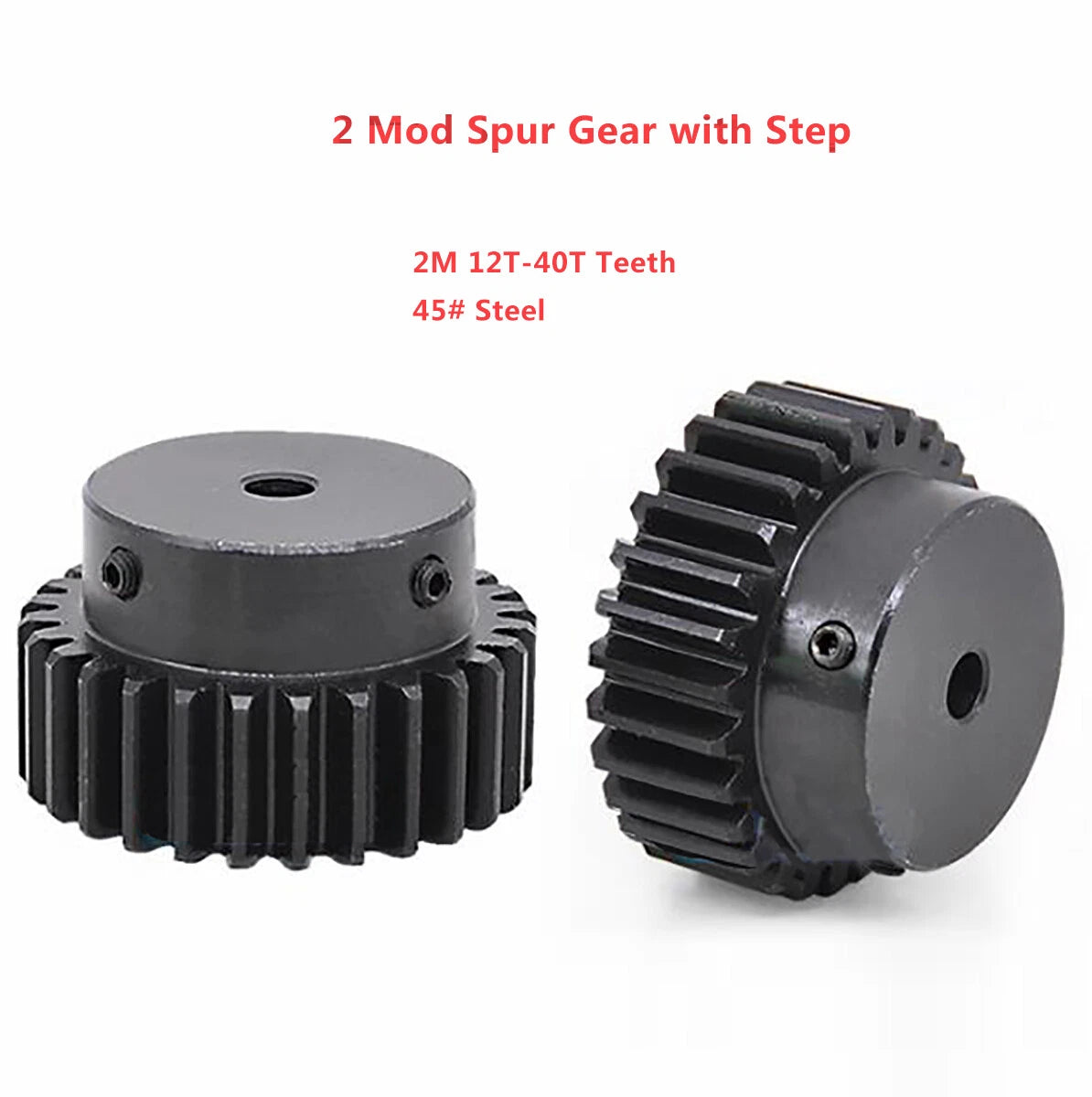
2 Mod Spur Gear with Step — Precision 45# Steel Transmission Gear for CNC & Motor Drives
When your motion-control build demands a gear that fits precisely, transmits torque reliably, and holds up under continuous load, a loose-tolerance or undersized gear becomes the weakest link in your drivetrain. Engineers, robotics builders, and CNC hobbyists who need a stepped-bore spur gear that mounts flush against a shoulder or housing will find this 2 Mod series purpose-built for that task.
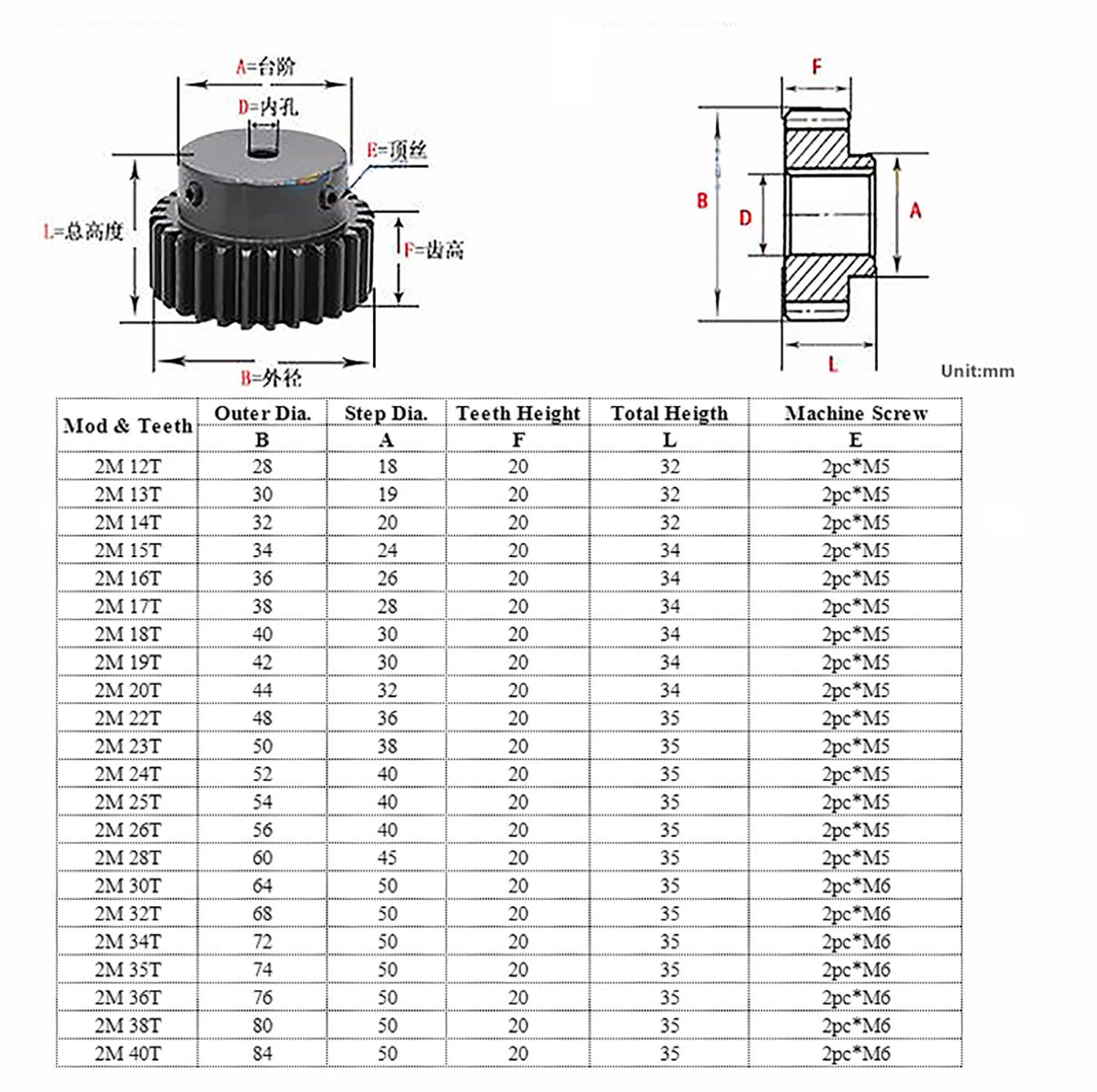
Each gear in this series is machined from 45# medium-carbon steel, offering a balance of machinability and surface hardness suitable for moderate-to-high load applications. The module is 2M (metric), with tooth counts ranging from 12T to 40T, giving pitch diameters from approximately 24 mm (0.94 in) to 80 mm (3.15 in). Bore diameters span 6 mm to 25 mm (0.24–0.98 in), including keyway-bored options (5×2.3 mm and 6×2.8 mm keyways), while the integrated step diameter ranges from 18 mm to 50 mm (0.71–1.97 in) depending on the selected variant.
Typical use cases include stepper and servo motor output shafts in desktop CNC routers, gear-reduction stages in robotic arm joints, and speed-matching transmission assemblies in automated conveyor or indexing systems — anywhere a compact, stepped-hub spur gear with a defined module is required.
⚙️
Compatibility: Designed for Module 2 (2M) gear systems. Meshes with any standard 2M rack, pinion, or mating spur gear. Verify bore diameter and step diameter against your shaft and housing dimensions before ordering.
✅ Key Features of These 2 Mod Spur Gears
🔩
45# Medium-Carbon Steel Construction
Machined from 45# steel for reliable tensile strength and wear resistance under sustained rotational loads in CNC, robotics, and automation drivetrains.
📐
Wide Tooth-Count Range: 12T to 40T
Twenty-two tooth-count options in a single product family let you dial in the exact gear ratio your transmission stage requires without sourcing from multiple suppliers.
🎯
Integrated Step Hub for Positive Axial Location
The machined step shoulder seats against a housing bore or bearing face, eliminating axial float and reducing the need for additional retaining hardware.
🔧
Multiple Bore Options Including Keyway Bores
Round bores from 6–25 mm and keyway-bored variants (5×2.3 mm, 6×2.8 mm) accommodate both smooth shafts with set-screw retention and keyed shafts for positive torque transfer.
📏
Standard Module 2 Tooth Profile
Full-depth involute tooth form machined to Module 2 standard ensures correct mesh with any 2M-compatible rack, pinion, or mating gear in your existing system.
🏭
Broad Variant Matrix for Design Flexibility
Over 100 bore-and-tooth combinations available in one listing, supporting prototyping through small-batch production without custom tooling lead times.
📐 Technical Specifications — 2 Mod Spur Gear
| Module |
2M (Metric Module 2) |
| Tooth Count Range |
12T – 40T (22 options) |
| Pitch Diameter Range |
24 mm – 80 mm (0.94 in – 3.15 in) |
| Bore Diameter Options |
6, 8, 10, 12, 14, 15, 16, 17, 18, 19, 20, 24, 25 mm; Keyway: 14 mm (5×2.3 mm), 15 mm (5×2.3 mm), 19 mm (6×2.8 mm), 20 mm (6×2.8 mm) |
| Step Diameter Range |
18 mm – 50 mm (0.71 in – 1.97 in) |
| Material |
45# Medium-Carbon Steel |
| Tooth Profile |
Standard Involute, Full Depth |
| Pressure Angle |
See variant options |
| Face Width |
See variant options |
| Surface Finish |
See variant options |
| Keyway Spec (where applicable) |
5×2.3 mm or 6×2.8 mm |
| Quantity per Order |
1 piece |
❓ Frequently Asked Questions
How do I choose the right tooth count for my application?
Select tooth counts based on your required gear ratio. Divide the driven gear teeth by the driving gear teeth to get the ratio. For example, a 12T pinion meshing with a 36T gear gives a 3:1 reduction. Smaller tooth counts (12T–16T) suit high-speed, lower-torque pinion positions; larger counts (30T–40T) are better for the driven gear in reduction stages.
What bore diameter should I order for my motor shaft?
Measure your motor or gearbox output shaft diameter with calipers. Select the matching bore size — for example, a 10 mm shaft requires the 10 mm bore variant. If your shaft has a keyway, choose the corresponding keyway-bore option (e.g., Keyway Bore: 10 mm is not listed; check available keyway variants for 14 mm, 15 mm, 19 mm, and 20 mm). For smooth shafts, a set screw or locking collar is typically used to secure the gear axially.
What is the purpose of the step (hub shoulder) on these gears?
The machined step acts as a positive axial stop. When the gear is inserted into a housing bore or seated against a bearing face, the step shoulder prevents the gear from migrating along the shaft under thrust loads. This eliminates the need for snap rings or additional spacers in many designs, simplifying assembly and reducing part count.
How strong are these gears — can they handle continuous duty loads?
45# steel has a typical tensile strength of approximately 600–700 MPa in the normalized condition. These gears are suitable for moderate continuous-duty applications such as CNC axis drives, robotic joints, and light industrial automation. For very high shock loads or continuous heavy-duty industrial use, consider heat-treated or alloy-steel alternatives. Actual load capacity depends on tooth count, face width, speed, and lubrication — consult a gear-load calculation for critical applications.
Are these gears corrosion-resistant? Can I use them in humid or outdoor environments?
45# carbon steel is not inherently corrosion-resistant. For humid, wet, or outdoor environments, apply a suitable lubricant or protective coating (grease, oil, or spray lacquer) and inspect periodically. For applications requiring inherent corrosion resistance, stainless steel or plastic gears would be more appropriate. Indoor, enclosed, or lightly lubricated environments are where these gears perform best.
Will this gear mesh correctly with my existing Module 2 rack or pinion?
Yes — any gear or rack manufactured to the Module 2 (2M) standard with a matching pressure angle will mesh correctly with these gears. Confirm that your existing components are also Module 2 (not Diametral Pitch or a different module) before ordering. Module 2 is a metric standard; do not mix with imperial DP gears.
Do I need to lubricate these gears, and how?
Lubrication is strongly recommended for all steel spur gear applications to reduce wear and noise. For enclosed gearboxes, use an appropriate gear oil (ISO VG 68–220 depending on speed and load). For open drives, a lithium-based grease applied to the tooth flanks works well. Re-lubricate periodically based on operating hours and environmental conditions.
🛒 Select your Mod & Teeth count, Bore Diameter, and Step Diameter above, then add to cart.