The chain is fine...but I ordered the wrong size. Nine links of the chain I ordered equals six of the size I wanted. My error...
How can I straighten out the springs? I can't use them coil uo as is.
Your payment information is processed securely. We do not store credit card details nor have access to your credit card information.
Get fitment advice & recommendations
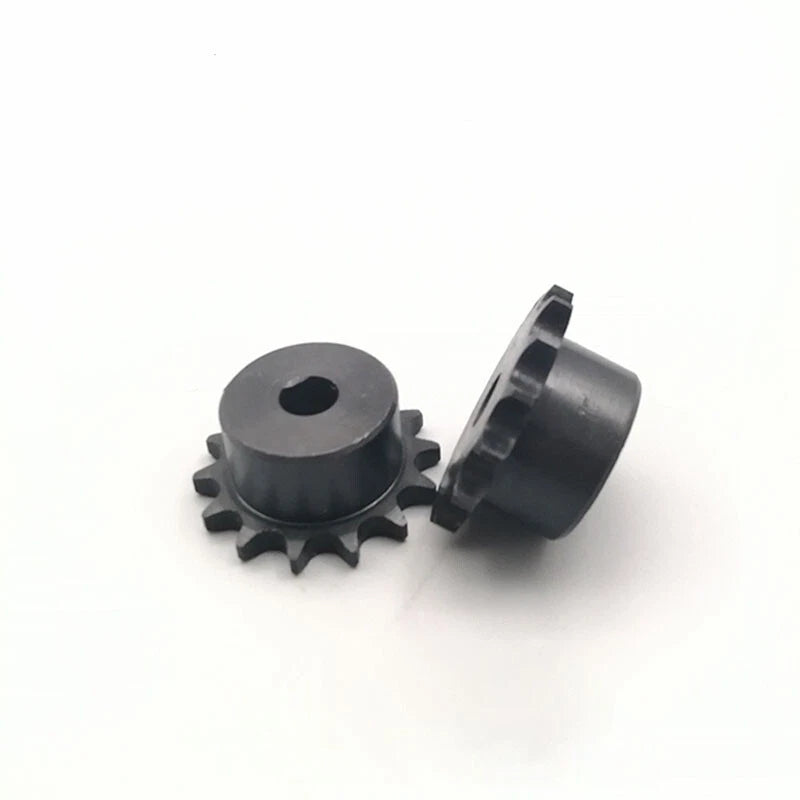
When a worn or undersized sprocket causes chain skip, vibration, or premature chain wear, the entire drive system suffers — whether you're running a go-kart, mini-bike, conveyor, or small agricultural machine. These 04C (#45 pitch) roller chain sprockets are engineered for makers, repair technicians, and machine builders who need a direct-fit replacement or a dependable component for a new build.
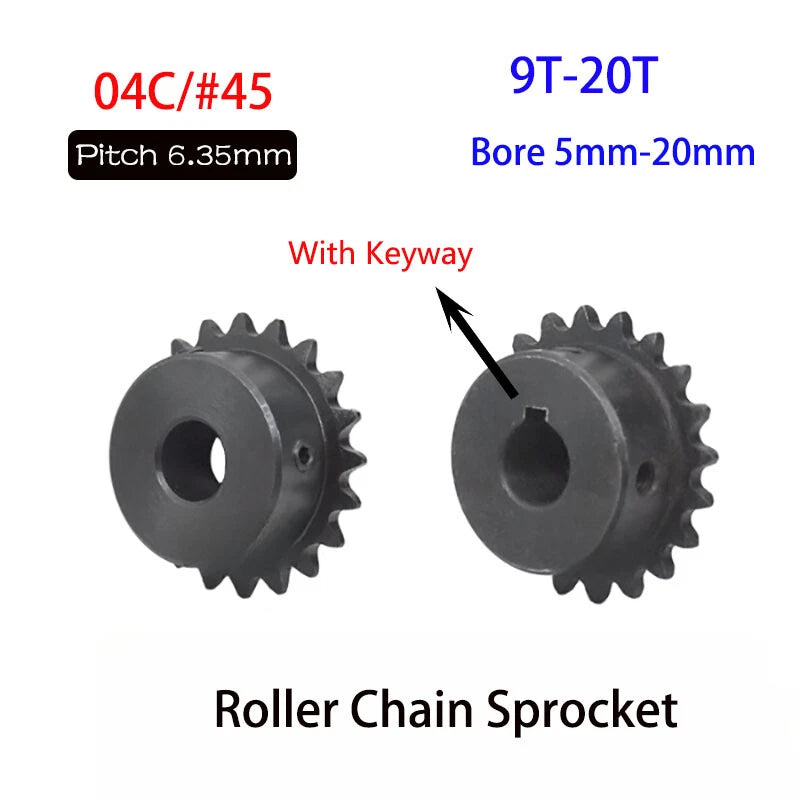
Each sprocket is machined from carbon steel with a natural or zinc-plated finish and is available in tooth counts from 9T to 20T. Bore options range from 5 mm (approx. 0.197 in) up to 20 mm (approx. 0.787 in), with select sizes offering a pre-cut keyway (typically 3x1.4 mm, 4x1.8 mm, or 5x2.3 mm) for positive shaft engagement without set-screw slippage.
Typical use cases include go-kart and mini-bike final-drive replacement, small conveyor and feeder drive systems, DIY electric scooter or bicycle mid-drive builds, and light-duty agricultural or garden-equipment power transmission — all applications where a compact 04C chain sprocket with precise bore sizing is critical to long service life.
Available in 9T through 20T, covering a broad range of drive ratios for speed reduction or torque multiplication in compact drive systems.
Bore options from 5 mm to 20 mm (including 6, 6.35, 7, 8, 10, 12, 14, 15, 16, 17, 18, 19, and 20 mm) allow direct shaft fit without additional machining on most standard motor and gearbox shafts.
Select tooth counts include a pre-machined keyway (3x1.4 mm, 4x1.8 mm, 5x2.3 mm, or 6x2.8 mm depending on bore size) for positive, slip-free shaft locking under load.
Tooth profile is ground to ANSI/ISO standards for 12.7 mm pitch #45 roller chain, ensuring smooth engagement and even load distribution across all teeth.
Machined from carbon steel for a balance of hardness and toughness; surface finish resists light corrosion in typical indoor and sheltered outdoor environments.
Each listing is for one sprocket. Order the exact tooth count and bore combination you need — no bundled extras you do not require.
| Chain Standard | #45 / 04C (ANSI/ISO) |
|---|---|
| Chain Pitch | 12.7 mm (0.500 in) |
| Tooth Count (Types) | 9T, 10T, 11T, 12T, 13T, 14T, 15T, 16T, 17T, 18T, 19T, 20T |
| Bore Range | 5 mm to 20 mm (see variant options) |
| Keyway Options | Plain bore or keyway (3x1.4 mm / 4x1.8 mm / 5x2.3 mm / 6x2.8 mm — see variant options) |
| Material | Carbon steel |
| Surface Finish | See variant options |
| Hub Style | See variant options |
| Packing Quantity | 1 pc per order |
| Weight | See variant options |
The tooth count determines your drive ratio. Divide the driven sprocket teeth by the drive sprocket teeth to get the reduction ratio. For example, a 9T drive sprocket paired with an 18T driven sprocket gives a 2:1 reduction — halving speed and doubling torque. Choose a smaller tooth count on the drive side for more torque, or a larger count for higher output speed.
Measure your shaft diameter with a caliper before ordering. The bore must match your shaft diameter exactly — a bore that is too large will cause runout and vibration, while one that is too small cannot be installed. Common motor shaft sizes include 5 mm, 6 mm, 6.35 mm (1/4 in), 8 mm, 10 mm, and 12 mm. If your shaft has a keyway, select the matching keyway bore variant.
A plain bore sprocket is typically secured with a set screw bearing against the shaft. This works well for light-duty or low-shock loads. A keyway version uses a key inserted between the shaft and sprocket to transmit torque mechanically, which is more reliable under high torque, reversing loads, or frequent start-stop cycles. If your shaft already has a keyway cut, use the matching keyway sprocket variant.
No. This sprocket is designed specifically for #45 / 04C roller chain with a 12.7 mm pitch. #40 chain has the same pitch but a narrower roller width, and #50 chain has a larger pitch (15.875 mm). Using a mismatched chain will cause poor engagement, accelerated wear, and potential chain derailment. Always match the sprocket to the chain standard.
Measure the distance between the centers of two adjacent pins — this is the pitch. For #45 / 04C chain, the pitch is 12.7 mm (0.500 in). You can also look for a stamped number on the chain link plate: "04C" or "45" confirms compatibility. If you are unsure, contact us with your chain measurements and we can confirm the correct sprocket.
Service life depends on load, lubrication, alignment, and operating environment. Under normal conditions with proper chain lubrication and correct tension, a carbon steel sprocket in a light-to-medium duty application can last thousands of operating hours. Always replace the chain and sprocket together when either shows significant wear — running a new sprocket on a worn chain accelerates wear on both components.
Carbon steel sprockets offer moderate corrosion resistance suitable for sheltered or intermittently wet environments when kept lubricated. For continuously wet, marine, or chemically aggressive environments, consider stainless steel alternatives or apply a protective coating. Regular lubrication with a chain-compatible oil or grease significantly extends service life in outdoor conditions.