The chain is fine...but I ordered the wrong size. Nine links of the chain I ordered equals six of the size I wanted. My error...
How can I straighten out the springs? I can't use them coil uo as is.
Your payment information is processed securely. We do not store credit card details nor have access to your credit card information.
Get fitment advice & recommendations
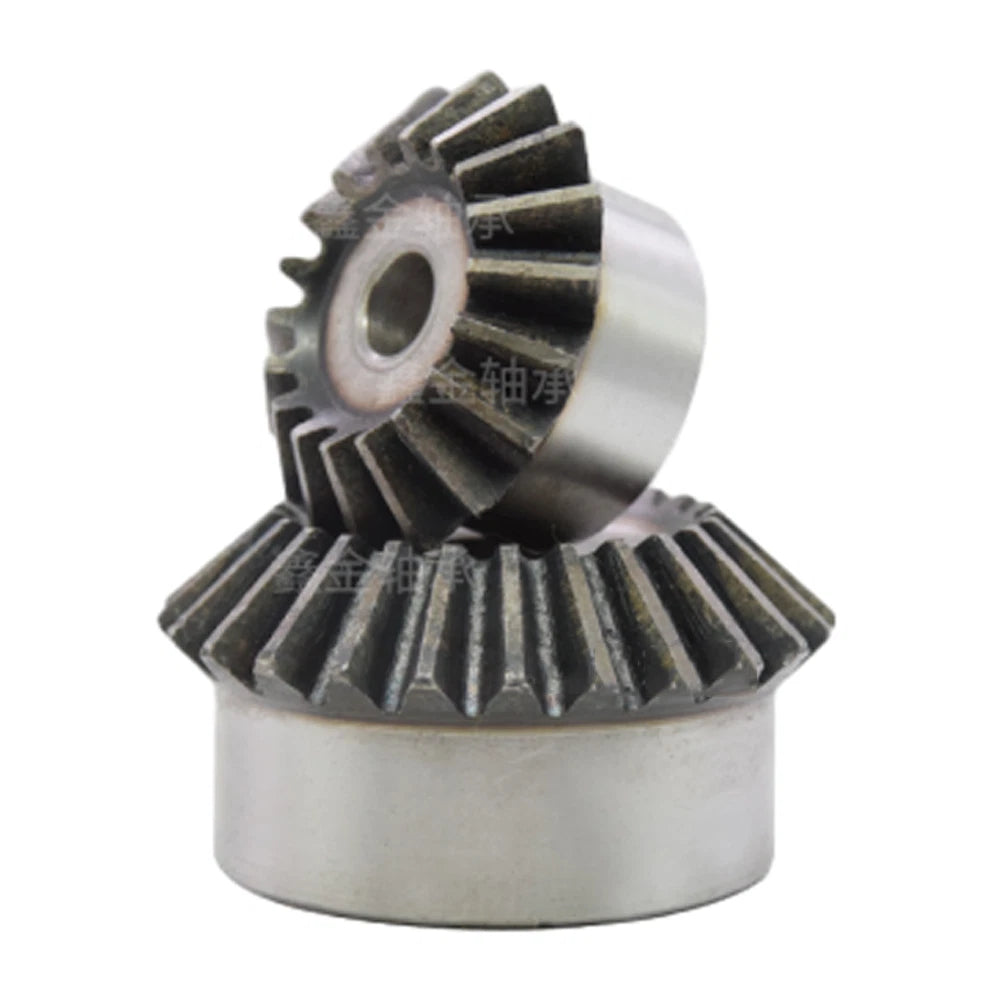
When your drivetrain needs to change direction without losing torque, a poorly matched bevel gear becomes the weakest link in the system. Makers, robotics engineers, and mechanical hobbyists who need reliable 90° power transmission demand gears with tight tooth tolerances and consistent hardness — and that is exactly what these 45# steel bevel gears are built to deliver.
Each gear is machined from 45# medium-carbon steel, a material known for its balanced combination of tensile strength and machinability. The range covers modulus 1, 1.5, 2, 2.5, and 3, with tooth counts from 15 to 40 teeth. Outer diameters span approximately 16.2 mm (0.64 in) for the smallest 1 Mod / 15T variant up to 123.7 mm (4.87 in) for the largest 3 Mod / 40T variant, giving you a wide selection for compact or heavy-duty builds.
These bevel gears are well suited for DIY CNC axis drives requiring angular redirection, robotics joint assemblies where compact 90° gearsets are needed, and custom mechanical projects such as hand-cranked winches, differential drives, or educational gear-train demonstrations.
Machined from 45# steel for a reliable balance of surface hardness and core toughness, reducing wear under sustained angular loads.
Five modulus options in a single listing let you match the gear to your torque and speed requirements without sourcing from multiple suppliers.
Broad tooth-count range supports gear ratios from 1:1 to approximately 1:2.67, covering both speed-reduction and torque-multiplication configurations.
Each variant lists its exact outer diameter (16.2 mm – 123.7 mm / 0.64 in – 4.87 in), so you can verify clearance in your housing before purchasing.
Conical tooth geometry enables smooth torque transfer between intersecting shafts, ideal for direction-change mechanisms in compact mechanical assemblies.
Consistent tooth profiles and standard modulus sizing make these gears straightforward to integrate into custom gearboxes, robot joints, and educational drivetrain models.
| Material | 45# Medium-Carbon Steel |
|---|---|
| Gear Type | Bevel Gear (conical tooth profile) |
| Available Modulus | 1 / 1.5 / 2 / 2.5 / 3 |
| Tooth Count Range | 15 – 40 Teeth (see variant options) |
| Outer Diameter Range | 16.2 mm – 123.7 mm (0.64 in – 4.87 in) |
| Pressure Angle | See variant options |
| Shaft Bore Diameter | See variant options |
| Keyway | See variant options |
| Surface Finish | See variant options |
| Pack Quantity | 1 piece per order (multi-pack options available) |
| Application | 90° angular drivetrain, CNC axis, robotics joints, DIY gearboxes |
Modulus determines the size of each tooth relative to the gear diameter. A higher modulus (e.g., 3) means larger, stronger teeth suited for higher-torque, lower-speed applications. A lower modulus (e.g., 1) produces finer teeth for compact, higher-speed mechanisms. Match the modulus to your load requirements and the space available in your assembly.
Yes. A bevel gear drive requires two mating gears of the same modulus. The tooth count ratio between the two gears determines the speed reduction or increase. For example, pairing a 15-tooth gear with a 30-tooth gear of the same modulus gives a 2:1 reduction ratio. Each listing sells individual gears, so order both the driver and driven gear.
45# steel (equivalent to AISI 1045) has a typical tensile strength of approximately 600–800 MPa in the normalized condition. It offers a good balance of hardness and toughness for moderate-load mechanical drives. For very high-cycle or heavy-shock applications, consider whether additional heat treatment or a higher-alloy steel would be more appropriate for your specific load case.
45# carbon steel is not inherently corrosion-resistant. For outdoor, humid, or washdown environments, we recommend applying a suitable lubricant or protective coating, or considering stainless steel alternatives. Regular lubrication will also extend service life and reduce surface oxidation in moderate-humidity conditions.
Each variant in the dropdown lists its exact outer diameter in millimeters. Measure the available bore diameter in your housing or chassis, then select the variant whose outer diameter fits within your clearance envelope. Allow a small assembly clearance (typically 0.5–1 mm) around the gear body for smooth rotation and thermal expansion.
Yes. These gears are commonly used in DIY CNC builds to redirect axis motion by 90°, for example driving a Z-axis leadscrew from a horizontally mounted motor. Select the modulus and tooth count that matches your torque and backlash requirements. For low-backlash CNC applications, ensure the gear mesh is properly adjusted and the shafts are precisely aligned.
Shaft bore diameter varies by modulus and tooth count. Please contact us to confirm the bore diameter for your specific variant before ordering, or refer to the product images for dimensional drawings where available.