Compression Die Mould Spring O.D 8/10/12mm Light/Medium/Heavy Duty Load Springs

No reviews

Price:
Sale price$5.11 USD
Stock:
In stock (500 units), ready to be shipped

Payment & Security

Ach Direct Debit Amazon American Express Apple Pay Bancontact BLIK Diners Club Discover EPS Google Pay iDEAL Wero JCB Maestro Mastercard Multibanco MobilePay PayPal Przelewy24 Shop Pay Twint Union Pay USDC Visa

Your payment information is processed securely. We do not store credit card details nor have access to your credit card information.

Limited Offer — Spend More, Save More
Spend $55+
Save $5
Spend $100+
Save $10
Spend $200+
Save $25
HomeDIYer DIY Expert Support

DIY Expert Support

Get fitment advice & recommendations

Mon–Fri  8:30 AM – 8:00 PM
24-Hour Fast Ship
Arrives in 3–14 Days
Worldwide Shipping
30-Day Returns
1 tree planted with every purchase

Description

Compression Die Mould Springs — Precision Load Control for Tooling & Stamping

When a worn or mismatched spring causes inconsistent press force, tool damage, or premature die failure, the fix starts with selecting the right compression die mould spring. Engineers, toolmakers, and maintenance technicians who demand repeatable stroke performance rely on color-coded duty-rated springs to eliminate guesswork and keep production running.

These compression die mould springs are manufactured from high-carbon chromium alloy steel wire, wound to close tolerances for consistent load characteristics. Outer diameters span 8 mm (0.31 in), 10 mm (0.39 in), and 12 mm (0.47 in), with matching inner diameters of 4 mm, 5 mm, and 6 mm respectively. Available lengths range from 15 mm (0.59 in) to 150 mm (5.91 in) across the full duty range.

Typical applications include injection mould stripper plates, progressive stamping dies, punch-and-die assemblies, and fixture clamping systems where a compression die mould spring must deliver controlled, repeatable return force cycle after cycle.

⚙️ Compatibility: Designed to ISO 10243 / JIS B 5012 colour-coding standards. Verify bore diameter, free length, and duty rating against your existing die set before ordering.

    ✅ Key Features of These Compression Die Mould Springs

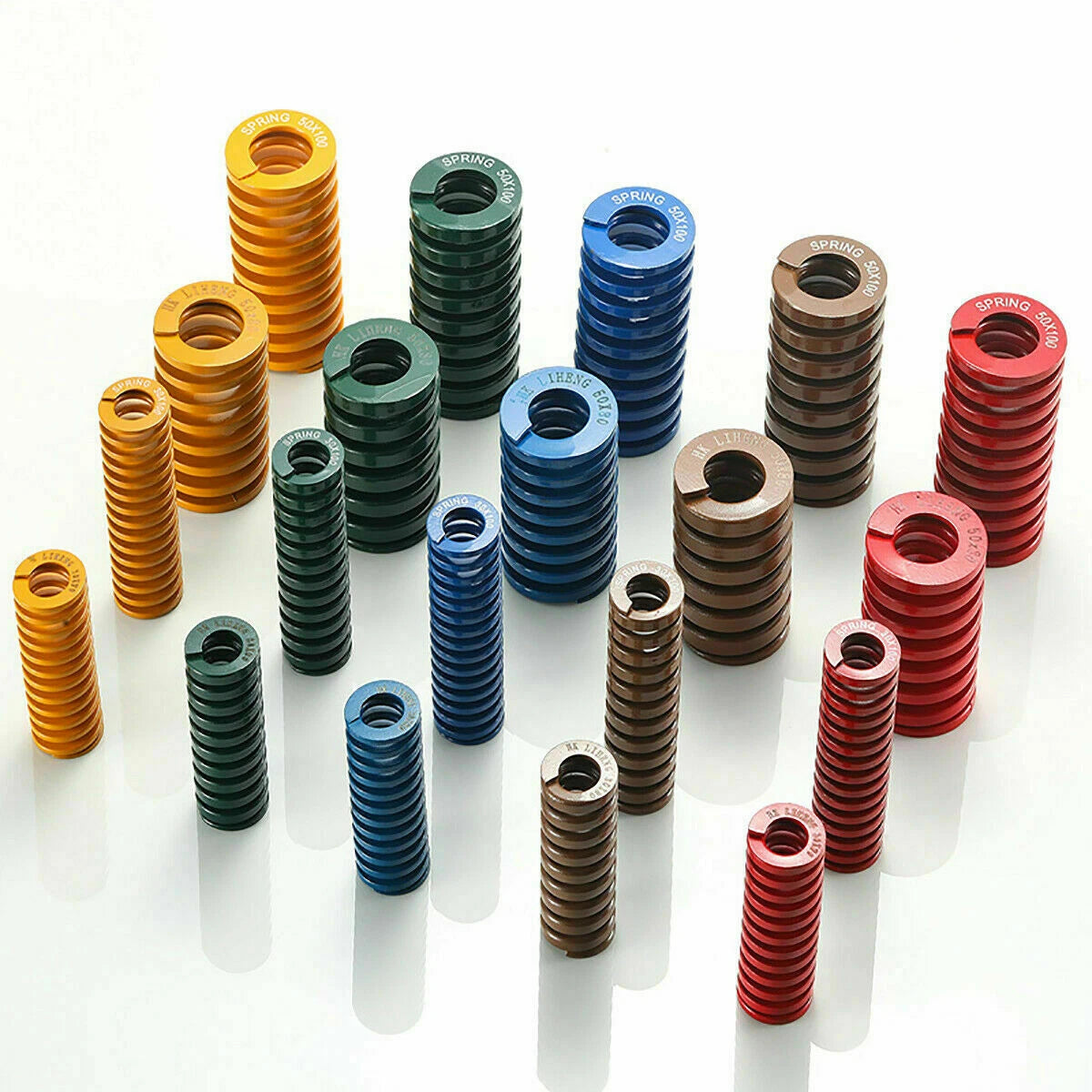
  • 🎨 5-Level Colour-Coded Duty Rating — Yellow (TF, Lightest), Blue (TL, Light), Red (TM, Medium), Green (TH, Heavy), Brown (TB, Super Heavy) for instant visual identification at the press.
  • 📐 Three OD / ID Combinations — 8×4 mm, 10×5 mm, and 12×6 mm outer-to-inner diameter pairings cover the most common die guide pin sizes in light-to-medium tooling.
  • 📏 Wide Length Range — 15 mm through 150 mm free lengths (select grades) let you match stroke depth without shimming or stacking springs.
  • 🔩 Alloy Steel Construction — Chrome-silicon or chrome-vanadium alloy wire provides fatigue resistance and consistent spring rate across the rated deflection range.
  • 🔄 Consistent Load Characteristics — Close-wound coils and controlled pitch deliver repeatable force curves, reducing variation between tool setups and maintenance cycles.
  • 🛡️ Corrosion-Resistant Finish — Surface treatment helps resist rust in coolant-exposed tooling environments, extending service intervals between spring replacements.

📐 Technical Specifications — Compression Die Mould Springs

Spring Type Rectangular wire compression die mould spring
Outer Diameter (OD) 8 mm / 10 mm / 12 mm (see variant options)
Inner Diameter (ID) 4 mm / 5 mm / 6 mm (matched to OD)
Free Length 15 mm – 150 mm (see variant options)
Duty Rating / Colour TF Yellow / TL Blue / TM Red / TH Green / TB Brown
Material High-carbon chromium alloy steel wire
Surface Treatment See variant options
Spring Rate See variant options
Max Deflection See variant options
Standard Reference ISO 10243 / JIS B 5012 (colour-code convention)
Sold As 1 piece per unit

❓ Frequently Asked Questions

How do I choose the right duty rating (colour) for my application?

Match the duty rating to the load your die requires at the working deflection. Yellow (TF) handles the lightest loads; Brown (TB) handles super-heavy loads. Calculate the required spring force at your stroke depth, then select the colour whose load curve covers that force at the corresponding deflection percentage. When in doubt, choose the next heavier rating to extend spring life.

What outer diameter and inner diameter should I select?

The inner diameter (ID) must clear your guide pin with a small running clearance — typically 0.2–0.5 mm. The outer diameter (OD) must fit inside the spring pocket without binding. Available combinations are 8×4 mm, 10×5 mm, and 12×6 mm. Measure your existing spring or die pocket before ordering.

How do I select the correct free length?

Free length should be long enough so the spring is still under slight preload at the open (top dead centre) position, and short enough that it does not reach solid height at full stroke. A common rule is: free length ≥ working length + stroke + 10–15% safety margin. Available lengths run from 15 mm to 150 mm depending on OD and duty rating.

Are these springs corrosion-resistant enough for coolant environments?

The surface treatment provides a degree of rust resistance suitable for typical toolroom and press-shop conditions with water-based coolants. For aggressive cutting fluids or high-humidity environments, inspect springs regularly and replace at the first sign of pitting or surface corrosion, as corrosion can initiate fatigue cracks and cause premature failure.

Can I stack two springs to increase load capacity?

Stacking springs in series reduces the combined spring rate (softer); stacking in parallel (side by side on the same pin) increases load capacity. If you need more force than a single TB-rated spring provides, consider using a larger OD spring or multiple springs in parallel. Never stack springs end-to-end to increase free length without verifying that the combined solid height still allows adequate working stroke.

How often should I replace compression die mould springs?

Replacement interval depends on deflection percentage and cycle count. Springs operated at 30% deflection typically last significantly longer than those run at 50%+. A common industry guideline is to inspect springs every 500,000 cycles and replace any spring showing set (permanent length loss), cracking, or load loss exceeding 10% of the rated value. Always replace springs in matched sets to maintain balanced die force.

Do these springs conform to ISO 10243 or JIS B 5012?

The colour-coding convention follows ISO 10243 / JIS B 5012 duty-rating designations (TF, TL, TM, TH, TB). This means the colour identifies the load class, making them interchangeable with other ISO/JIS-coded springs of the same OD, ID, and free length. Verify load curves against your die design data before substituting springs from different manufacturers.

🛒 Select your Colour (duty rating), Outer Dia x Inner Dia, and Length above, then add to cart.

You may also like

Recently viewed