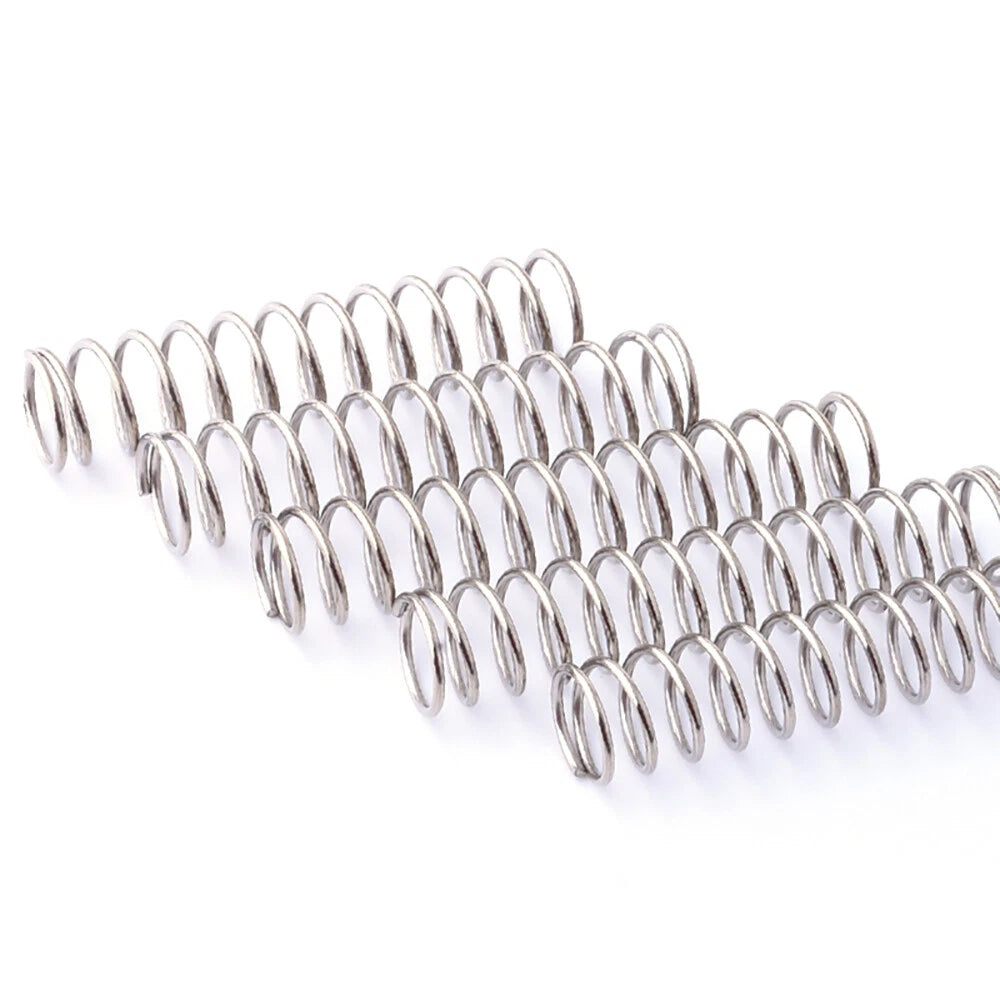
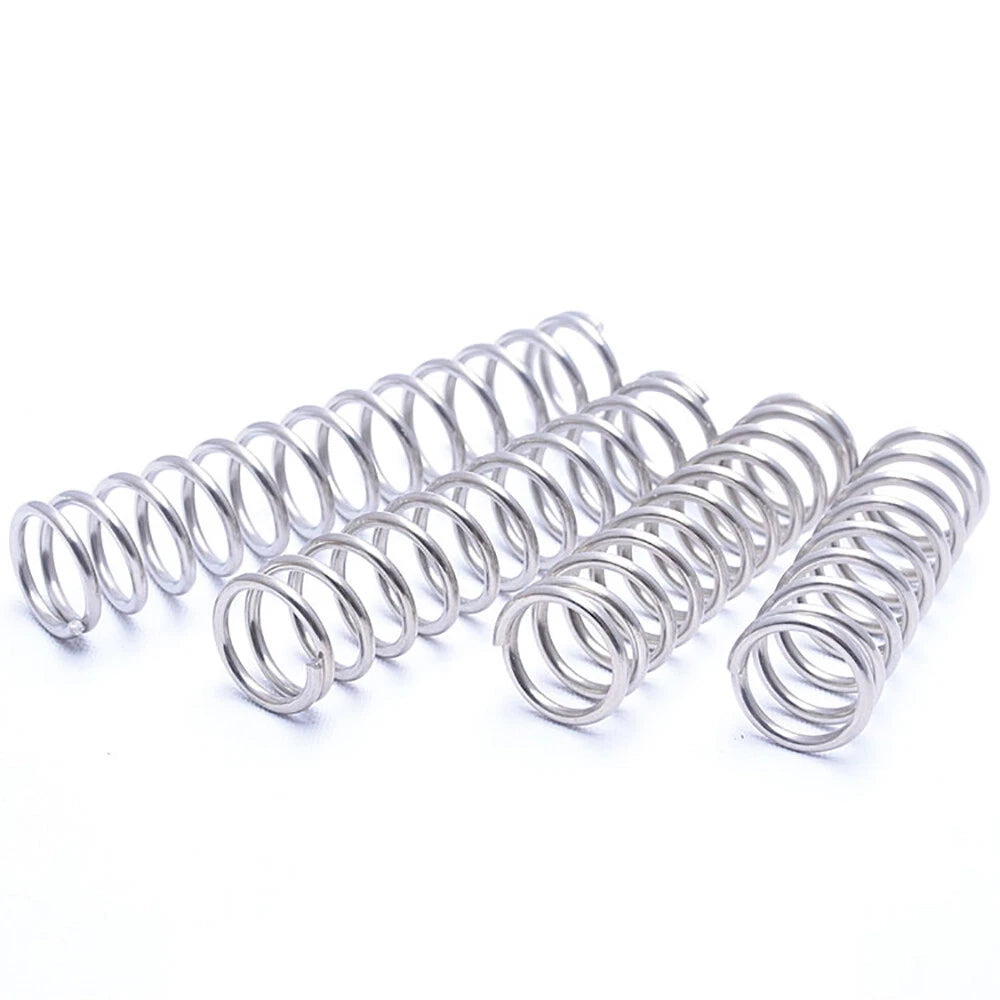
Compression Springs — Precision-Wound for Reliable Elastic Return Force
Engineers and makers working on tight-tolerance assemblies often struggle to find compression springs that match both the wire gauge and free length they need without ordering custom parts. These compression springs are designed for DIY builders, robotics hobbyists, and small-batch manufacturers who need a reliable, dimensionally consistent spring in a range of sizes without minimum-order constraints.
Each spring is wound from round steel wire with diameters ranging from 1.4 mm to 2.0 mm (approximately 0.055 in to 0.079 in). Outside diameters span 10 mm to 25 mm (approx. 0.39 in to 0.98 in), and free lengths run from 120 mm to 200 mm (approx. 4.72 in to 7.87 in). The open-coil helical construction provides consistent linear spring rates across the compression range.
Typical use cases include compression springs for 3D printer Z-axis bed leveling, return springs in pneumatic valve assemblies, and load-bearing springs in custom robotics end-effectors — all applications where a predictable spring rate and repeatable free length are critical to system performance.
⚙️ Compatibility: Suitable for spring seats, guide rods, and bores sized to match the selected outside diameter. Verify bore clearance and seat depth against your chosen variant before assembly.
✅ Key Features of These Compression Springs
🔩
Wide Size Matrix
Five wire diameters (1.4–2.0 mm) combined with ten outside diameters (10–25 mm) and four free lengths (120–200 mm) give you over 140 size combinations in a single listing.
📐
Consistent Free Length
Each spring is wound to a defined free length — 120 mm, 150 mm, 180 mm, or 200 mm — so you can design your assembly around a known unloaded dimension without measuring individual pieces.
🔄
Open-Coil Helical Design
The open-coil geometry allows progressive compression without coil binding until solid height, making these springs suitable for applications requiring a full working stroke.
⚖️
Scalable Spring Rate by Wire Diameter
Heavier wire diameters (1.8–2.0 mm) deliver higher spring rates for load-bearing applications, while lighter gauges (1.4–1.5 mm) suit lighter-duty return and positioning tasks.
🏭
Small-Batch Friendly Quantities
Sold individually, making them accessible for prototyping, repair, and small-production runs without committing to bulk packaging.
🛠️
Broad Application Compatibility
Fits standard spring guide rods and counterbored seats used in 3D printers, pneumatic actuators, jigs, fixtures, and general mechanical assemblies.
📐 Technical Specifications — Compression Springs
| Wire Diameter Range |
1.4 mm – 2.0 mm (0.055 in – 0.079 in) |
| Outside Diameter Range |
10 mm – 25 mm (0.39 in – 0.98 in) |
| Free Length Range |
120 mm – 200 mm (4.72 in – 7.87 in) |
| Coil Type |
Open-coil helical compression |
| End Type |
See variant options |
| Material |
Steel wire (surface finish: See variant options) |
| Spring Rate |
See variant options |
| Solid Height |
See variant options |
| Number of Active Coils |
See variant options |
| Operating Temperature |
Contact us to confirm |
| Unit Sold |
1 piece per order |
❓ Frequently Asked Questions
How do I choose the right wire diameter for my application?
Wire diameter directly affects spring rate and load capacity. Lighter wire (1.4–1.5 mm) suits low-load return and positioning applications such as button mechanisms or light-duty latches. Heavier wire (1.8–2.0 mm) is better for load-bearing tasks like bed-leveling springs on 3D printers or actuator return springs. If you know your required spring force, calculate the spring rate needed and match it to the wire diameter and outside diameter combination.
What outside diameter should I select to fit my guide rod or bore?
For guide rod installations, the spring's inside diameter (ID = outside diameter minus twice the wire diameter) should be slightly larger than the rod diameter to allow free sliding. For bore installations, the outside diameter should be slightly smaller than the bore to prevent binding. Always add 0.5–1 mm clearance on each side as a starting point.
Are these springs corrosion-resistant?
These springs are made from steel wire. The surface finish and corrosion resistance level depend on the specific variant — please contact us to confirm coating or plating details for your chosen size. For environments with moisture or mild chemicals, consider applying a light machine oil or selecting a coated variant if available.
Can I use these springs in a compressed state for extended periods?
Holding a compression spring at or near solid height for extended periods can cause stress relaxation (set), reducing the free length over time. For static preload applications, it is advisable to design the assembly so the spring operates at no more than 70–80% of its maximum deflection to preserve long-term spring rate consistency.
What is the difference between the 120 mm and 200 mm length variants?
The free length determines the unloaded height of the spring in your assembly. A 200 mm spring provides more working stroke before reaching solid height compared to a 120 mm spring of the same wire and outside diameter. Choose the longer variant when you need greater travel range; choose the shorter variant when space is constrained.
Are these suitable for 3D printer bed leveling?
Yes. Compression springs in the 1.4–1.6 mm wire diameter range with outside diameters of 10–15 mm are commonly used for 3D printer heated bed leveling. Select a free length that gives you adequate adjustment range above and below your nominal bed height. The 120 mm and 150 mm variants are typically used for standard bed-leveling setups.
How do I calculate the spring rate for a specific variant?
Spring rate (k) can be estimated using the formula: k = (G × d⁴) / (8 × D³ × n), where G is the shear modulus of the wire material (~79,000 MPa for steel), d is the wire diameter, D is the mean coil diameter (OD minus wire diameter), and n is the number of active coils. For precise values, please contact us with your selected variant details.
🛒 Select your Wire Diameter, Outside Diameter, and Length above, then add to cart.