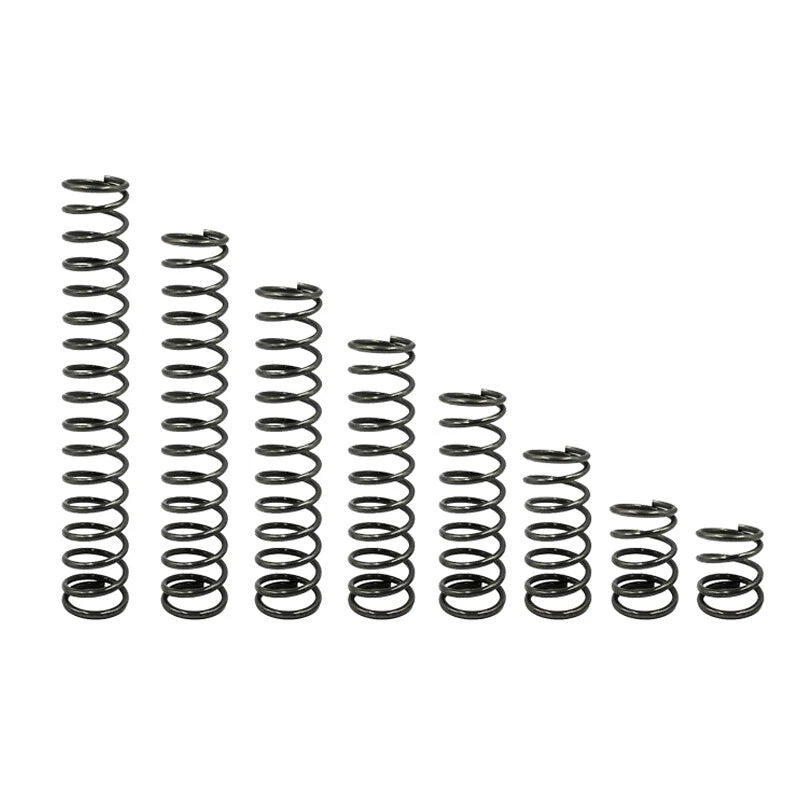
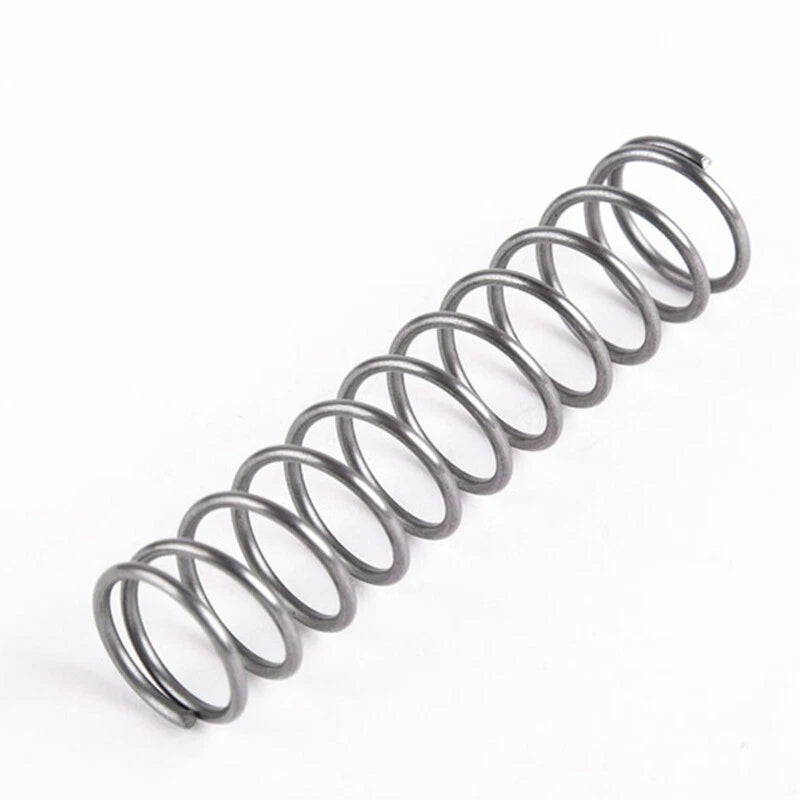
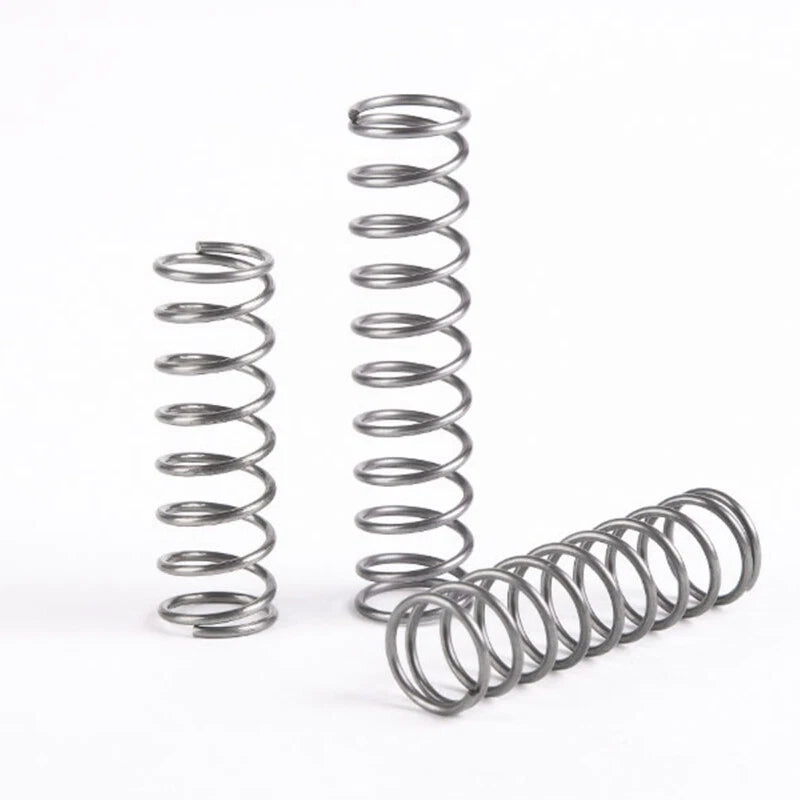
Compression Springs Material Spring Steel Wire Dia 0.6mm Pressure Spring for DIY

No reviews

Price:
Sale price$3.16 USD
Stock:
In stock (500 units), ready to be shipped

Payment & Security

Ach Direct Debit Amazon American Express Apple Pay Bancontact BLIK Diners Club Discover EPS Google Pay iDEAL Wero JCB Maestro Mastercard Multibanco MobilePay PayPal Przelewy24 Shop Pay Twint Union Pay USDC Visa

Your payment information is processed securely. We do not store credit card details nor have access to your credit card information.

Limited Offer — Spend More, Save More
Spend $55+
Save $5
Spend $100+
Save $10
Spend $200+
Save $25
HomeDIYer DIY Expert Support

DIY Expert Support

Get fitment advice & recommendations

Mon–Fri  8:30 AM – 8:00 PM
24-Hour Fast Ship
Arrives in 3–14 Days
Worldwide Shipping
30-Day Returns
1 tree planted with every purchase

Description

Compression Springs in Spring Steel — Reliable Elastic Force for Every DIY Task

When a worn-out spring causes a drawer to stick, a valve to leak, or a mechanism to lose its snap, finding the right replacement fast matters. These compression springs in spring steel are designed for makers, repair technicians, and engineers who need a dependable elastic component in a compact, precisely wound form. Whether you are restoring a household appliance or prototyping a mechanical assembly, having the correct wire diameter and free length on hand eliminates guesswork.

Each spring is wound from spring steel wire with a diameter of 0.6 mm (0.024 in). Outer diameters span 3–15 mm (0.12–0.59 in) and free lengths range from 5–100 mm (0.20–3.94 in), covering a wide spectrum of applications. Springs are available in packs of 5 or 10 pieces, letting you stock exactly what your project demands.

Typical use cases include small appliance repair (pen mechanisms, clicker buttons, battery contacts), light-load valve and actuator assemblies requiring a consistent return force, and electronics or sensor housings where a miniature compression spring for DIY projects keeps components seated under vibration.

🔧 Compatibility: Suitable for shafts or bores sized to match the selected outer diameter. Verify your housing inner diameter and shaft outer diameter against the chosen OD before ordering. Spring steel variants are not recommended for highly corrosive or salt-spray environments without additional protective coating.

✅ Key Features of These Compression Springs

🔩 Spring Steel Construction

Wound from spring steel wire for consistent elastic modulus and reliable return force across repeated compression cycles.

📐 0.6 mm Wire Diameter

Fine 0.6 mm (0.024 in) wire diameter enables compact coil geometry suited to tight housings and miniature mechanisms.

📏 Wide Size Range

OD from 3–15 mm and free length from 5–100 mm — select the exact combination for your application without custom fabrication.

🔄 Consistent Coil Pitch

Uniform coil spacing ensures even load distribution along the spring axis, reducing lateral buckling under compression.

📦 5 or 10 Piece Packs

Choose the pack size that fits your project — single repairs or batch builds — without over-ordering.

⚙️ Versatile DIY Applications

Ideal for pen mechanisms, battery contacts, valve returns, sensor housings, and light-load actuator assemblies across electronics and mechanical DIY projects.

📐 Technical Specifications — Compression Spring

Material Spring Steel
Wire Diameter 0.6 mm (0.024 in)
Outer Diameter (OD) 3 mm – 15 mm (0.12 in – 0.59 in)
Free Length 5 mm – 100 mm (0.20 in – 3.94 in)
Spring Type Compression (closed / ground ends typical)
End Style See variant options
Surface Finish See variant options
Load Capacity See variant options
Spring Rate See variant options
Pack Quantity 5 Pcs or 10 Pcs (select above)

❓ Frequently Asked Questions

How do I choose the right outer diameter for my application?

Measure the inner diameter of the housing or bore the spring will sit inside. The spring OD should be slightly smaller than the bore — typically 0.2–0.5 mm clearance — to allow free movement without binding. If the spring rides on a shaft, the shaft OD should be smaller than the spring inner diameter (OD minus 2× wire diameter).

What free length should I select?

The free length is the uncompressed length of the spring. Choose a free length longer than your required working length so the spring remains under compression in its installed position. As a starting point, the free length is typically 1.2–1.5× the desired working (compressed) length for light-load applications.

How strong are these springs — what load can they handle?

With a 0.6 mm wire diameter, these are light-duty springs suited for low-load applications such as pen mechanisms, battery contacts, small valves, and sensor retention. They are not designed for heavy industrial loads. Exact spring rate depends on the OD and free length of the specific variant — contact us to confirm if you have a specific load requirement.

Are these springs corrosion resistant?

Spring steel offers moderate corrosion resistance suitable for indoor and dry environments. For applications exposed to moisture, chemicals, or salt spray, consider adding a protective coating or selecting a stainless steel spring instead. If you need stainless steel variants, please contact us.

Can I use these springs in electronics or PCB assemblies?

Yes. The 0.6 mm wire diameter and small OD options (3–6 mm) make these compression springs well suited for battery contact springs, push-button mechanisms, and component retention in PCB housings. Ensure the spring material is compatible with any conformal coating or cleaning solvents used in your assembly process.

Should I order 5 pcs or 10 pcs?

If you are doing a single repair or prototype, the 5-piece pack gives you spares without excess. For batch production, recurring maintenance, or if you are testing multiple sizes, the 10-piece pack offers better value per unit. Both pack sizes contain identical springs — only the quantity differs.

How do I measure a spring I need to replace?

Use a digital caliper to measure: (1) wire diameter — the thickness of the wire itself; (2) outer diameter — the widest point of the coil; (3) free length — the total uncompressed length. Match these three measurements to the variant options above. If your existing spring is slightly compressed or deformed, measure the wire diameter and OD first, then estimate the free length from the housing depth.

🛒 Select your Wire Dia x OD x Length and Amount above, then add to cart.

You may also like

Recently viewed