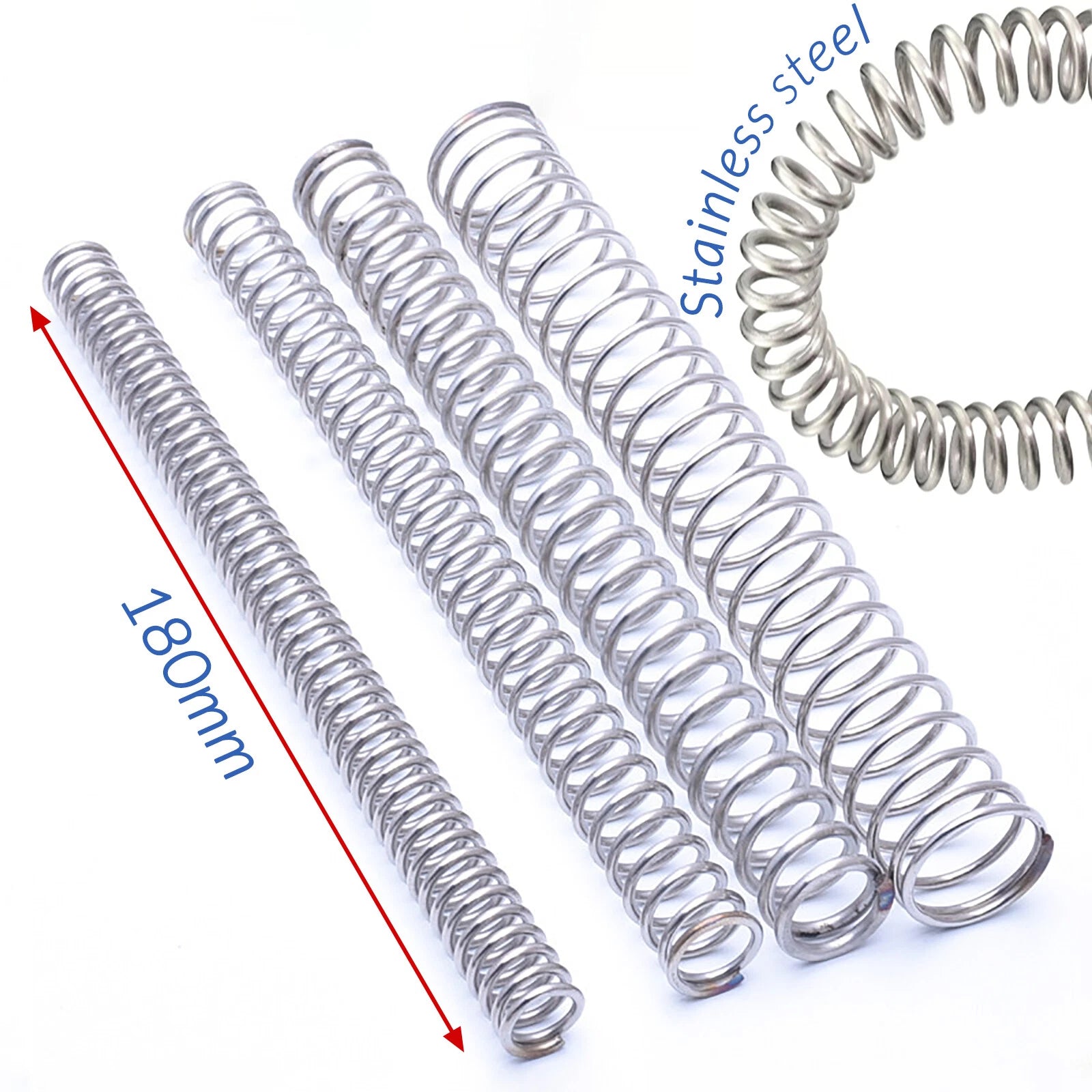
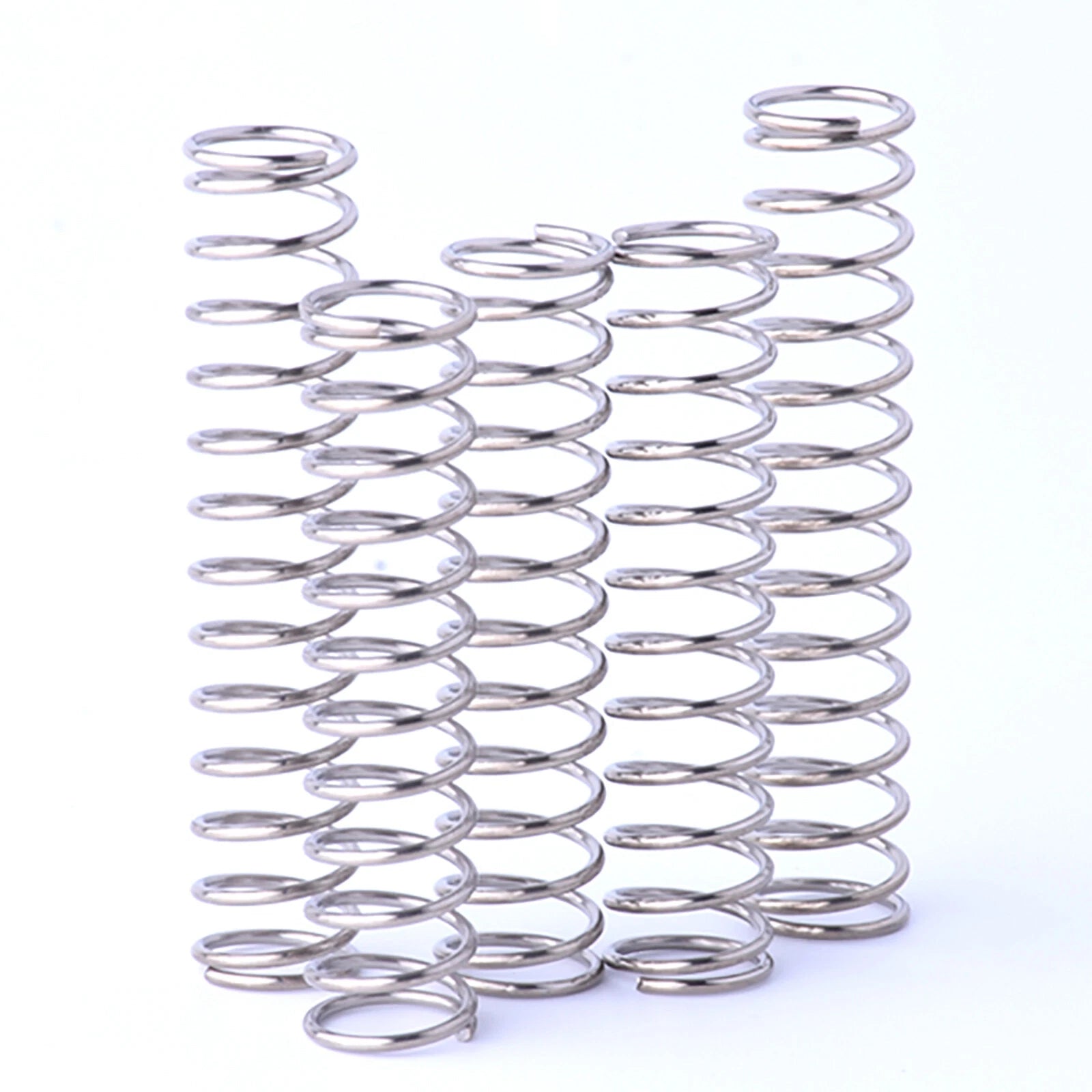
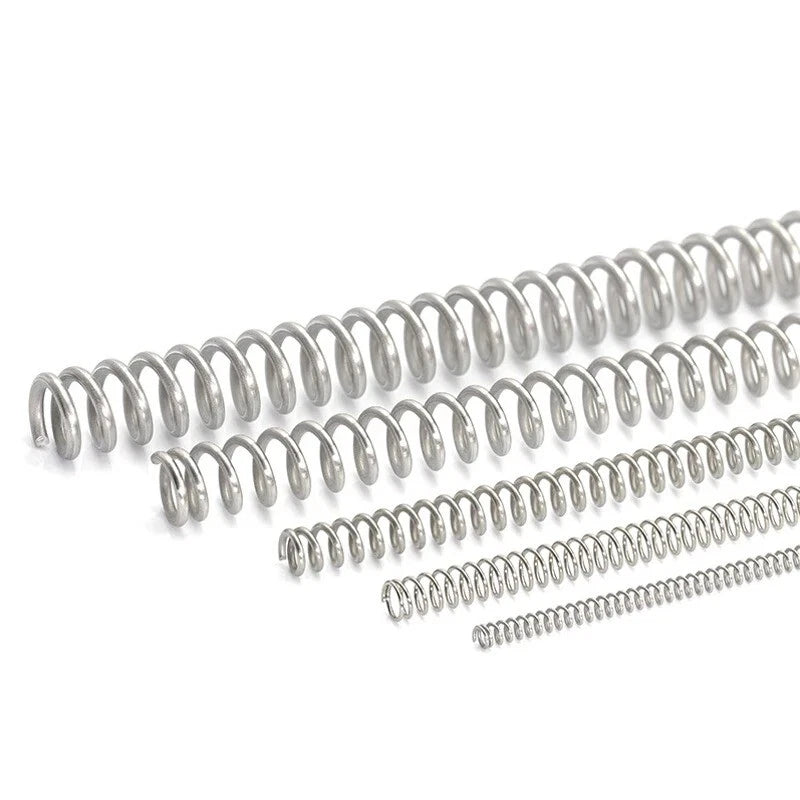
Compression Stainless steel 0.3- 2mm Wire Dia Pressure Coil Springs Length 180mm

No reviews

Price:
Sale price$11.56 USD
Stock:
In stock (500 units), ready to be shipped

Payment & Security

Ach Direct Debit Amazon American Express Apple Pay Bancontact BLIK Diners Club Discover EPS Google Pay iDEAL Wero JCB Maestro Mastercard Multibanco MobilePay PayPal Przelewy24 Shop Pay Twint Union Pay USDC Visa

Your payment information is processed securely. We do not store credit card details nor have access to your credit card information.

Limited Offer — Spend More, Save More
Spend $55+
Save $5
Spend $100+
Save $10
Spend $200+
Save $25
HomeDIYer DIY Expert Support

DIY Expert Support

Get fitment advice & recommendations

Mon–Fri  8:30 AM – 8:00 PM
24-Hour Fast Ship
Arrives in 3–14 Days
Worldwide Shipping
30-Day Returns
1 tree planted with every purchase

Description

Stainless Steel Compression Coil Springs — Precise Force in Every Coil

When a mechanism fails because a spring loses tension, corrodes, or simply doesn't fit, the whole project stalls. Engineers, makers, and workshop professionals who need reliable, repeatable spring force turn to stainless steel compression coil springs that hold their spec across thousands of cycles. These compression stainless steel pressure coil springs are built for exactly that demand.

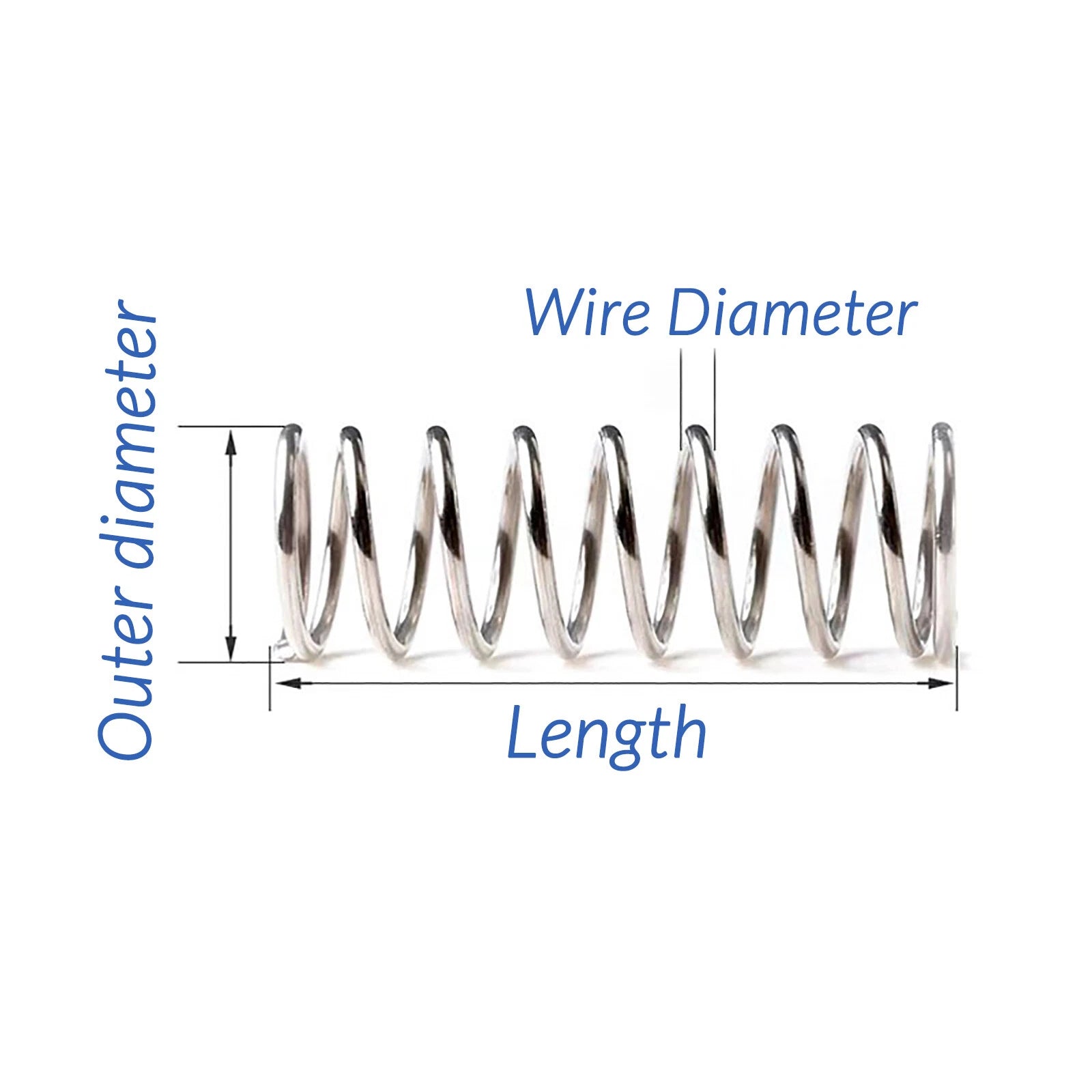
Each spring is wound from stainless steel wire ranging from 0.3 mm to 2 mm in diameter (approximately 0.012" to 0.079"), with outer diameters spanning 3 mm to 25 mm (approx. 0.12" to 0.98") and a fixed free length of 180 mm (approx. 7.09"). The wire is formed into a close-wound helical coil that delivers consistent axial compression force with squared and ground ends for stable seating.

Typical applications include return mechanisms in jigs and fixtures, valve spring replacements in pneumatic assemblies, tension-balancing in 3D printer extruder arms, and cushioning elements in small-scale robotics — all scenarios where a stainless steel compression spring with a known wire diameter and outer diameter is non-negotiable.

⚙️ Compatibility: Suitable for standard spring seats, guide rods, and bores sized to match the selected outer diameter. Verify inner diameter clearance against your guide rod before ordering.

✅ Key Features of These Stainless Steel Compression Coil Springs

🔩 Wide Wire Diameter Range

Available in 0.3, 0.4, 0.5, 0.6, 0.7, 0.8, 1.0, 1.2, 1.4, 1.5, 1.6, 1.8, and 2.0 mm wire diameters — covering light-duty to medium-load applications in a single product line.

📐 Consistent 180 mm Free Length

All variants share a uniform 180 mm free length, simplifying design calculations and allowing direct substitution across different wire and outer diameter combinations.

🛡️ Stainless Steel Construction

Wound from stainless steel wire for resistance to oxidation, moisture, and mild chemical exposure — maintaining spring rate stability in humid or outdoor-adjacent environments.

🎯 Multiple Outer Diameter Options

Outer diameters from 3 mm to 25 mm let you match the spring to your bore or guide rod precisely, reducing lateral play and extending service life.

📦 Flexible Pack Quantities

Choose from 1, 2, 3, 4, 5, 10, or 25 pieces per order — ideal for prototyping single units or stocking a workshop with a full assortment.

🔄 Squared Ends for Stable Seating

Squared (and typically ground) end coils ensure the spring sits flat on its seat, distributing load evenly and preventing tilt-induced side loading on guide rods.

📐 Technical Specifications — Compression Coil Springs

Spring Type Compression (helical coil)
Material Stainless steel wire
Wire Diameter Range 0.3 mm – 2.0 mm (0.012" – 0.079")
Outer Diameter Range 3 mm – 25 mm (0.12" – 0.98")
Free Length 180 mm (7.09")
End Type Squared (closed)
Wind Direction See variant options
Spring Rate See variant options
Surface Finish Natural stainless (no coating)
Pack Quantity 1 / 2 / 3 / 4 / 5 / 10 / 25 pcs (select above)

❓ Frequently Asked Questions

How do I choose the right wire diameter for my application?

Wire diameter directly controls spring stiffness (spring rate) and load capacity. Thinner wire (0.3–0.6 mm) suits light-duty applications such as small electronics, pen mechanisms, or delicate return springs. Mid-range wire (0.7–1.2 mm) covers general mechanical assemblies, jigs, and fixtures. Heavier wire (1.4–2.0 mm) is appropriate for higher-load applications like pneumatic valves or industrial tooling. When in doubt, calculate the required spring rate from your load and deflection requirements, then select accordingly.

What outer diameter should I select to fit my guide rod or bore?

For a guide rod application, the spring's inner diameter (ID) must be slightly larger than the rod diameter to allow free movement. ID is approximately equal to the outer diameter minus twice the wire diameter. For a bore application, the spring's outer diameter should be slightly smaller than the bore to prevent binding. Measure your rod or bore carefully and select the outer diameter variant that gives 0.5–1.0 mm clearance on each side.

Are these springs corrosion-resistant enough for outdoor or humid environments?

Yes. Stainless steel offers significantly better corrosion resistance than carbon steel or music wire springs. These springs are suitable for humid workshops, light outdoor enclosures, and applications with occasional water exposure. For continuous immersion or aggressive chemical environments, verify the specific stainless alloy grade meets your requirements before use.

Can I cut these springs to a shorter free length?

Compression springs can be cut shorter, but doing so changes the spring rate and may leave an open, unground end that seats unevenly. If you need a specific free length shorter than 180 mm, cutting is possible with a rotary tool or spring cutter, followed by light grinding to re-square the end. For critical applications, it is better to select a spring closer to your target length from the outset.

How many pieces should I order — single or multi-pack?

For prototyping or one-off repairs, the 1- or 2-piece options keep costs low. For workshop stock or production runs where you need spares on hand, the 5-, 10-, or 25-piece packs offer a lower per-unit cost and reduce reorder frequency. Consider ordering at least 2–3 extra pieces for any critical application to account for testing and potential failures during setup.

What is the difference between this spring and an extension spring?

A compression spring resists being compressed — it pushes back when you squeeze it. An extension spring resists being stretched — it pulls back when you elongate it. Compression springs typically have open or squared ends and no initial tension, while extension springs have hooks or loops at each end and are wound with initial tension. These listings are compression springs; use them where you need a pushing or return force when the spring is compressed along its axis.

Are these springs compatible with 3D printer or robotics applications?

Yes. The fine wire diameter options (0.3–0.8 mm) and small outer diameters (3–8 mm) are well-suited for 3D printer extruder tensioners, bed leveling assemblies, and small robotic joints. The consistent 180 mm free length means you can cut to size or use as-is for longer travel mechanisms. Stainless steel construction also avoids the rust contamination risk that can occur with carbon steel springs in enclosed printer enclosures.

🛒 Select your Wire Diameter, Outer Diameter, and Length & Quantity above, then add to cart.

You may also like

Recently viewed