The chain is fine...but I ordered the wrong size. Nine links of the chain I ordered equals six of the size I wanted. My error...
How can I straighten out the springs? I can't use them coil uo as is.
Your payment information is processed securely. We do not store credit card details nor have access to your credit card information.
Get fitment advice & recommendations
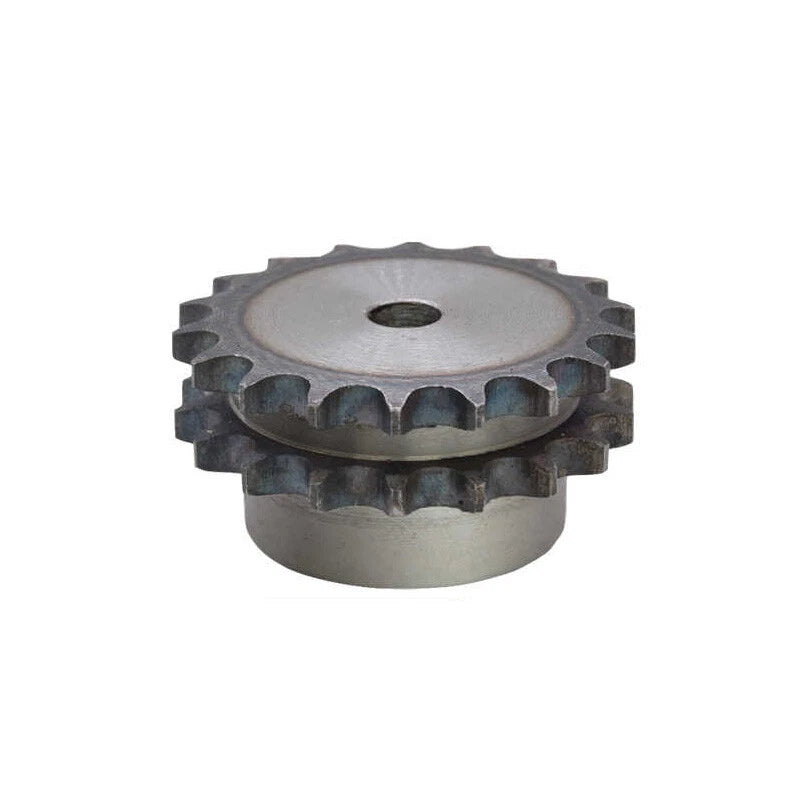
When a single-row sprocket simply cannot handle the torque load of your conveyor line, packaging machine, or heavy-duty DIY power transmission build, you need a double row roller chain sprocket engineered to share the load across two parallel chain strands. These sprockets are designed for makers, maintenance engineers, and machine builders who cannot afford slippage, premature wear, or misalignment in their drivetrain.
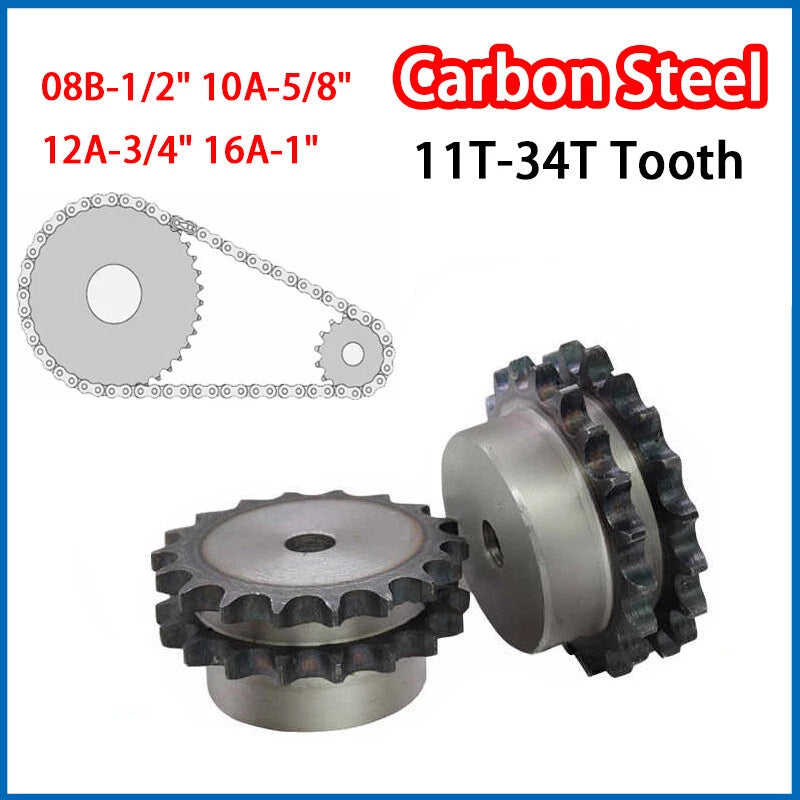
Each sprocket is machined from carbon steel and covers four standard pitch series: 08B (1/2" pitch), 10A (5/8" pitch), 12A (3/4" pitch), and 16A (1" pitch). Tooth counts range from 11T to 34T, with outside diameters spanning approximately 49 mm (1.93") to 148 mm (5.83"). The double-strand tooth profile is precision-cut to ISO/ANSI chain engagement tolerances, ensuring smooth meshing and reduced vibration across the full speed range.
Typical applications include industrial conveyor drives requiring doubled load capacity, agricultural and food-processing machinery with dual-strand chain runs, and custom DIY power transmission rigs where a single-row sprocket would be undersized. Long-tail use cases: replacement double row sprocket for 08B conveyor, 10A dual strand sprocket for packaging line, 12A carbon steel sprocket 16-tooth, 16A roller chain sprocket 1 inch pitch.
Covers 08B (1/2"), 10A (5/8"), 12A (3/4"), and 16A (1") pitch — select the series that matches your existing double-strand chain without sourcing from multiple suppliers.
Twin parallel tooth rows machined to ISO/DIN engagement tolerances, distributing chain pull across two strands to roughly double the effective load capacity versus a single-row sprocket of the same pitch.
Solid carbon steel body provides the hardness and tensile strength needed for sustained high-torque operation, resisting tooth deformation under shock loads common in conveyor start-stop cycles.
From compact 11-tooth drive sprockets (small OD, higher speed ratio) up to 34-tooth driven sprockets (larger OD, lower speed ratio) — dial in your exact gear ratio without custom machining.
Outside diameters are listed per variant (49 mm to 148 mm / 1.93" to 5.83"), so you can confirm physical clearance in your machine frame before ordering.
Tooth pitch, roller seating radius, and strand spacing follow ISO 606 / ANSI B29.1 standards, making these sprockets dimensionally interchangeable with OEM double-row sprockets of the same series and tooth count.
| Chain Standard | ISO 606 / DIN 8187 (B-series) & ANSI B29.1 (A-series) |
|---|---|
| Strand Configuration | Double row (2-strand) |
| Available Pitch Series | 08B (1/2"), 10A (5/8"), 12A (3/4"), 16A (1") |
| Tooth Count Range | 11T – 34T (see variant options for per-series availability) |
| Outside Diameter Range | 49 mm – 148 mm (1.93" – 5.83") |
| Material | Carbon steel |
| Surface Finish | See variant options |
| Bore Type | See variant options |
| Bore Diameter | See variant options |
| Hub Style | See variant options |
| Keyway | See variant options |
| Compatible Chain | 08B-2 / 10A-2 / 12A-2 / 16A-2 double-strand roller chain |
Match the pitch series to your existing double-strand roller chain. Measure the distance between the centers of two adjacent chain pins: 1/2" (12.7 mm) = 08B, 5/8" (15.875 mm) = 10A, 3/4" (19.05 mm) = 12A, 1" (25.4 mm) = 16A. If you are unsure, check the chain manufacturer's part number — the pitch designation is typically embedded in the chain code (e.g., 08B-2, 12A-2).
Speed ratio = driven sprocket teeth ÷ drive sprocket teeth. For example, a 12-tooth drive sprocket paired with a 24-tooth driven sprocket gives a 2:1 reduction. Choose a smaller tooth count on the drive shaft for speed reduction and torque multiplication, or a larger tooth count for speed increase. The 11T–34T range in this listing covers most common industrial reduction ratios from approximately 1:1 up to 3:1 in a single stage.
A double row (duplex) sprocket and matching 2-strand chain roughly doubles the load capacity for the same pitch and tooth count compared to a single-strand setup. This is the preferred solution when torque demands exceed the rated working load of a single-strand chain, or when you need redundancy in a critical drive application — without increasing the sprocket diameter or reducing speed.
Carbon steel offers excellent strength and hardness but has limited inherent corrosion resistance. For outdoor, washdown, or mildly corrosive environments, regular lubrication with a chain-compatible grease or oil is recommended to protect tooth surfaces. For highly corrosive or food-grade wet environments, consider stainless steel sprockets instead. In dry, enclosed, or well-lubricated industrial settings, carbon steel is the standard and cost-effective choice.
Check two dimensions before ordering: (1) Outside diameter — listed per variant (49–148 mm), confirm you have adequate clearance in your machine frame or guard. (2) Bore diameter and keyway — listed as "See variant options"; contact us to confirm the bore size for your specific variant before ordering if your shaft diameter is a critical constraint. We recommend verifying both dimensions against your existing sprocket or engineering drawing.
Yes, provided the replacement sprocket matches the original in pitch series, tooth count, strand count (double row), and bore diameter. These sprockets are manufactured to ISO 606 / ANSI B29.1 dimensional standards, which are the same standards used by most OEM conveyor and machinery manufacturers. Always cross-reference the tooth count, outside diameter, and bore before installation to ensure a drop-in fit.
The letter suffix indicates the chain standard: B-series follows ISO/DIN (European standard, e.g., 08B, 12A uses ISO 606), while A-series follows ANSI (North American standard, e.g., 10A, 16A follow ANSI B29.1). Although pitch dimensions are identical between equivalent series (e.g., 08B and 40 ANSI both have 1/2" pitch), there are subtle differences in roller diameter and inner plate width. Always match the sprocket series to your chain series — do not mix B-series sprockets with A-series chain or vice versa.