The chain is fine...but I ordered the wrong size. Nine links of the chain I ordered equals six of the size I wanted. My error...
How can I straighten out the springs? I can't use them coil uo as is.
Your payment information is processed securely. We do not store credit card details nor have access to your credit card information.
Get fitment advice & recommendations
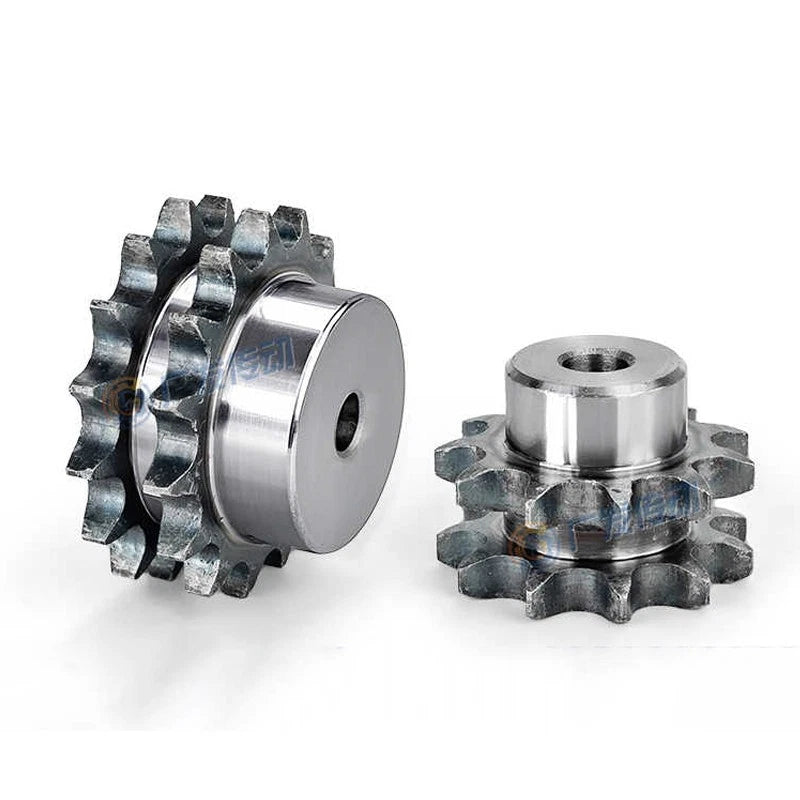
When a worn or mismatched sprocket causes chain skip, accelerated wear, or unexpected downtime, the fix starts with a correctly spec'd replacement. These duplex chain sprockets are engineered for makers, machine builders, and maintenance professionals who need a reliable drive component that installs correctly the first time and holds up under continuous load.
Each sprocket is machined from 45# medium-carbon steel and designed to the ANSI #50 / ISO 10A standard with a pitch of 15.875 mm (5/8 in). The duplex (double-strand) tooth profile accommodates two parallel roller chain strands side by side, doubling torque capacity compared to a simplex sprocket of the same tooth count. Tooth counts span 12T through 30T, covering a wide range of speed-ratio requirements. Bore diameter varies by tooth count — see variant options for exact bore dimensions.
Typical applications include conveyor drive systems requiring high torque in a compact footprint, agricultural and industrial machinery using #50 duplex roller chain, and custom power-transmission builds where a specific gear ratio must be achieved with a double-strand chain drive.
Tooth geometry and pitch (15.875 mm / 5/8 in) conform to ANSI B29.1 and ISO 606 for #50 duplex chain, ensuring drop-in compatibility with standard double-strand roller chain.
Machined from 45# steel (equivalent to SAE 1045), offering a tensile strength typically in the 570–700 MPa range — tough enough for sustained drive loads without excessive weight.
Sixteen tooth-count options from 12 to 30 teeth let you dial in the exact speed ratio your drive system requires, whether you need a fast output or a torque-multiplying reduction.
The dual-row tooth profile transmits power across two parallel chain strands simultaneously, effectively doubling load capacity versus a single-strand sprocket of the same size.
The machined steel surface is treated to resist oxidation during storage and operation in typical indoor industrial environments. For harsh or wet environments, additional lubrication is recommended.
Each sprocket features a machined center bore sized to the tooth count. Bore diameter and keyway dimensions vary by model — select your tooth count above to confirm the exact bore specification.
| Chain Standard | ANSI #50 / ISO 10A |
|---|---|
| Chain Type | Duplex (Double-Strand) Roller Chain |
| Pitch | 15.875 mm (5/8 in) |
| Tooth Count (T) | 12T, 13T, 14T, 15T, 16T, 17T, 18T, 19T, 20T, 21T, 22T, 24T, 25T, 26T, 27T, 30T |
| Material | 45# Medium-Carbon Steel |
| Bore Diameter | See variant options |
| Keyway | See variant options |
| Hub Style | See variant options |
| Outer Diameter | See variant options |
| Hub Length | See variant options |
| Surface Treatment | Machined steel, oxidation-resistant finish |
| Quantity per Order | 1 Pcs |
The tooth count determines your speed ratio. Divide the driven sprocket teeth by the driver sprocket teeth to get the reduction ratio. For example, a 12T driver paired with a 24T driven sprocket gives a 2:1 reduction — the output shaft turns at half the input speed with twice the torque. Select the tooth count that achieves your target ratio while keeping chain wrap angle above 120° on the smaller sprocket.
Yes — provided your chain is ANSI #50 or ISO 10A duplex (double-strand) with a pitch of 15.875 mm (5/8 in). These sprockets are machined to that standard. If your chain is a different pitch or a simplex (single-strand) #50 chain, this sprocket will not be compatible.
45# steel is a medium-carbon steel (approximately equivalent to SAE/AISI 1045) widely used for machined mechanical components. It offers a tensile strength typically in the 570–700 MPa range and good machinability, making it well-suited for sprockets, shafts, and gears operating under moderate to heavy cyclic loads.
The sprocket has a machined steel finish with basic oxidation resistance suitable for typical indoor industrial use. For outdoor, wet, or corrosive environments, we recommend applying a chain lubricant or anti-rust coating regularly, or considering a stainless-steel alternative if long-term corrosion resistance is critical.
Bore diameter and keyway dimensions vary by tooth count and are listed in the variant detail for each model. Select your tooth count from the options above to view the exact bore and keyway specification before ordering. If you need a custom bore size, contact us to confirm availability.
This is a duplex (double-strand) sprocket, meaning it has two rows of teeth to engage two parallel strands of roller chain simultaneously. A simplex sprocket has only one row. Using a duplex sprocket with a duplex chain roughly doubles the power transmission capacity compared to a simplex setup of the same pitch and tooth count. Do not use a duplex sprocket with a single-strand chain.
Mount the sprocket on the shaft so the centerline of the sprocket teeth aligns with the centerline of the mating sprocket within ±0.5 mm lateral offset. Use a straightedge or laser alignment tool across the sprocket faces to check alignment before tensioning the chain. Misalignment accelerates tooth and chain wear significantly.