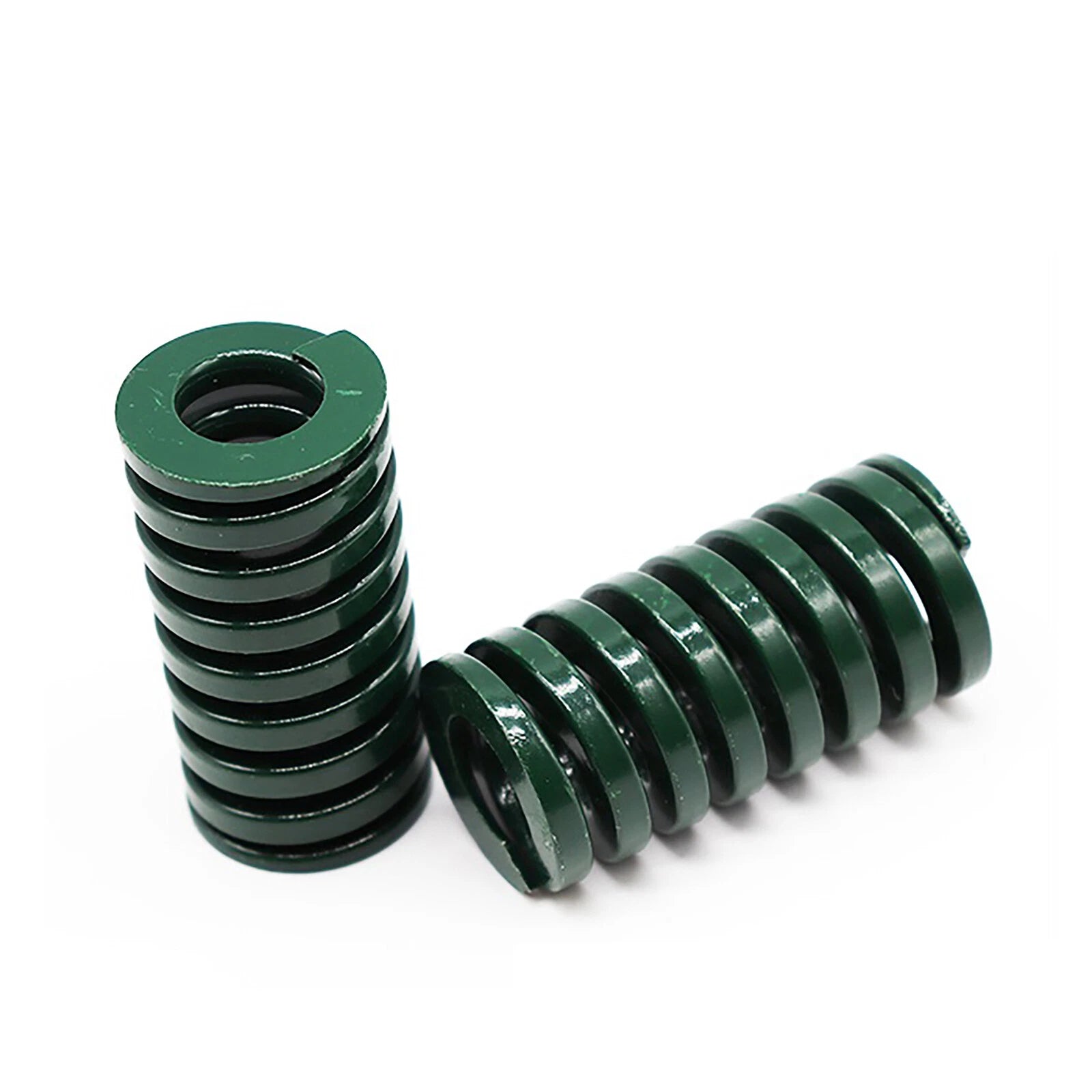
Heavy Load Duty Compression Die Spring, 8-40 mm OD & 4-20 mm ID & 15-300 mm Long

No reviews

Price:
Sale price$2.69 USD
Stock:
In stock (500 units), ready to be shipped

Payment & Security

Ach Direct Debit Amazon American Express Apple Pay Bancontact BLIK Diners Club Discover EPS Google Pay iDEAL Wero JCB Maestro Mastercard Multibanco MobilePay PayPal Przelewy24 Shop Pay Twint Union Pay USDC Visa

Your payment information is processed securely. We do not store credit card details nor have access to your credit card information.

Limited Offer — Spend More, Save More
Spend $55+
Save $5
Spend $100+
Save $10
Spend $200+
Save $25
HomeDIYer DIY Expert Support

DIY Expert Support

Get fitment advice & recommendations

Mon–Fri  8:30 AM – 8:00 PM
24-Hour Fast Ship
Arrives in 3–14 Days
Worldwide Shipping
30-Day Returns
1 tree planted with every purchase

Description

Heavy Load Compression Die Springs — Reliable Force for Demanding Applications

When your press tooling, stamping die, or industrial fixture demands consistent, repeatable force under heavy loads, a weak or undersized spring becomes a costly liability. Engineers, toolmakers, and serious DIYers who need a heavy load compression die spring that holds its rated force cycle after cycle will find this range purpose-built for exactly that challenge.

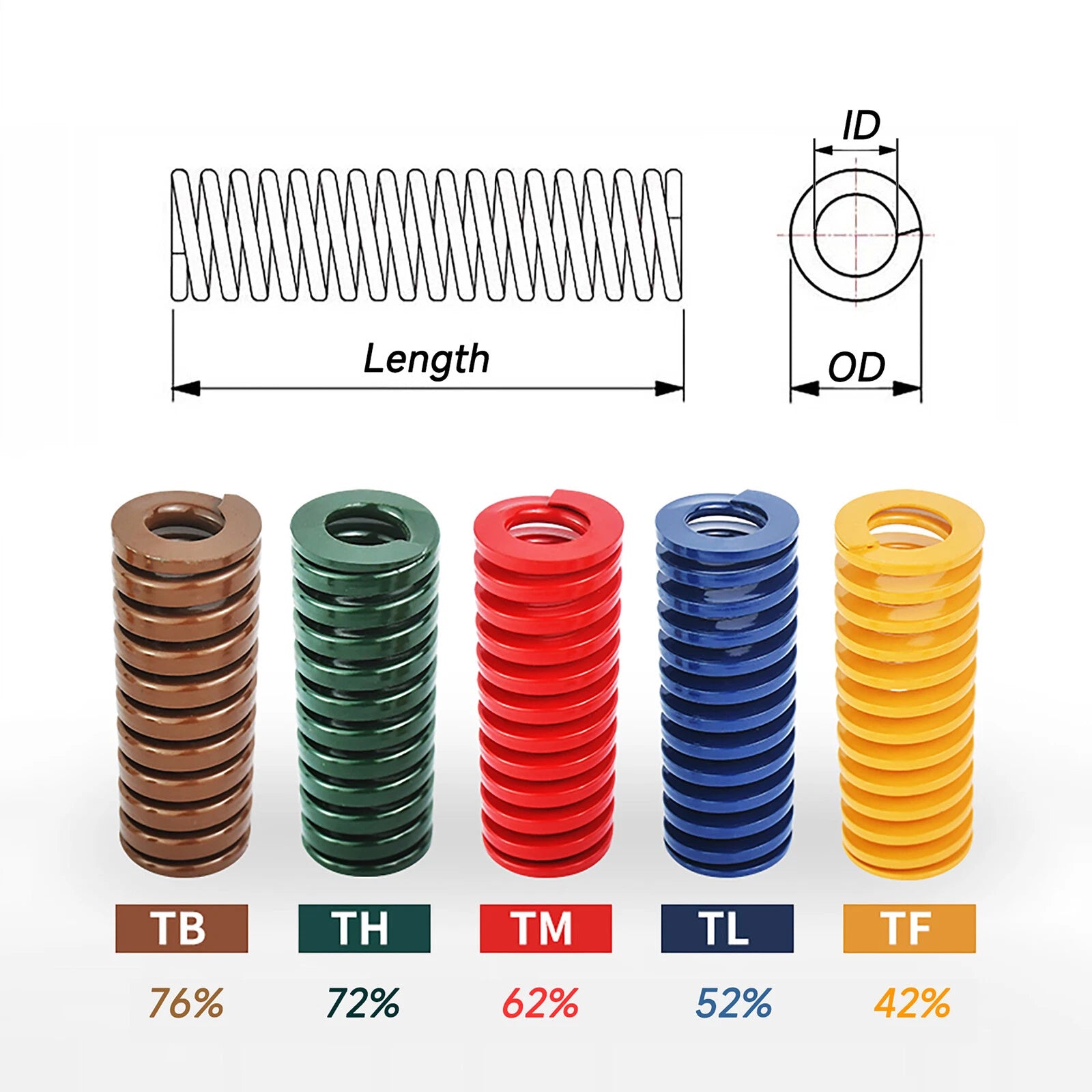
These compression die springs are manufactured from high-carbon chromium alloy steel wire, wound to close tolerances and finished with a protective coating. Outside diameter (OD) ranges from 8 mm to 40 mm (approx. 0.31 in to 1.57 in), inside diameter (ID) from 4 mm to 20 mm (approx. 0.16 in to 0.79 in), and free length from 15 mm to 300 mm (approx. 0.59 in to 11.81 in). Each variant is color-coded red to indicate heavy load rating per ISO 10243 / JIS B 5012 conventions.

Typical use cases include stamping and blanking die sets requiring heavy return force, injection mold ejector systems where consistent spring-back is critical, and custom jig-and-fixture builds where a heavy load compression die spring must fit a precise bore and shaft combination. The wide size matrix also suits maintenance replacement in existing tooling without custom fabrication.

⚙️ Compatibility: Designed to fit standard die-set guide posts and bores. Match OD to your bore diameter and ID to your guide post diameter. Confirm free length against your shut height before ordering.

✅ Key Features of These Heavy Load Compression Die Springs

🔴 Heavy Load Rating

Color-coded red per ISO 10243 / JIS B 5012 heavy load classification, delivering high spring force relative to deflection for demanding press and die applications.

🔩 Wide Size Matrix

OD from 8–40 mm, ID from 4–20 mm, and free length from 15–300 mm — covering the most common die-set bore and post combinations in a single product family.

🛡️ Alloy Steel Construction

Wound from high-carbon chromium alloy steel wire for fatigue resistance and consistent load characteristics across repeated compression cycles.

📐 Close Winding Tolerances

Precision-wound coils maintain squareness and parallelism of end faces, ensuring even load distribution and reducing lateral buckling risk in guided applications.

🔄 Protective Surface Finish

Applied coating guards against surface oxidation during storage and service, extending functional life in workshop and production environments.

🏭 Drop-In Replacement Geometry

Dimensioned to ISO 10243 / JIS B 5012 standards so these springs serve as direct replacements in existing tooling without modification to the die set.

📐 Technical Specifications — Compression Die Spring

Product Type Heavy Load Compression Die Spring
Load Rating Heavy (Red)
Standard Reference ISO 10243 / JIS B 5012
Outside Diameter (OD) 8 mm – 40 mm (0.31 in – 1.57 in)
Inside Diameter (ID) 4 mm – 20 mm (0.16 in – 0.79 in)
Free Length 15 mm – 300 mm (0.59 in – 11.81 in)
Material High-carbon chromium alloy steel
Surface Finish Protective coating (color: red)
End Type Closed and ground ends
Spring Rate See variant options
Maximum Deflection See variant options
Wire Diameter See variant options

❓ Frequently Asked Questions

How do I choose the right OD and ID for my die set?

Match the outside diameter (OD) to your die bore so the spring seats without side play, and match the inside diameter (ID) to your guide post so the spring slides freely without binding. A typical clearance of 0.5–1 mm between the ID and post diameter is recommended. Select your OD and ID from the variant dropdowns above.

What does the red color coding mean?

Red indicates a heavy load rating per ISO 10243 and JIS B 5012 standards. Heavy load springs have a higher spring rate (more force per mm of deflection) compared to light (yellow), medium (blue), or extra-heavy (brown) rated springs. Choose heavy load when your application requires significant return force in a compact free length.

How do I select the correct free length?

Measure your die shut height and the required working stroke. The free length should equal the shut height plus the working stroke plus any pre-load deflection you intend to apply. Avoid compressing heavy load die springs beyond 30–35% of their free length to maintain fatigue life.

Are these springs corrosion resistant?

The protective coating provides resistance to surface oxidation during normal workshop storage and use. For environments with continuous moisture, coolant exposure, or chemical contact, consider applying a compatible lubricant or grease to the spring coils during installation to extend service life.

Can I use these springs as replacements in existing tooling?

Yes. These springs are dimensioned to ISO 10243 / JIS B 5012 standards, making them direct replacements for springs of the same OD, ID, free length, and load color in most commercial die sets. Verify the OD, ID, free length, and load color of your existing spring before ordering.

What is the maximum recommended deflection for heavy load die springs?

For heavy load (red) die springs, the maximum recommended deflection is typically 30–35% of the free length for extended fatigue life. Operating at or near solid height will significantly reduce cycle life. If your application requires more than 35% deflection, consider using a longer free length or a different load class.

How many springs do I need per die station?

The number of springs depends on the total stripping or return force required divided by the force each spring provides at your working deflection. Calculate the required total force from your material thickness and shear strength, then divide by the per-spring force at working deflection. Using multiple springs of the same size ensures even load distribution across the die plate.

🛒 Select your Outside Diameter, Inside Diameter, and Length above, then add to cart.

You may also like

Recently viewed