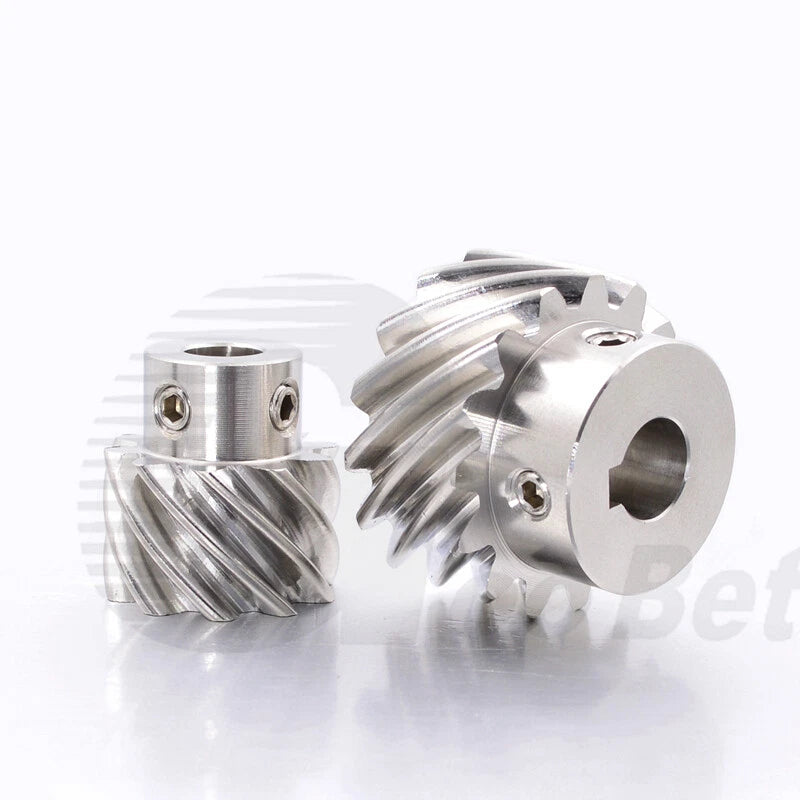
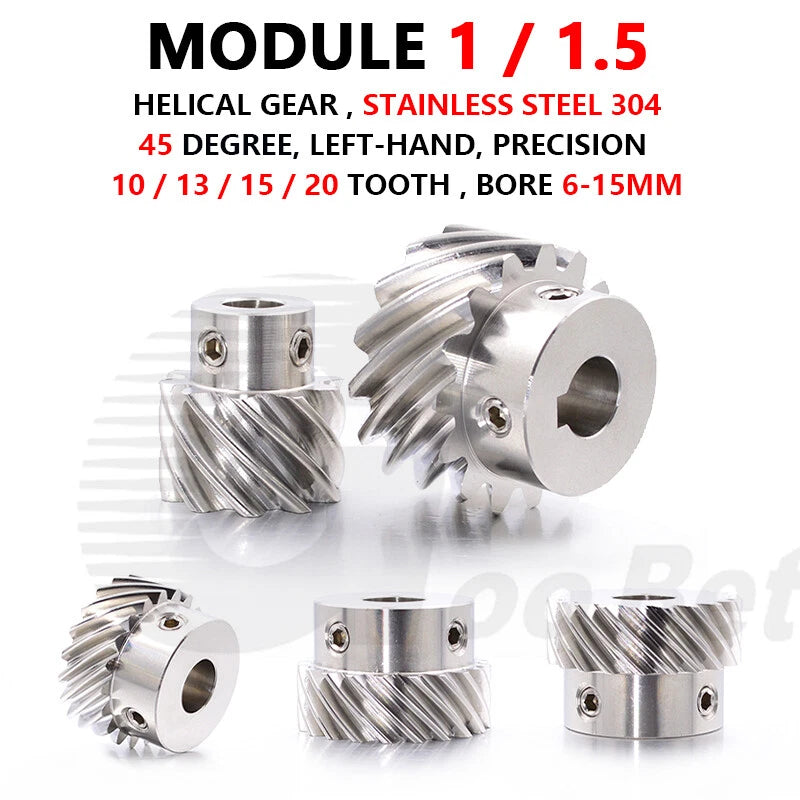
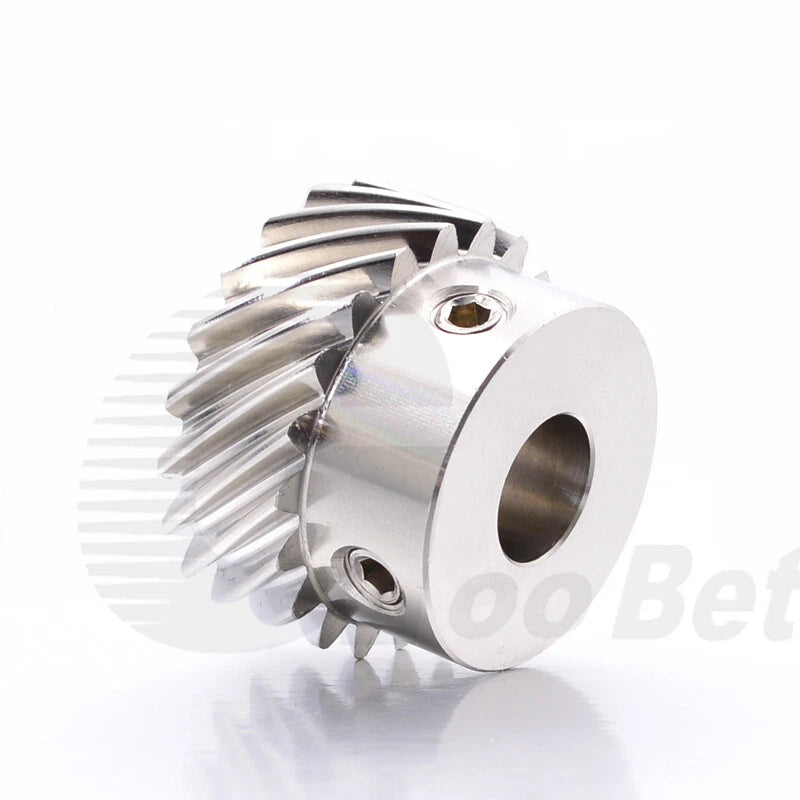
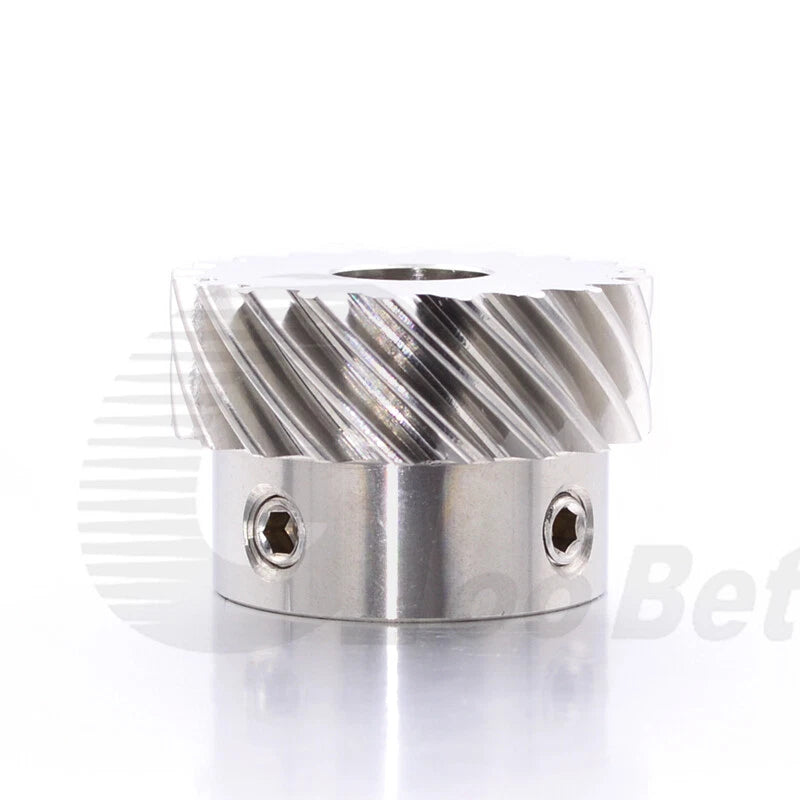
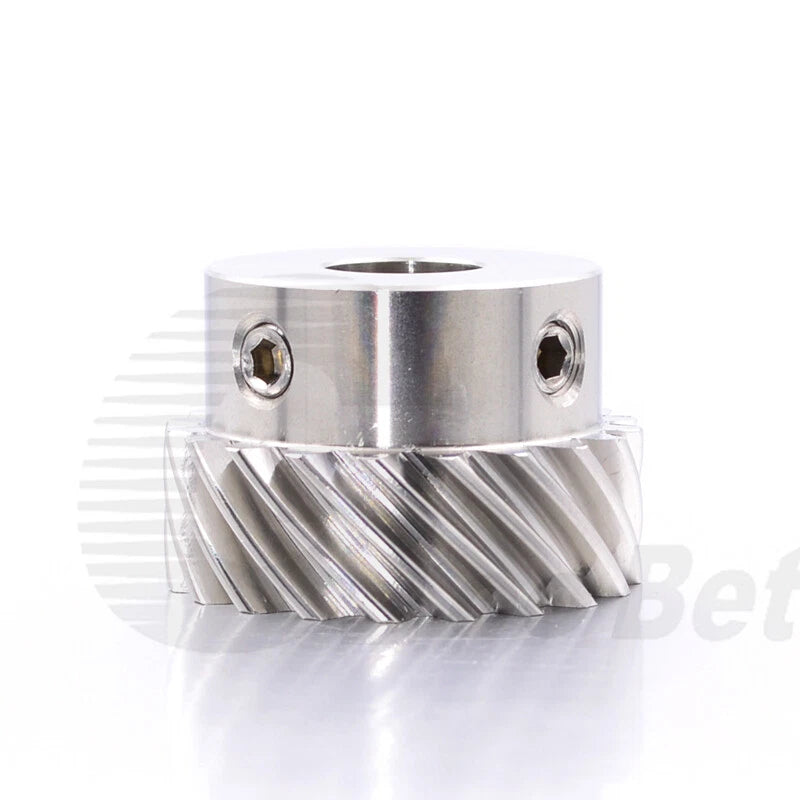
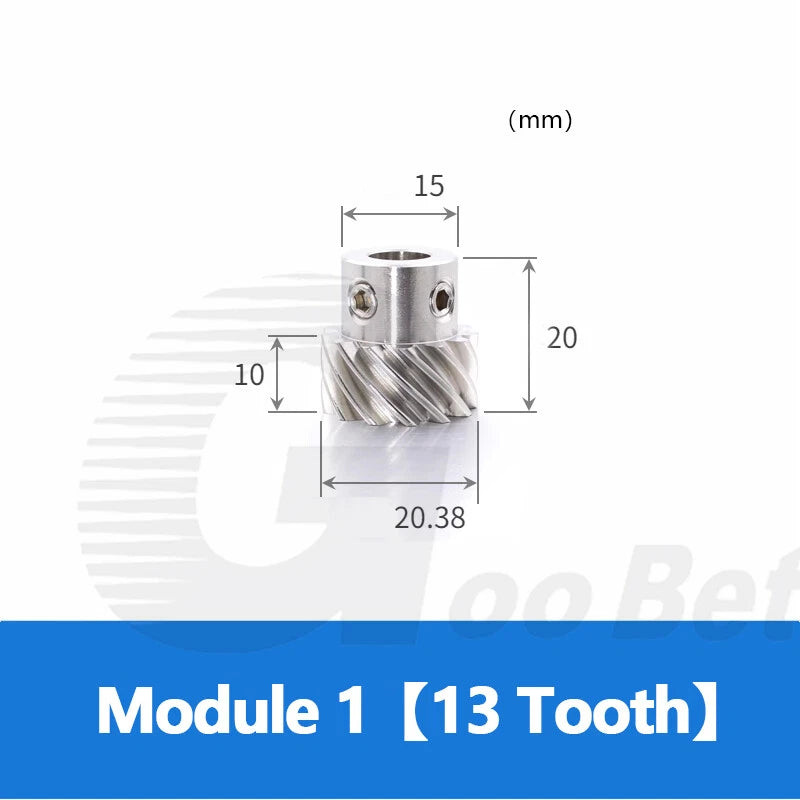
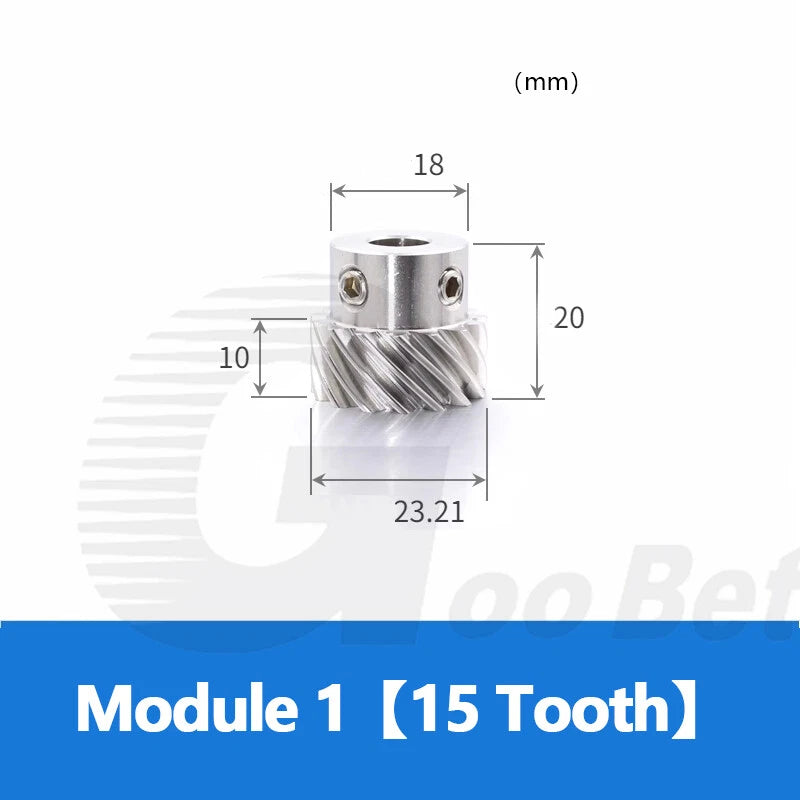
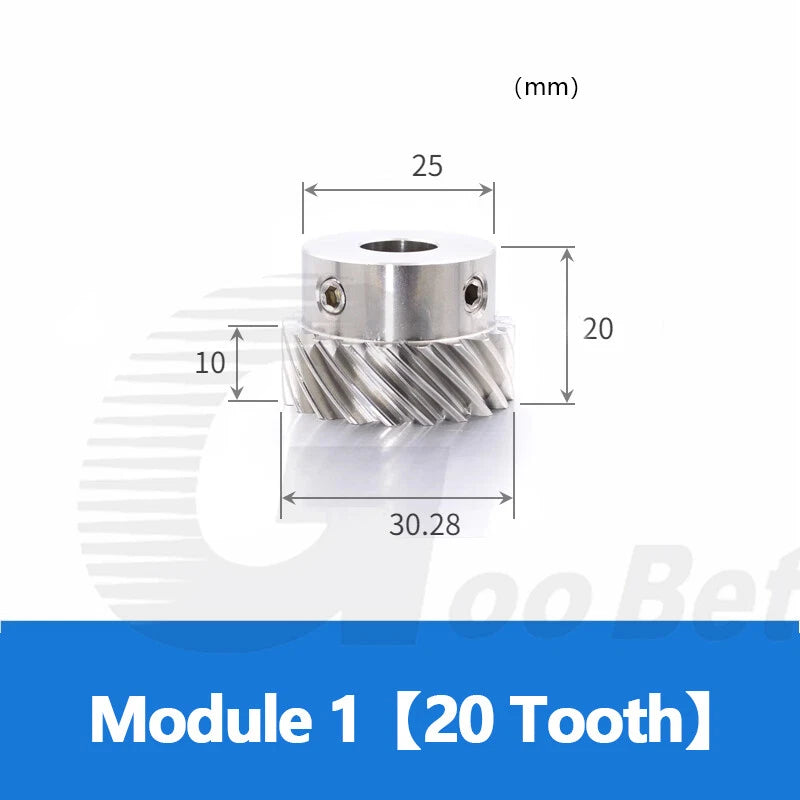
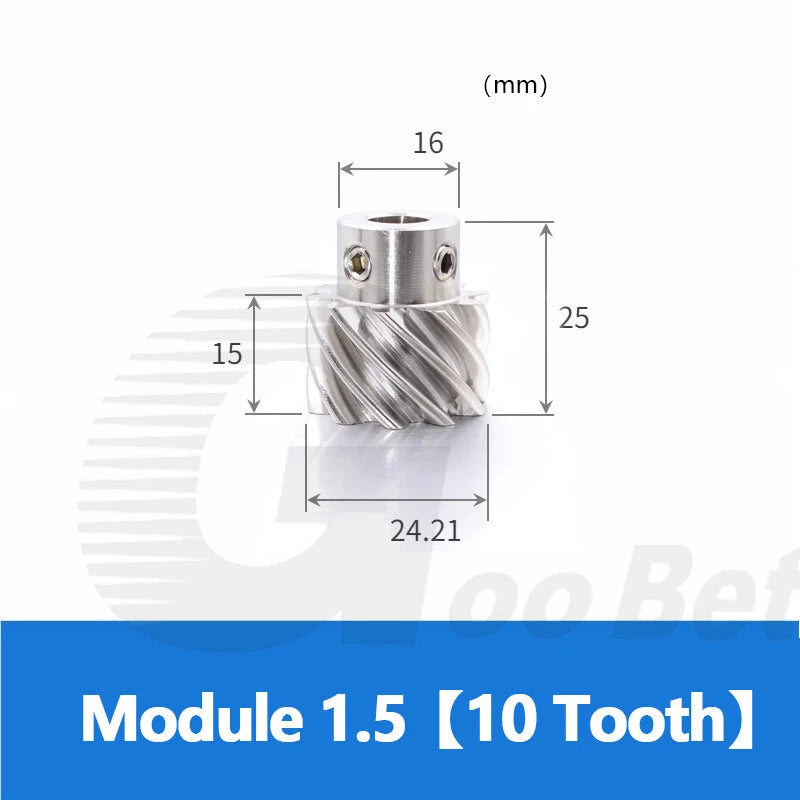
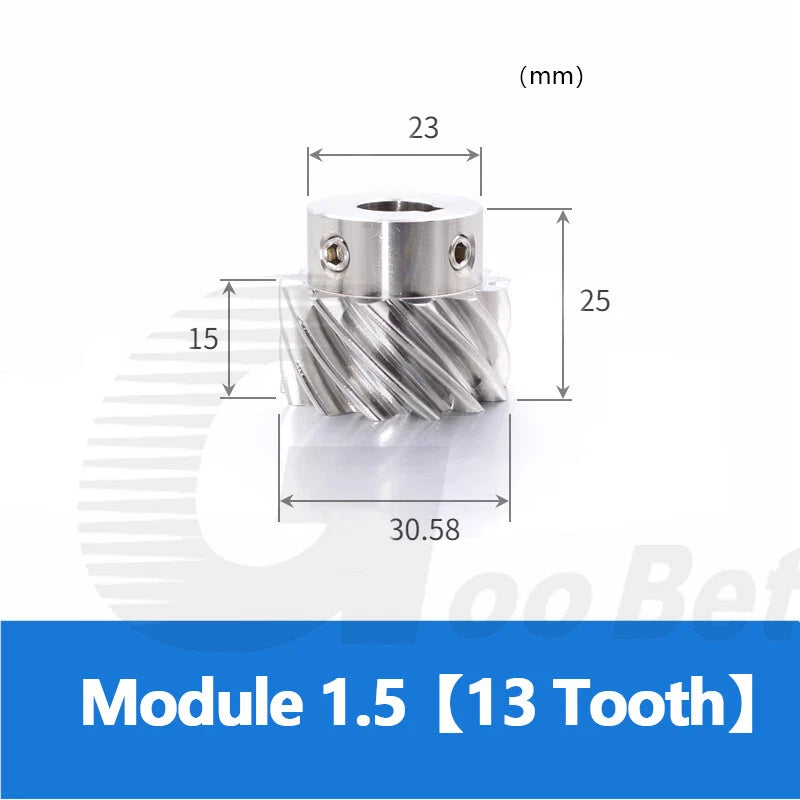
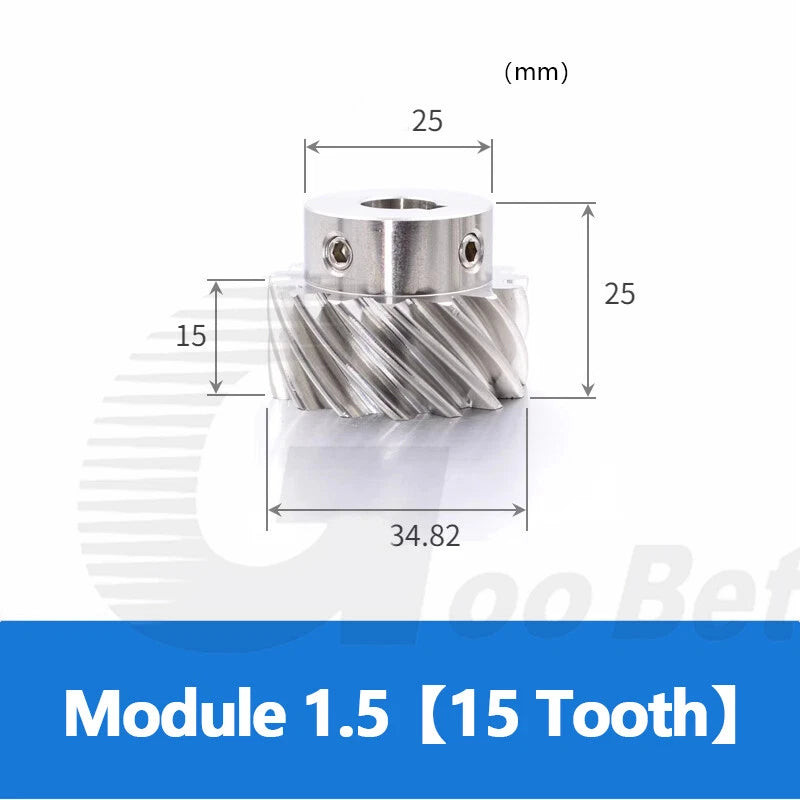
Helical Gear Module 1 1.5 Stainless Steel 45° Left-hand 10-20 Tooth Motor Pinion

No reviews

Price:
Sale price$20.39 USD
Stock:
In stock (500 units), ready to be shipped

Payment & Security

Ach Direct Debit Amazon American Express Apple Pay Bancontact BLIK Diners Club Discover EPS Google Pay iDEAL Wero JCB Maestro Mastercard Multibanco MobilePay PayPal Przelewy24 Shop Pay Twint Union Pay USDC Visa

Your payment information is processed securely. We do not store credit card details nor have access to your credit card information.

Limited Offer — Spend More, Save More
Spend $55+
Save $5
Spend $100+
Save $10
Spend $200+
Save $25
HomeDIYer DIY Expert Support

DIY Expert Support

Get fitment advice & recommendations

Mon–Fri  8:30 AM – 8:00 PM
24-Hour Fast Ship
Arrives in 3–14 Days
Worldwide Shipping
30-Day Returns
1 tree planted with every purchase

Description

Left-Hand Helical Gear Module 1 & 1.5 — Stainless Steel Motor Pinion for Precision Drives

When backlash, noise, and axial load management matter in your motion system, a standard spur gear simply won't cut it. Engineers, CNC builders, and robotics integrators who demand smooth, quiet power transmission under continuous load rely on left-hand helical gears to deliver consistent performance across demanding duty cycles.

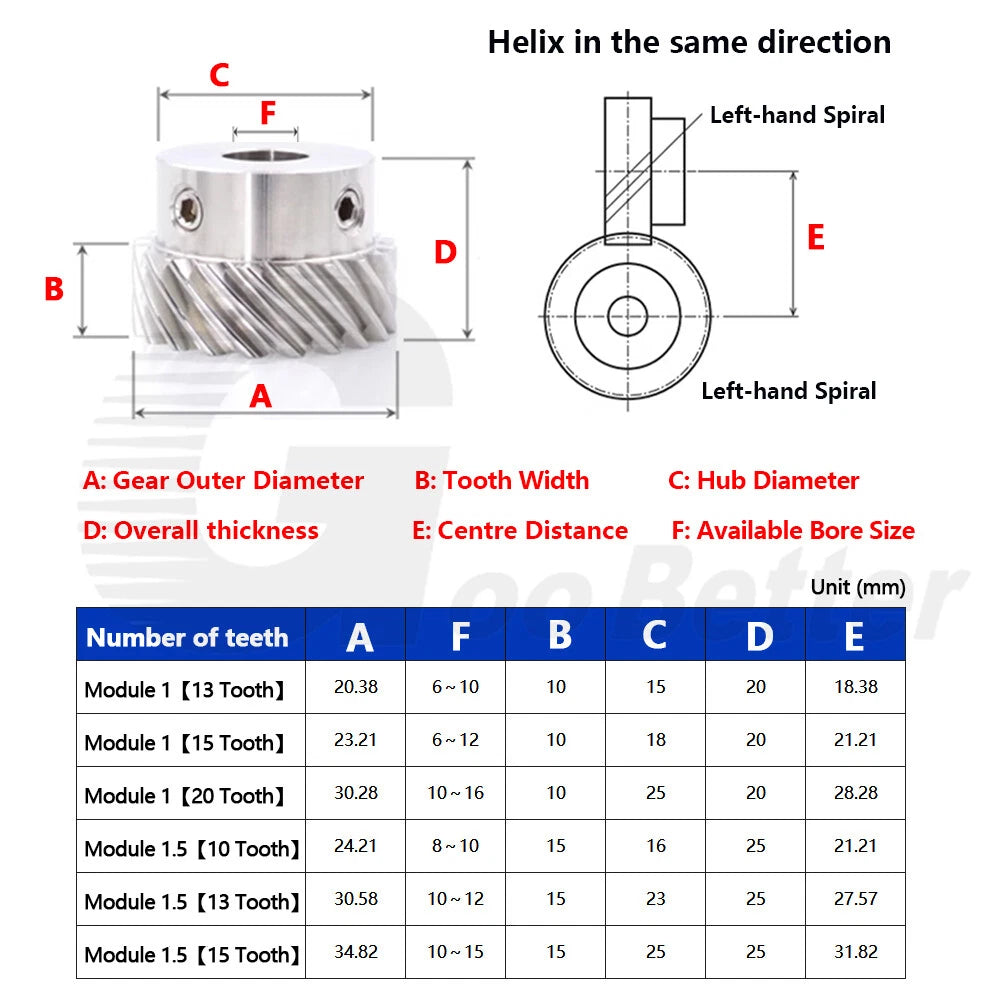
These left-hand helical gears are machined from stainless steel with a 45° helix angle, available in Module 1 and Module 1.5 configurations. Tooth counts range from 10 to 20 teeth, with bore sizes spanning 6 mm (0.24 in) to 16 mm (0.63 in). Select variants include a precision-cut keyway (4 mm or 5 mm) for positive torque transmission without set-screw slip.

Typical applications include CNC router motor pinion drives, robotic joint actuators requiring low-noise helical mesh, and paired left/right helical gear sets for crossed-axis or parallel-shaft gearboxes. Long-tail use cases: stainless steel helical pinion gear for stepper motor, Module 1 left-hand gear for CNC Z-axis, 45-degree helix angle gear for quiet automation drive.

⚙️ Compatibility: Pairs with right-hand helical gears of the same module (Module 1 or Module 1.5) and matching helix angle (45°). Confirm shaft diameter before ordering — bore sizes range from 6 mm to 16 mm with optional keyway.

✅ Key Features of These Left-Hand Helical Gears

  • 🔩Stainless Steel Construction — Corrosion-resistant stainless steel body withstands moisture, mild chemicals, and continuous mechanical stress without surface degradation.
  • 📐45° Left-Hand Helix Angle — Engineered 45° helix delivers gradual tooth engagement, reducing impact noise and distributing load across multiple teeth simultaneously for smoother torque transfer.
  • 🎯Multiple Module & Tooth Options — Available in Module 1 (13, 15, 20 tooth) and Module 1.5 (10, 13, 15 tooth) to match a wide range of gear ratio and pitch diameter requirements.
  • 🔧Wide Bore Size Range — Bore options from 6 mm to 16 mm accommodate common motor and shaft diameters; keyway variants (4 mm or 5 mm) provide positive rotational locking for high-torque applications.
  • Motor Pinion Ready — Compact tooth counts (10–20 T) and precise bore tolerances make these gears ideal as direct motor pinions on stepper, servo, and DC gear motors.
  • 🔄Pairs with Right-Hand Counterpart — Designed to mesh with matching right-hand helical gears of the same module for parallel-shaft or crossed-axis drive configurations in robotics and automation assemblies.

📐 Technical Specifications — Left-Hand Helical Gears

Material Stainless Steel
Helix Angle 45°
Hand Left-Hand
Module Module 1 / Module 1.5 (see variant options)
Tooth Count 10 T / 13 T / 15 T / 20 T (see variant options)
Bore Size 6 mm / 8 mm / 10 mm / 12 mm / 14 mm / 15 mm / 16 mm (see variant options)
Keyway 4 mm keyway (10 mm, 12 mm bore) / 5 mm keyway (14 mm, 15 mm bore) / None (see variant options)
Pitch Diameter (Module 1) Typically 13–20 mm depending on tooth count
Pitch Diameter (Module 1.5) Typically 15–22.5 mm depending on tooth count
Finish Natural stainless (uncoated)
Quantity per Order 1 pcs
Weight See variant options

❓ Frequently Asked Questions

How do I choose between Module 1 and Module 1.5?

Module number defines the tooth size and pitch diameter. Module 1.5 gears have larger, stronger teeth and a bigger pitch diameter for the same tooth count compared to Module 1. Choose Module 1 for compact, lightweight drives; choose Module 1.5 when you need higher torque capacity or are matching an existing Module 1.5 mating gear.

Do I need a keyway bore, or will a plain bore work?

A plain bore secured with a set screw is sufficient for light-to-moderate torque applications. If your motor or shaft transmits high torque or experiences reversing loads, a keyway bore provides a positive mechanical lock that prevents rotational slip. Select the keyway variant that matches your shaft's existing key dimensions (4 mm or 5 mm).

Is stainless steel strong enough for my application?

Stainless steel offers a good balance of tensile strength, corrosion resistance, and machinability. It is well-suited for light-to-medium duty automation, robotics, and CNC applications. For very high-load industrial gearboxes, consider whether a hardened alloy steel gear would be more appropriate for your torque and fatigue requirements.

Will these gears corrode in humid or wet environments?

Yes — stainless steel provides inherent corrosion resistance suitable for humid environments, light splash exposure, and mild chemical contact. It is not recommended for continuous immersion in aggressive acids or chloride-heavy solutions without additional protective measures.

What right-hand gear do I pair with this left-hand helical gear?

You need a right-hand helical gear with the same module (1 or 1.5) and the same 45° helix angle. The tooth counts of the two mating gears determine your gear ratio — they do not need to be identical. Ensure the center distance matches the sum of the two pitch radii for proper mesh.

Can I use this gear directly on a stepper or servo motor shaft?

Yes. The compact tooth counts (10–20 T) and available bore sizes (6–16 mm) cover the most common NEMA 17, NEMA 23, and small servo motor shaft diameters. Verify your motor shaft diameter and select the matching bore size. For shafts with a flat or key, choose the corresponding keyway variant.

How do I confirm the correct bore size before ordering?

Measure your motor or drive shaft diameter with a caliper. The bore size must match or be within the tolerance of your shaft diameter. If your shaft has a key slot, measure the key width (typically 4 mm or 5 mm for shafts in this diameter range) and select the matching keyway bore option.

🛒 Select your Models, Bore Size, and Amount above, then add to cart.

You may also like

Recently viewed