
The chain is fine...but I ordered the wrong size. Nine links of the chain I ordered equals six of the size I wanted. My error...
How can I straighten out the springs? I can't use them coil uo as is.
Your payment information is processed securely. We do not store credit card details nor have access to your credit card information.
Get fitment advice & recommendations
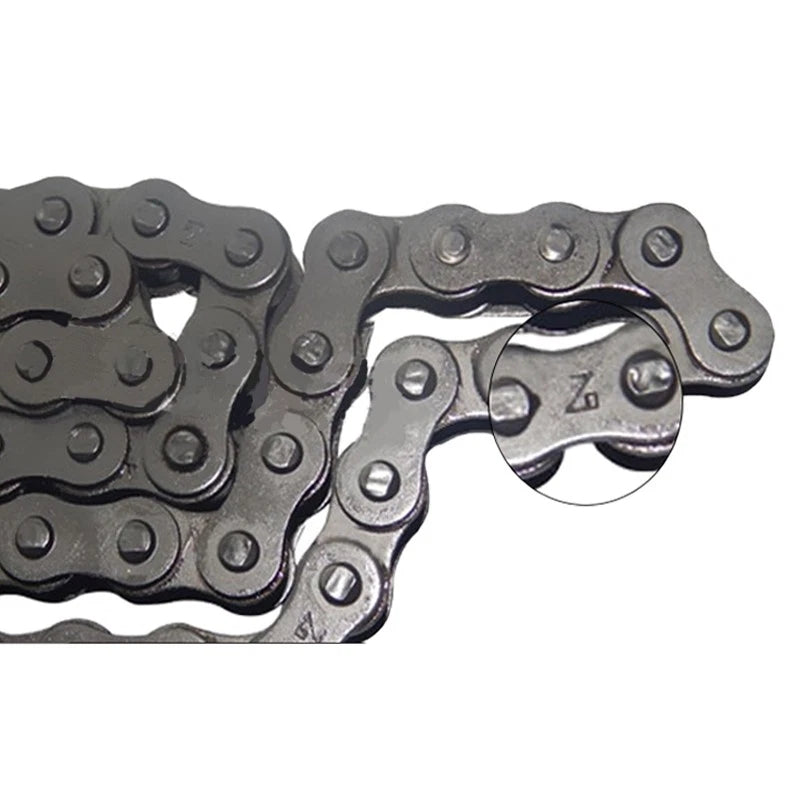
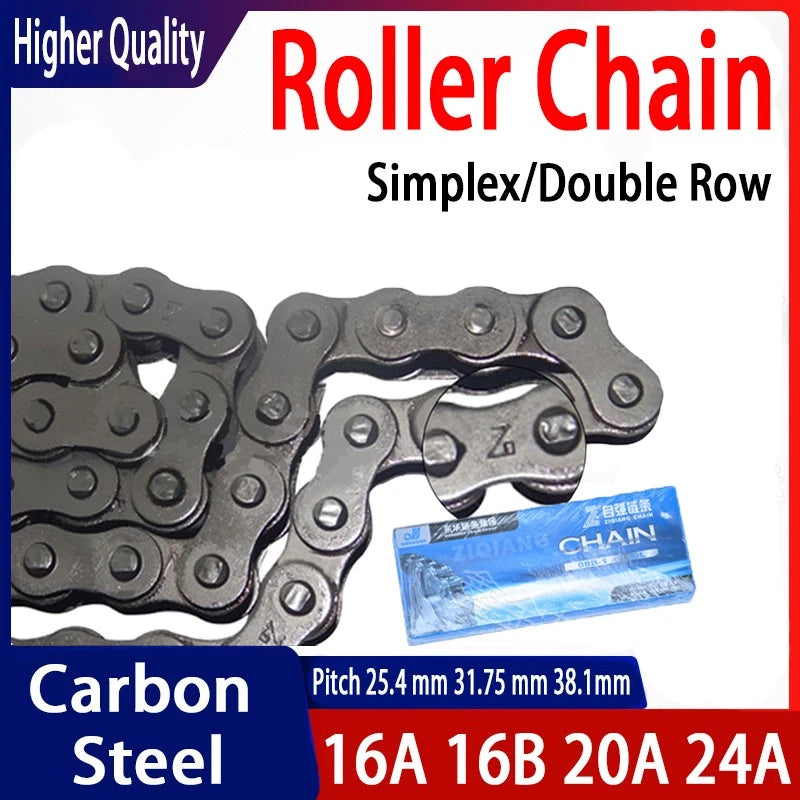
When a worn or snapped drive chain brings your machinery to a halt, every minute of downtime costs you. Whether you're a maintenance engineer keeping a production line running, a workshop owner repairing agricultural equipment, or a maker building a custom power-transmission system, finding the right roller chain in the correct pitch and strand configuration shouldn't be a struggle. This listing covers a comprehensive range of ISO-standard simplex and duplex roller chains — #80 (16A/16B), #100 (20A), and #120 (24A) — along with matching full buckle and half buckle connecting links, so you can source chain and hardware in one order.
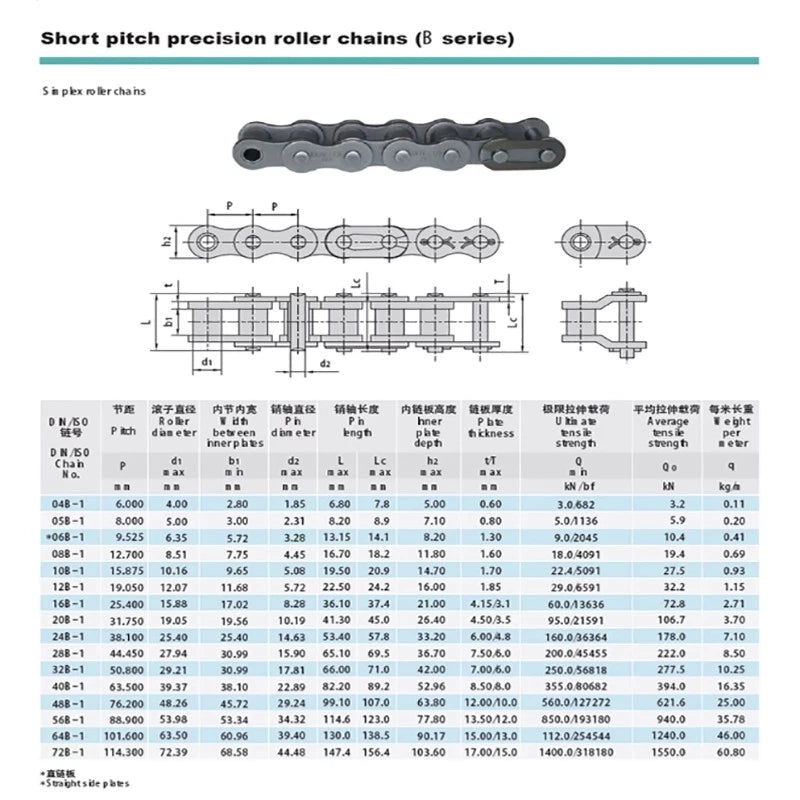
Each roller chain section is supplied in a 1.5-meter (approx. 59 in) length and is manufactured to ISO 606 / ANSI B29.1 dimensional standards. The #80 / 16A and 16B series feature a 25.4 mm (1 in) pitch; the #100 / 20A series steps up to a 31.75 mm (1.25 in) pitch; and the #120 / 24A series runs at a 38.1 mm (1.5 in) pitch. Roller diameter, inner plate width, and pin diameter all conform to the respective ISO series, ensuring drop-in compatibility with standard sprockets of the same designation.
Typical use cases include replacement drive chains on industrial conveyor systems, power-transmission upgrades on agricultural machinery such as combine harvesters and balers, custom chain-drive builds for go-karts and mini-bikes, and maintenance of packaging or bottling line equipment. Long-tail search terms this product addresses: ISO 16A roller chain 25.4mm pitch, ANSI #80 simplex chain 1.5m, duplex roller chain 16A double strand, #100 conveyor drive chain replacement, 24A heavy-duty roller chain with connecting link.
Pitch, roller diameter, inner width, and pin diameter all meet international standards, guaranteeing interchangeability with any conforming sprocket of the same chain number — no custom machining required.
Choose single-strand (simplex) for standard drives or double-strand (duplex) for higher load capacity on the same sprocket center distance — both available in #80 16A series.
Full buckle (outer plate + spring clip) and half buckle (offset link) connecting links are available individually, letting you join or shorten chain runs without specialist tools.
Covers the most common heavy-duty pitch sizes in one listing: 1 in (#80), 1.25 in (#100), and 1.5 in (#120), spanning light industrial to demanding conveyor and agricultural applications.
Pins and rollers are case-hardened to resist wear under cyclic loading, reducing elongation over time and extending the interval between chain replacements.
Each roller chain is supplied as a 1.5 m (≈ 59 in) section — easy to handle, cut to length, and join with the included or separately purchased connecting links to suit your exact drive geometry.
| Chain Standard | ISO 606 / ANSI B29.1 |
|---|---|
| Available Models | #80 16A Simplex, #80 16B Simplex, #100 20A Simplex, #120 24A Simplex, #80 16A Duplex |
| Chain Pitch | 25.4 mm (1 in) | 31.75 mm (1.25 in) | 38.1 mm (1.5 in) |
| Strand Configuration | Simplex (single) or Duplex (double) — see variant options |
| Section Length | 1.5 m (approx. 59 in) per piece |
| Roller Diameter | See variant options |
| Inner Plate Width | See variant options |
| Pin Diameter | See variant options |
| Connecting Link Types | Full Buckle (spring clip) / Half Buckle (offset link) |
| Surface Treatment | See variant options |
| Minimum Tensile Strength | See variant options |
| Lubrication | Pre-lubricated; periodic re-lubrication recommended |
| Product Type | Roller Chain & Connecting Links |
Both 16A and 16B share the same 25.4 mm pitch, but they differ in inner plate width and pin diameter per their respective ISO series (A-series vs. B-series). The A-series (16A) follows ANSI-derived dimensions common in North American equipment, while the B-series (16B) follows European ISO dimensions. Check your existing chain's inner width or your sprocket's chain-number marking to confirm which series your application requires before ordering.
No. Simplex (single-strand) chain must be paired with a simplex sprocket, and duplex (double-strand) chain requires a duplex sprocket. Mixing strand configurations will result in misalignment, accelerated wear, and potential chain failure. Always match the strand count of the chain to the sprocket.
A full buckle (also called a master link) consists of an outer plate and a spring clip that snaps over the pin ends — it is the standard method for joining two chain ends and is fully removable without tools. A half buckle (offset link) is a single link with one inner and one outer plate, used when the required chain length falls on an odd number of pitches. Use a full buckle for most joins; use a half buckle only when an odd-pitch adjustment is necessary, as offset links are slightly weaker than standard links.
Minimum tensile strength varies by chain number and strand count. As a general ISO 606 reference: #80 / 16A simplex is rated at approximately 60 kN; #100 / 20A simplex at approximately 100 kN; #120 / 24A simplex at approximately 140 kN. Duplex chains carry roughly 1.75× the simplex rating for the same series. For precise working load limits, apply the manufacturer's service factor (typically 1/6 to 1/8 of tensile strength) based on your drive speed and shock loading conditions. Contact us to confirm exact ratings for your selected variant.
Standard carbon-steel roller chains offer moderate corrosion resistance suitable for indoor and sheltered outdoor use. For consistently wet, washdown, or chemically exposed environments, we recommend applying a chain-compatible lubricant with corrosion inhibitors and re-lubricating frequently. If your application demands stainless-steel or nickel-plated chain, please contact us to confirm availability for your required chain number.
Use a chain breaker (chain splitter) tool matched to your chain pitch. Position the tool over a roller pin, press the pin out, and separate the chain at the desired link count. Reconnect the ends using a full buckle connecting link (available as a separate variant in this listing). Avoid using angle grinders or cutting discs, as heat can damage the hardened pins and compromise chain integrity.
The chain number is usually stamped on the outer link plates of your existing chain (e.g., "16A", "20A", "80"). If the marking is worn, measure the pitch (center-to-center distance between two adjacent roller centers) with a caliper: 25.4 mm = #80/16A or 16B; 31.75 mm = #100/20A; 38.1 mm = #120/24A. Cross-reference with your equipment's service manual or sprocket part number for confirmation.





