The chain is fine...but I ordered the wrong size. Nine links of the chain I ordered equals six of the size I wanted. My error...
How can I straighten out the springs? I can't use them coil uo as is.
Your payment information is processed securely. We do not store credit card details nor have access to your credit card information.
Get fitment advice & recommendations
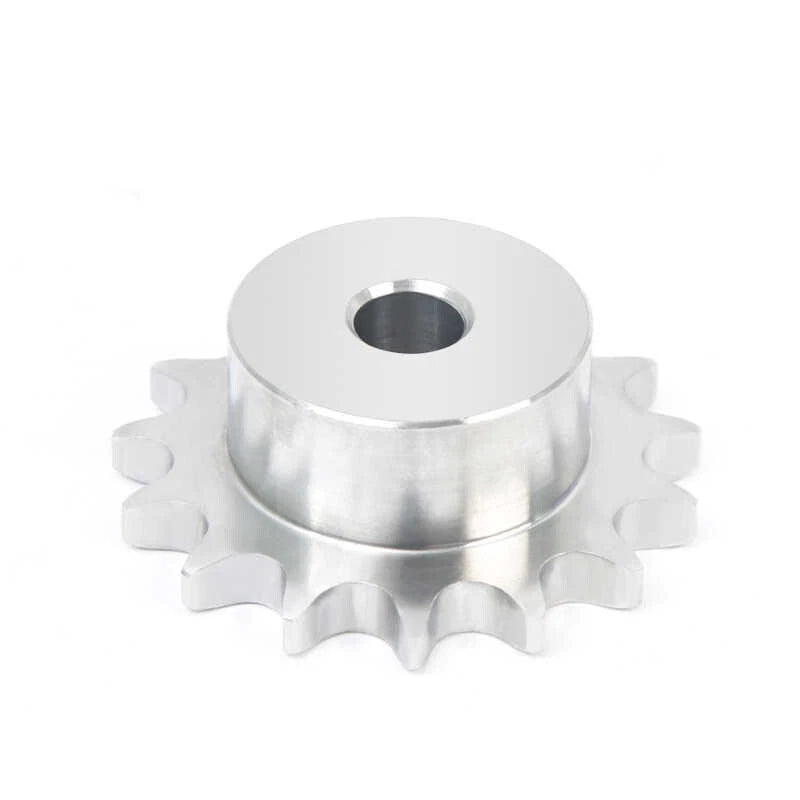
When a corroded or mismatched sprocket causes chain skip, premature wear, or unexpected downtime, the fix starts with the right material and the right tooth count. These A2 stainless steel roller chain sprockets are engineered for makers, machine builders, and maintenance professionals who need a reliable, corrosion-resistant drive component that installs once and stays in spec.
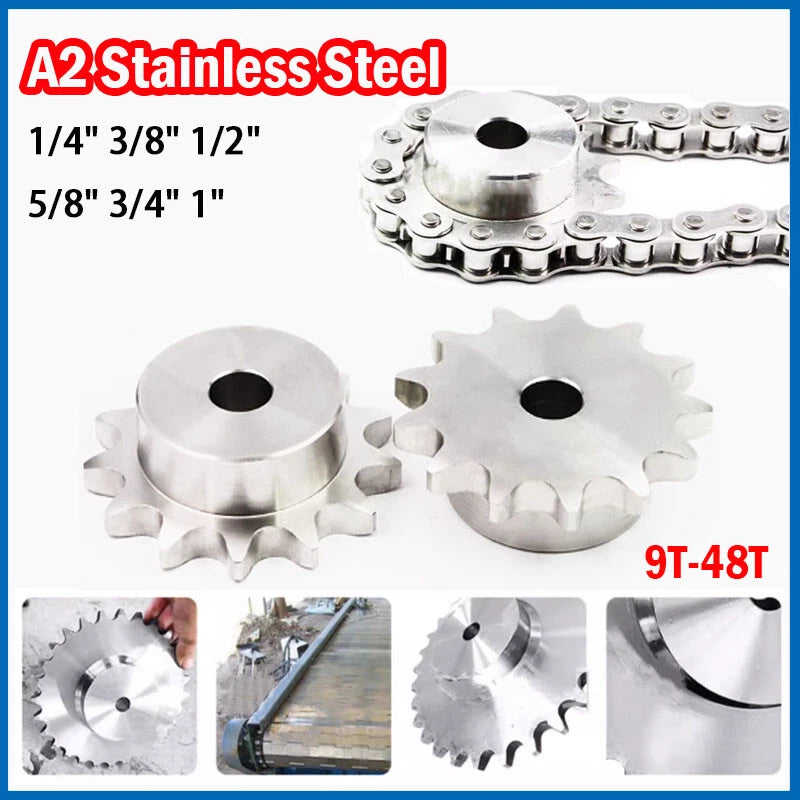
Each sprocket is machined from A2 (304) stainless steel and covers six standard chain pitches: 04C (1/4"), 06B (3/8"), 08B (1/2"), 10A (5/8"), 12A (3/4"), and 16A (1"). Tooth counts range from 9T to 48T, with outer diameters spanning 23.5 mm (0.93") to 199 mm (7.83"), giving you a single source for both compact and large-format drive systems.
Typical applications include conveyor drive systems requiring stainless chain sprockets for food-adjacent environments, custom CNC and automation builds using 1/2" roller chain sprocket replacements, and agricultural or outdoor machinery where a 3/4" stainless steel sprocket must resist moisture and chemical exposure without frequent replacement.
Made from A2 (304) stainless steel for solid corrosion resistance in wet, humid, or mildly chemical environments — a step up from carbon steel sprockets that rust and seize.
Covers 04C (1/4"), 06B (3/8"), 08B (1/2"), 10A (5/8"), 12A (3/4"), and 16A (1") — so you can match the exact pitch of your existing roller chain without sourcing from multiple suppliers.
From compact 9-tooth drive sprockets to large 48-tooth driven sprockets, this range supports a broad variety of gear ratios for speed reduction or torque multiplication in custom drive trains.
Tooth geometry conforms to ISO/DIN roller chain sprocket standards, ensuring smooth chain engagement, reduced noise, and even load distribution across the chain links.
OD scales predictably with tooth count per ISO standards — from 23.5 mm (0.93") on the smallest 04C-10T up to 199 mm (7.83") on the 16A-21T, covering both miniature and heavy-duty drive applications.
Whether you are replacing a worn sprocket on a conveyor, building a custom chain drive for a robotics project, or maintaining agricultural equipment, these sprockets fit standard roller chain systems without modification.
| Material | A2 (304) Stainless Steel |
|---|---|
| Chain Pitch Options | 04C (1/4"), 06B (3/8"), 08B (1/2"), 10A (5/8"), 12A (3/4"), 16A (1") |
| Tooth Count Range | 9T – 48T (varies by pitch series) |
| Outer Diameter Range | 23.5 mm – 199 mm (0.93" – 7.83") |
| Standard | ISO/DIN Roller Chain Sprocket |
| Bore Diameter | See variant options |
| Hub Style | See variant options |
| Surface Finish | Natural stainless (uncoated) |
| Quantity per Order | 1 piece |
| Weight | See variant options |
Match the chain pitch first — the pitch is the distance between chain pin centers. Common pitches are 1/4" (04C), 3/8" (06B), 1/2" (08B), 5/8" (10A), 3/4" (12A), and 1" (16A). Then choose the tooth count based on your desired gear ratio. Finally, confirm the bore diameter matches your shaft. If you are unsure of your chain pitch, measure the distance between three consecutive pins and divide by two.
A-series designations (e.g., 10A, 12A) follow the ANSI/ASME B29.1 standard, while B-series (e.g., 06B, 08B) follow the ISO/DIN 8187 standard. Both standards define roller chain geometry, but the inner link width and roller diameter differ slightly between equivalent pitch sizes. Always match the sprocket series to your chain series — do not mix A-series sprockets with B-series chains of the same pitch.
A2 (304) stainless steel has a tensile strength of approximately 515–620 MPa, which is suitable for light-to-medium duty roller chain drives. It is commonly used in food processing, conveyor systems, and automation equipment where corrosion resistance is prioritized. For heavy-duty industrial applications with high shock loads or very high torque, consider whether a hardened carbon steel or A4 (316) stainless sprocket may be more appropriate for your load requirements.
A2 (304) stainless steel provides solid resistance to atmospheric corrosion, moisture, and many mild chemicals. It performs well in outdoor, humid, and food-adjacent environments. However, it is not fully immune to chloride-induced pitting in high-salt or marine environments — for those conditions, A4 (316) stainless steel is recommended. Regular cleaning will extend service life in any environment.
Gear ratio = driven sprocket teeth ÷ drive sprocket teeth. For example, a 10-tooth drive sprocket paired with a 30-tooth driven sprocket gives a 3:1 reduction — the output shaft turns at one-third the speed of the input shaft with three times the torque. Use this formula to select the correct tooth combination for your speed and torque requirements before ordering.
Bore diameter varies by sprocket size and is listed in the variant options. If you need a specific bore diameter that is not listed, contact us to confirm availability. Many sprockets can be machined to a custom bore by a local machine shop — the stainless steel material machines cleanly with standard tooling.
The outer diameter (OD) is determined by the chain pitch and tooth count according to the ISO/DIN formula: OD = pitch ÷ sin(180° ÷ teeth). The Diameter variant option in this listing shows the exact OD for each Type/tooth count combination — for example, a 08B-1/2"-10 Tooth sprocket has an OD of 45.2 mm (1.78"), while a 08B-1/2"-30 Tooth sprocket has an OD of 95 mm (3.74"). Select your Type first and the corresponding Diameter will be shown.