The chain is fine...but I ordered the wrong size. Nine links of the chain I ordered equals six of the size I wanted. My error...
How can I straighten out the springs? I can't use them coil uo as is.
Your payment information is processed securely. We do not store credit card details nor have access to your credit card information.
Get fitment advice & recommendations
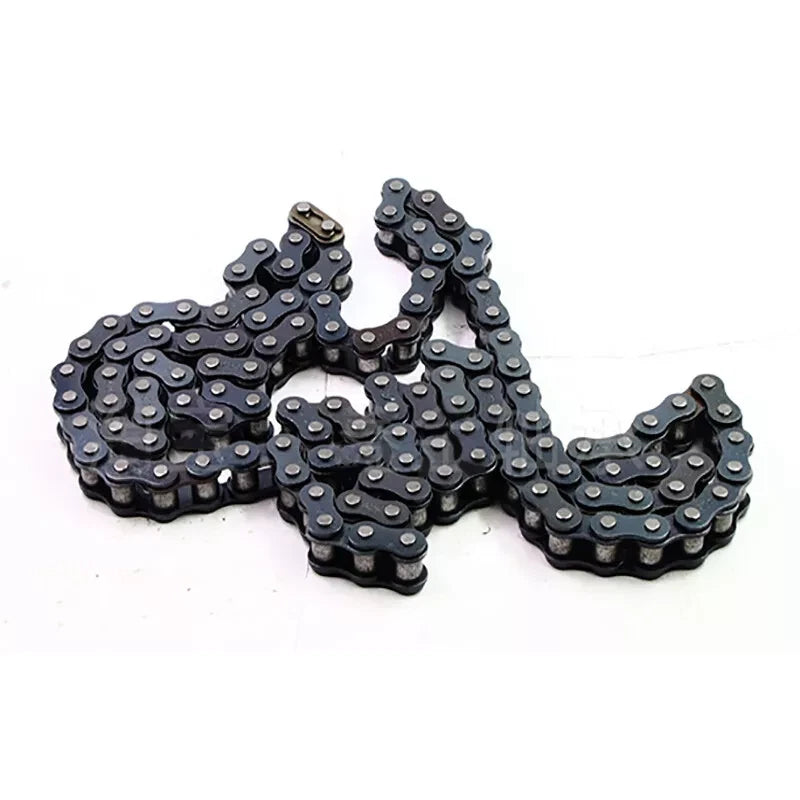
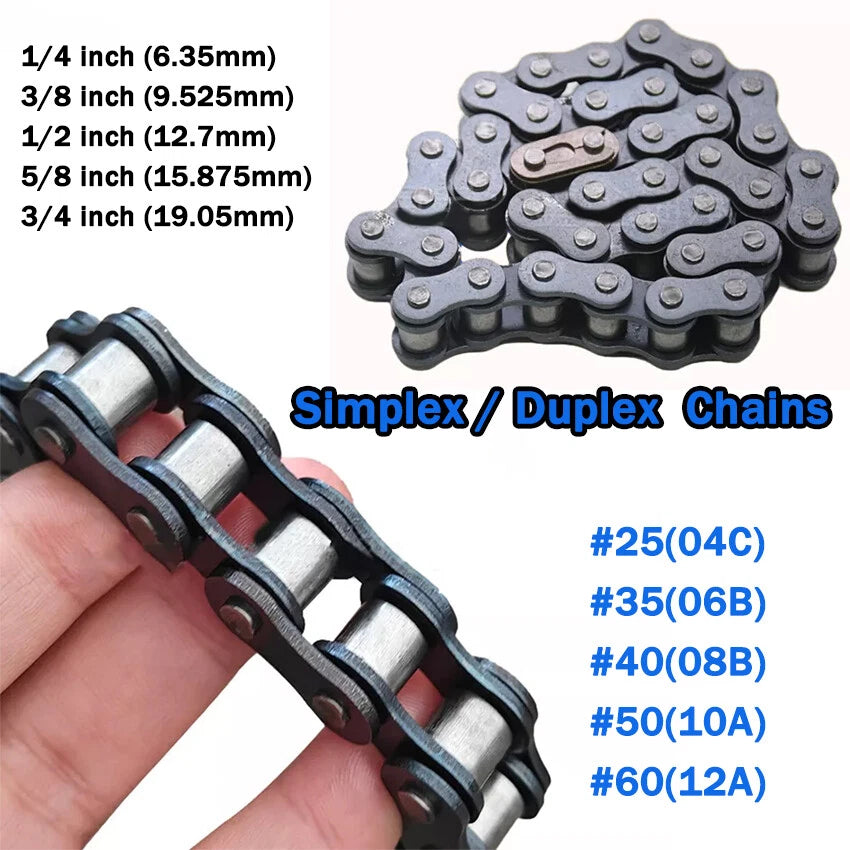
When a worn or undersized drive chain causes slippage, noise, or unexpected downtime, engineers and makers need a reliable replacement they can size and order without guesswork. These simplex and duplex roller chains are stocked in the most common ANSI/ISO series — #25 (04C), #35 (06B), #40 (08B), #50 (10A), and #60 (12A) — covering pitches from 1/4 inch (6.35 mm) up to 3/4 inch (19.05 mm), so hobbyists, maintenance technicians, and small-batch manufacturers can find the exact spec in one place.
Each chain is constructed from carbon steel link plates, precision-ground pins, and hardened rollers. Simplex (single-strand) chains are available from 0.5 m to 5 m lengths; duplex (double-strand) chains are available in 1.524 m lengths. The roller diameter and inner plate height conform to ISO 606 / ANSI B29.1 dimensional standards, ensuring drop-in compatibility with standard sprockets of the same series number.
Typical use cases include go-kart and mini-bike final drives (#35 simplex), conveyor and packaging line drives (#40 and #50 simplex/duplex), agricultural equipment power transmission (#50 duplex), and light industrial automation where a compact #25 chain replaces a timing belt. Whether you are building a custom roller chain conveyor system or sourcing a replacement roller chain for a go-kart drivetrain, these chains deliver consistent pitch accuracy and long service intervals.
Five ANSI/ISO series in one listing — #25 (6.35 mm pitch) through #60 (19.05 mm pitch) — eliminating the need to source from multiple suppliers for a single project.
Choose single-strand simplex for standard drives or double-strand duplex for higher load capacity without increasing sprocket size, ideal for compact gearbox outputs.
Roller diameter, pin diameter, and plate height conform to published standards, ensuring interchangeability with any compliant sprocket on the market.
Heat-treated rollers reduce sprocket tooth wear; precision-ground pins maintain consistent pitch under cyclic loading, extending chain life in continuous-duty applications.
Available in 0.5 m, 1 m, 1.5 m, 1.524 m, and 5 m lengths so you order only what you need — no waste from cutting down an oversized reel.
Suitable for go-kart drives, conveyor lines, agricultural equipment, light industrial automation, and DIY power transmission projects requiring a dependable roller chain replacement.
| Chain Standard | ISO 606 / ANSI B29.1 |
|---|---|
| Series Available | #25 (04C), #35 (06B), #40 (08B), #50 (10A), #60 (12A) |
| Pitch Range | 6.35 mm – 19.05 mm (1/4 in – 3/4 in) |
| Strand Configuration | Simplex (single-strand) / Duplex (double-strand) |
| Available Lengths | 0.5 m, 1 m, 1.5 m, 1.524 m, 5 m |
| Link Plate Material | Carbon steel |
| Pin Treatment | Precision ground |
| Roller Treatment | Heat treated / hardened |
| Roller Diameter | See variant options |
| Inner Plate Height | See variant options |
| Breaking Load | See variant options |
| Weight per Meter | See variant options |
| Finish | Natural steel (uncoated) |
| Lubrication | Pre-lubricated at assembly; periodic re-lubrication recommended |
Simplex (single-strand) chains are the standard choice for most drives where the sprocket width and center distance allow adequate wrap. Duplex (double-strand) chains carry roughly twice the load of the equivalent simplex series, making them the right pick when you need higher torque capacity without moving to a larger pitch — common in compact gearbox outputs and heavy conveyor drives.
Most go-karts and mini-bikes use #35 (06B) simplex chain with a 3/8 inch (9.525 mm) pitch. Some heavier karts or those with larger engines use #40 (08B) simplex. Check your existing sprocket markings or measure the pitch between three consecutive pins and divide by two to confirm the series before ordering.
Yes — provided your sprockets are manufactured to the same ANSI/ISO series standard. Match the series number on your sprocket (e.g., 35, 40, 50) to the chain model number in the variant selector. If your sprocket is marked with an ISO designation (06B, 08B, 10A), use the corresponding chain model shown in parentheses in the listing.
These chains are manufactured from carbon steel with a natural (uncoated) finish and are pre-lubricated at assembly. They are suitable for indoor and sheltered outdoor environments. For wet, washdown, or chemically aggressive environments, consider stainless steel or nickel-plated chain variants. Regular re-lubrication with a chain-specific oil will significantly extend service life in moderately humid conditions.
Calculate the required chain length using the standard formula: L = 2C + (N₁ + N₂)/2 + (N₂ − N₁)²/(4π²C), where C is center distance in pitches and N₁/N₂ are the tooth counts of the small and large sprockets. Round up to the nearest even link count, then convert to meters using the pitch of your selected series. If you need a custom cut, order the next available length above your calculated requirement.
Yes. Standard connecting links (also called master links) of the matching series can be used to join chain sections end-to-end. Ensure the total link count results in an even number for a straight-link join; if an odd count is unavoidable, use an offset link of the same series. Both connecting links and offset links are available separately in our fasteners category.
Measure chain elongation using a chain wear indicator tool or a ruler: place the tool or measure across a fixed number of links and compare against the new-chain dimension. A chain elongated by 1% (e.g., a 12-inch span measuring 12.12 inches or more) should be replaced to prevent accelerated sprocket wear. Also inspect for cracked plates, stiff links, or visible roller damage.
The chain is supplied in the length you select at checkout. If your calculated requirement falls between available lengths, order the next size up and trim using a chain breaker tool (also called a chain splitter) of the appropriate series. A chain breaker drives out the pin cleanly without damaging adjacent links, and the removed section can be saved as a spare connecting link.