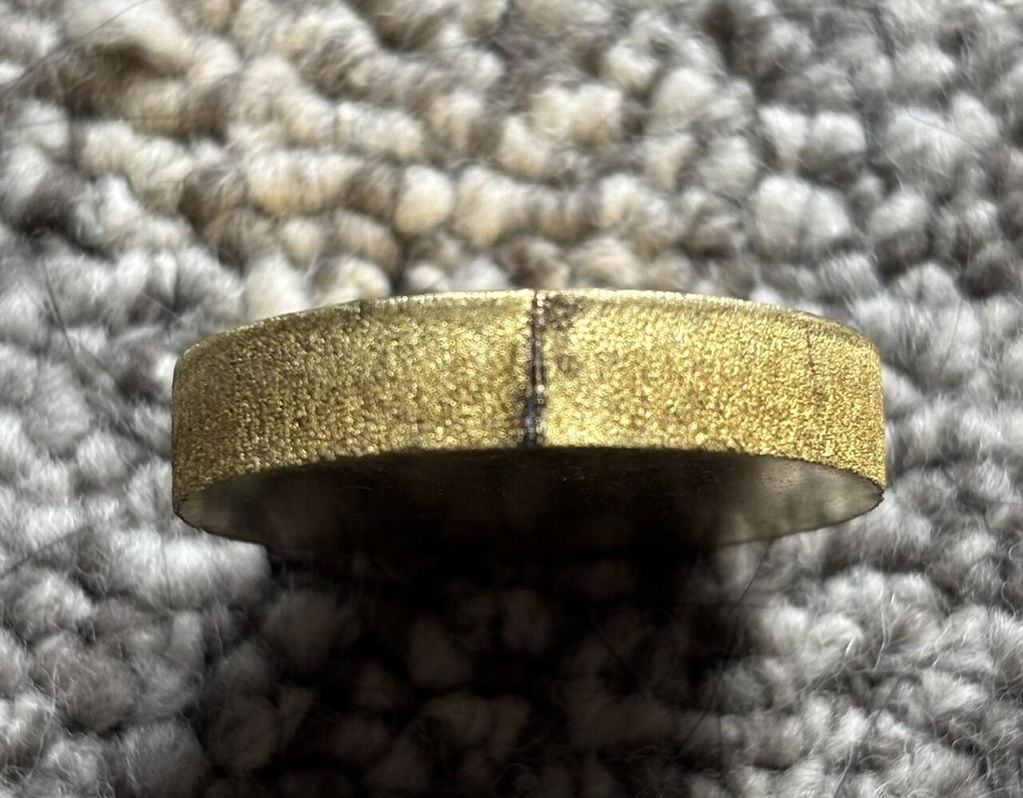
The chain is fine...but I ordered the wrong size. Nine links of the chain I ordered equals six of the size I wanted. My error...
How can I straighten out the springs? I can't use them coil uo as is.
Your payment information is processed securely. We do not store credit card details nor have access to your credit card information.
Get fitment advice & recommendations
When a worn or undersized sprocket causes your #25 roller chain to skip, stretch prematurely, or jump under load, the entire drive system loses efficiency — and downtime follows. Makers, robotics builders, go-kart enthusiasts, and light-industrial maintenance teams who rely on ANSI #25 (ISO 04C) chain need a sprocket that holds tight tooth engagement across every revolution.
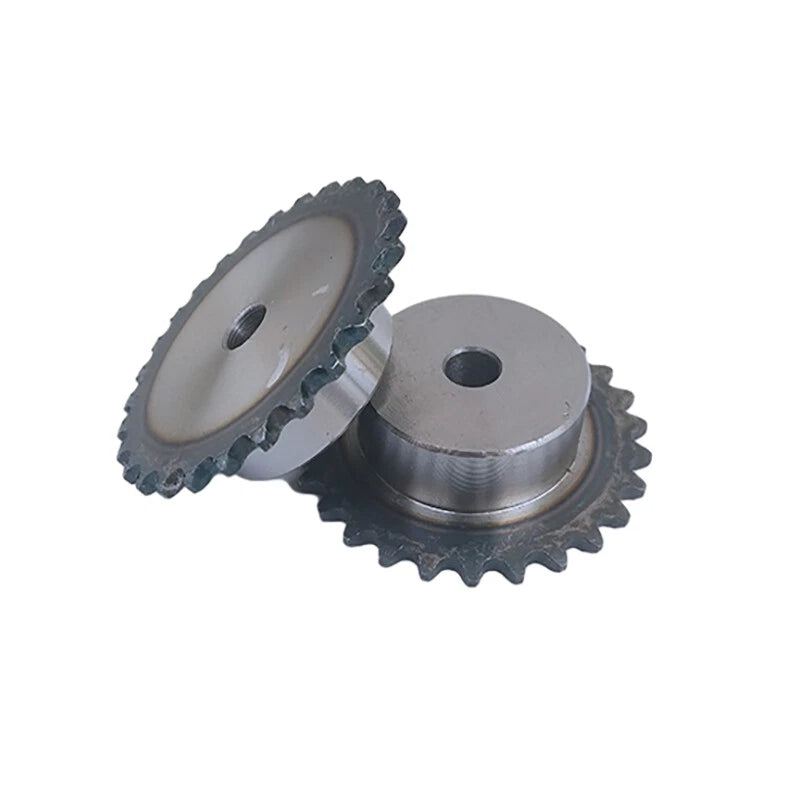
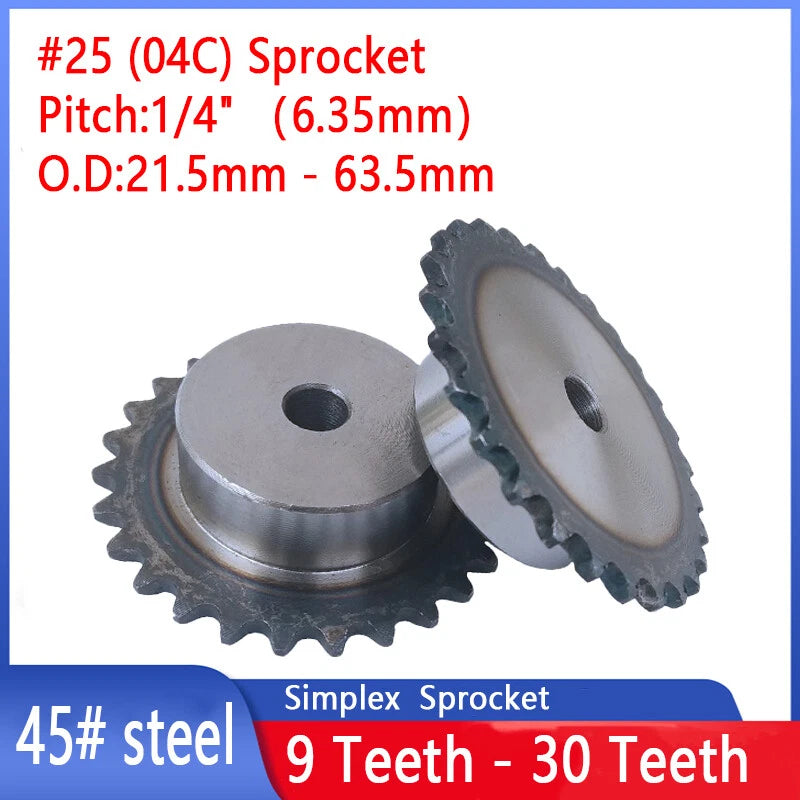
This simplex sprocket wheel is machined to suit #25 (04C) roller chain with a standardized pitch of 1/4 inch (6.35 mm). Available in tooth counts from 9T through 30T, outer diameters range from approximately 21.5 mm (~0.85 in) for the 9T up to 63.5 mm (~2.50 in) for the 30T. The bore is finished for standard shaft fitment; confirm your shaft diameter against the variant listing before ordering.
Typical applications include small go-kart and mini-bike final drives, robotics and automation chain-drive stages, conveyor indexing systems using #25 chain, and DIY power-transmission projects requiring a compact, low-pitch sprocket. The compact outer diameter range makes these sprockets well-suited for tight-clearance enclosures and multi-stage reduction gearboxes.
| Chain Standard | ANSI #25 / ISO 04C Simplex |
|---|---|
| Pitch | 1/4 inch (6.35 mm) |
| Roller Diameter | 3/16 inch (4.76 mm) |
| Tooth Count Range | 9T – 30T (22 options) |
| Outer Diameter Range | 21.5 mm – 63.5 mm (0.85 – 2.50 in) |
| Bore Diameter | See variant options |
| Hub Style | See variant options |
| Material | See variant options |
| Surface Treatment | Oxidation-resistant finish |
| Chain Type Compatibility | Simplex (single-strand) only |
| Available Quantities | 1 PCS / 2 PCS / 5 PCS / 10 PCS |
| Product Type | Roller Chain Sprocket |
The tooth count determines your drive ratio. Divide the driven sprocket teeth by the driver sprocket teeth to get the reduction ratio. For example, a 9T driver paired with a 27T driven sprocket gives a 3:1 reduction. Smaller tooth counts produce higher speed at the output shaft; larger tooth counts increase torque. Match the outer diameter to your available center distance and chain length.
Yes — provided your chain is ANSI #25 or ISO 04C simplex (single-strand) with a 6.35 mm pitch and a 4.76 mm roller diameter. These are the most common #25 chain dimensions. If your chain is duplex (#25-2) or triplex (#25-3), this sprocket is not compatible.
Bore diameter varies by tooth count and is listed in the individual variant details. Please check the variant description or contact us to confirm the bore size before ordering, especially if you need a specific shaft fit (e.g., 6 mm, 8 mm, or 10 mm).
The surface treatment provides moderate resistance to oxidation and is suitable for typical workshop conditions and light-outdoor use. For continuous outdoor exposure or wet environments, we recommend applying a chain lubricant regularly and inspecting the sprocket periodically for surface wear.
ANSI #25 chain and matching sprockets are rated for light-duty to medium-duty applications. The #25 chain has a typical breaking load of approximately 3.1 kN (700 lbf). Actual working load capacity depends on speed, lubrication, and the number of teeth in engagement. For heavy-duty or high-cycle applications, consider upgrading to #35 or #40 chain and sprockets.
Yes. The compact outer diameters of the smaller tooth-count variants (9T–14T, OD 21.5–31.5 mm) make them well-suited for multi-stage chain-drive reductions in robotics, go-karts, and DIY gearboxes. Ensure adequate center distance between stages and use a chain tensioner if the chain slack cannot be managed by adjusting center distance alone.
Multi-packs offer a lower per-unit cost and ensure you have spares on hand for ongoing projects or production runs. If you are building multiple identical assemblies or maintaining a fleet of machines, stocking 5 or 10 pieces reduces reorder frequency and keeps your build schedule on track.