The chain is fine...but I ordered the wrong size. Nine links of the chain I ordered equals six of the size I wanted. My error...
How can I straighten out the springs? I can't use them coil uo as is.
Your payment information is processed securely. We do not store credit card details nor have access to your credit card information.
Get fitment advice & recommendations
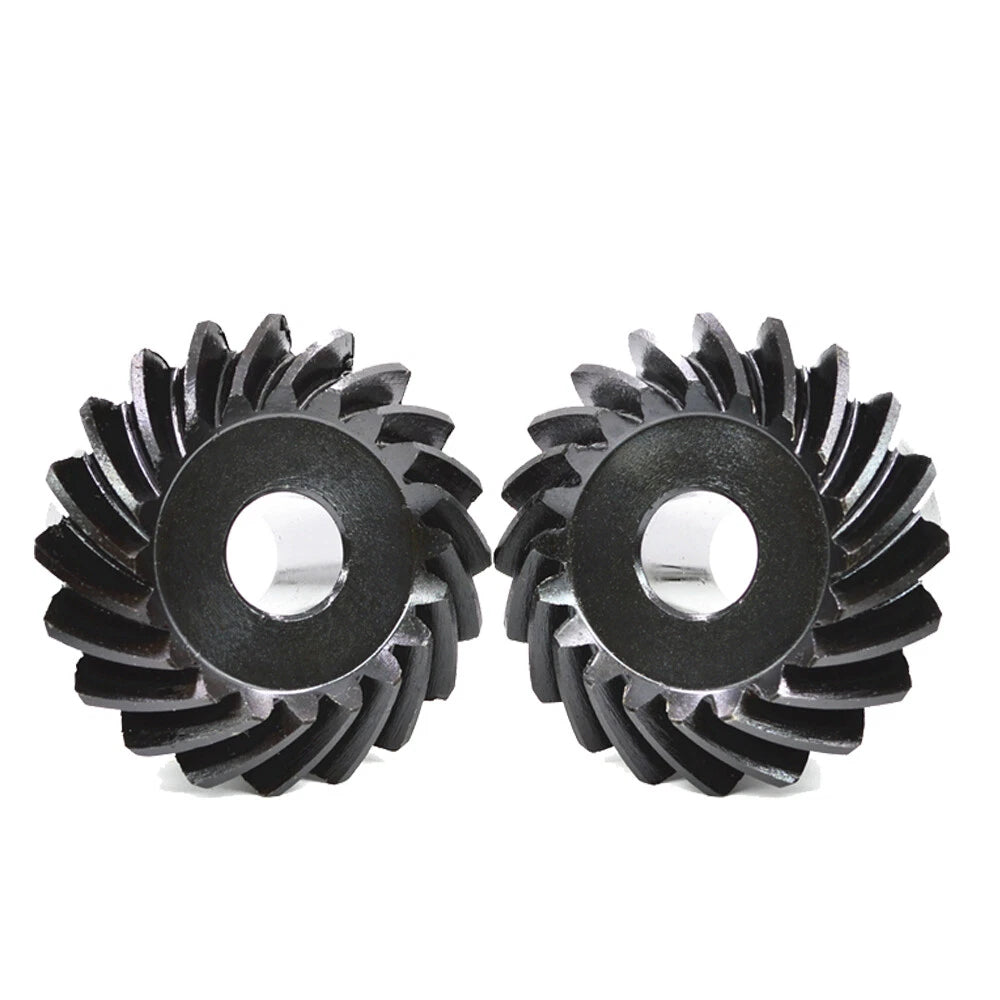
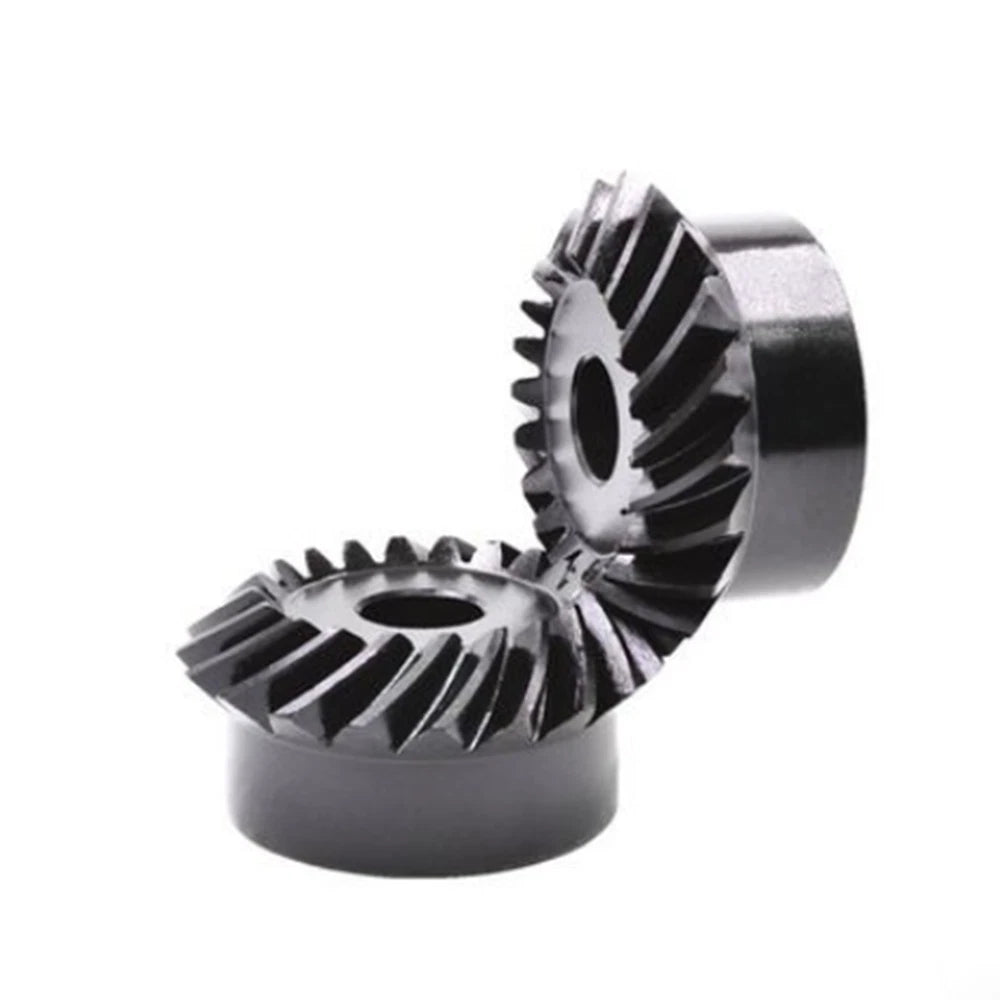
When your build demands a clean 90-degree direction change without sacrificing torque or rotational accuracy, standard spur gears simply fall short. Engineers, robotics builders, and CNC machine designers rely on spiral bevel gears to deliver smooth, low-noise power transfer at right angles — and this matched 1:1 pairing set is engineered exactly for that purpose.
Each set consists of a matched pair of spiral bevel gears machined from alloy steel, available in Module 1.5, 2, 2.5, 3, and 4, with tooth counts of 20T, 25T, and 30T. Spiral hand options include Left Spiral, Right Spiral, or a Left + Right Spiral matched pair. Gear outer diameters range from approximately 30 mm (1.18 in) for Module 1.5 / 20T up to approximately 120 mm (4.72 in) for Module 4 / 30T, with face widths typically 8–20 mm (0.31–0.79 in) depending on module size.
Typical applications include 90-degree gearbox assemblies for CNC router axis drives, robotic joint actuators requiring equal input/output speed ratios, industrial conveyor corner drives, and custom power transmission rigs where helical tooth engagement reduces vibration compared to straight bevel alternatives.
Each order includes a factory-matched gear pair engineered for equal input-to-output speed ratio at a precise 90° shaft angle — no ratio mismatch, no shimming guesswork.
Helical spiral tooth form delivers gradual tooth engagement, reducing impact noise and vibration versus straight bevel gears — critical for precision motion control and quiet operation.
Five module sizes cover a wide torque and speed spectrum. Select the module that matches your shaft diameter, load requirement, and center distance — from compact robotics (M1.5) to heavy-duty machinery (M4).
Choose 20T for higher rotational speed with compact geometry, 25T for a balanced torque-speed profile, or 30T for increased tooth contact area and load capacity in demanding applications.
Available in Left Spiral, Right Spiral, or a Left + Right Spiral set. Spiral hand determines the axial thrust direction — select the correct hand for your bearing arrangement and shaft layout.
Machined from alloy steel with a hardened tooth surface for wear resistance and dimensional stability under cyclic loading — suitable for continuous-duty drive systems.
| Product Type | Spiral Bevel Gear, Matched 1:1 Pair |
|---|---|
| Gear Modulus | 1.5 / 2 / 2.5 / 3 / 4 (see variant options) |
| Number of Teeth | 20T / 25T / 30T (see variant options) |
| Spiral Hand | Left Spiral / Right Spiral / Left + Right Spiral (see variant options) |
| Shaft Angle | 90° |
| Gear Ratio | 1:1 |
| Pressure Angle | 20° |
| Material | Alloy Steel |
| Surface Treatment | See variant options |
| Outer Diameter | See variant options |
| Bore Diameter | See variant options |
| Face Width | See variant options |
| Quantity per Set | 1 pair (2 gears) |
Module size determines the physical tooth size and the gear's load-carrying capacity. Larger modules (e.g., M3, M4) handle higher torques and suit heavier machinery, while smaller modules (M1.5, M2) are ideal for compact robotics or light-duty drives. Match the module to your shaft diameter and the torque your system transmits — a general rule is that the module should be proportional to the shaft diameter at the bore.
Yes, spiral hand matters significantly. Left and Right Spiral refer to the direction the teeth curve across the face of the gear. The spiral hand determines the direction of axial thrust generated during operation, which affects your bearing selection and housing design. For a 90° 1:1 pair, one gear must be Left Spiral and the other Right Spiral — the "Left + Right Spiral" set option provides exactly this matched pair. If you order individual gears, ensure you select opposite hands for the two mating gears.
No. These gears are designed as 1:1 matched pairs — both gears in a set must have the same tooth count and the same module. Mixing tooth counts between the two mating gears will result in incorrect meshing geometry, accelerated wear, and potential failure. If you need a ratio other than 1:1, a different bevel gear set with the appropriate tooth count ratio is required.
These spiral bevel gears are designed around metric module standards and are intended for use with metric shafts. The bore diameter varies by module and tooth count — please refer to the variant options or contact us to confirm the bore size for your selected variant before ordering, especially if you need to match a specific shaft diameter or require a keyway.
The alloy steel construction with hardened tooth surfaces provides solid fatigue resistance for continuous-duty applications. Actual load capacity depends on the module size, rotational speed (RPM), lubrication method, and operating temperature. Larger modules (M3, M4) with higher tooth counts (25T, 30T) offer the greatest load capacity in this range. For critical load calculations, refer to standard bevel gear rating methods (e.g., AGMA or ISO 10300).
Yes, spiral bevel gears require lubrication for reliable long-term operation. For enclosed gearbox applications, an ISO VG 220 or VG 320 gear oil is typically appropriate. For open-drive or low-speed applications, a lithium-based grease rated for gear use can be applied directly to the tooth flanks. Avoid running these gears dry, as the spiral tooth geometry generates axial loads that increase surface contact stress without adequate lubrication.
These gears are well-suited for CNC machine axis drives, robotic joint assemblies, custom gearbox builds, conveyor corner drives, agricultural equipment, and DIY power transmission projects requiring a 90° direction change at a 1:1 speed ratio. The spiral tooth form makes them particularly effective in applications where noise reduction and smooth torque delivery are priorities over straight bevel alternatives.