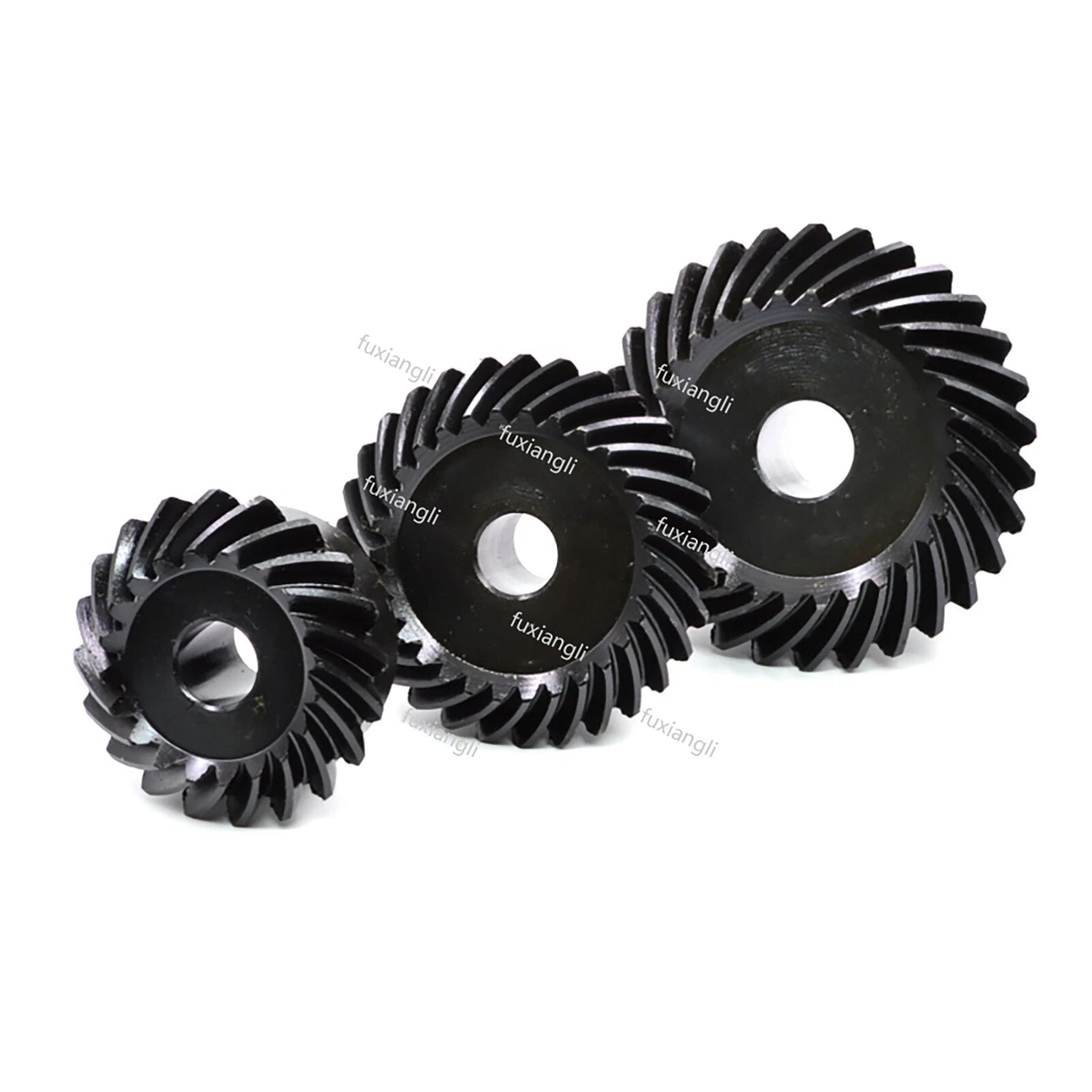
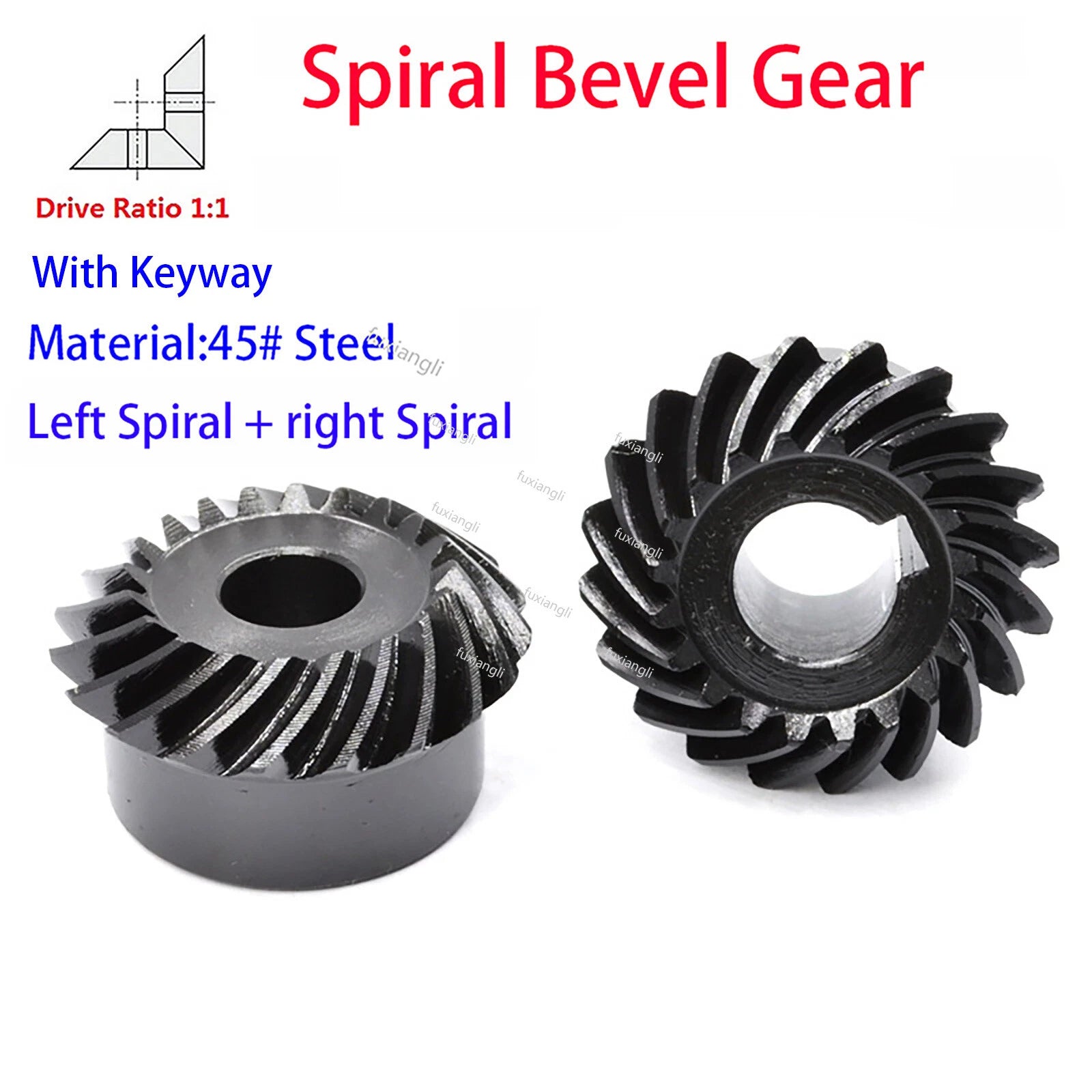
Spiral Bevel Gears 1.5/2 Modulus 90° 1:1 Pairing With Keyway,Left + right Spiral

No reviews

Price:
Sale price$49.64 USD
Stock:
In stock (500 units), ready to be shipped

Payment & Security

Ach Direct Debit Amazon American Express Apple Pay Bancontact BLIK Diners Club Discover EPS Google Pay iDEAL Wero JCB Maestro Mastercard Multibanco MobilePay PayPal Przelewy24 Shop Pay Twint Union Pay USDC Visa

Your payment information is processed securely. We do not store credit card details nor have access to your credit card information.

Limited Offer — Spend More, Save More
Spend $55+
Save $5
Spend $100+
Save $10
Spend $200+
Save $25
HomeDIYer DIY Expert Support

DIY Expert Support

Get fitment advice & recommendations

Mon–Fri  8:30 AM – 8:00 PM
24-Hour Fast Ship
Arrives in 3–14 Days
Worldwide Shipping
30-Day Returns
1 tree planted with every purchase

Description

Spiral Bevel Gears — Matched 90° Pairs for Smooth, Quiet Power Transmission

When your drivetrain demands a precise 90° direction change without the noise and vibration of straight-cut bevel gears, engineers and makers alike turn to spiral bevel gears. Whether you are building a CNC axis, a robotic joint, or a custom gearbox, mismatched or poorly paired bevel gears cause backlash, premature wear, and frustrating alignment headaches. This listing solves that problem by supplying a factory-matched left-spiral and right-spiral pair, guaranteed to mesh at the correct 90° angle with a 1:1 ratio right out of the box.

Each set consists of two spiral bevel gears machined from alloy steel, featuring a helical tooth profile for gradual engagement and reduced operating noise. Available in 1.5 modulus and 2 modulus configurations, with tooth counts of 20T, 25T, and 30T. Bore diameters range from 10 mm (0.39 in) to 25 mm (0.98 in), and each bore is precision-cut with a standard keyway — 4×2 mm, 5×2.5 mm, 6×3 mm, or 8×3.5 mm depending on the bore size — for positive, slip-free shaft engagement.

Typical applications include 90° right-angle gearboxes for CNC router Z-axes, robotic arm wrist joints requiring compact torque redirection, custom agricultural or industrial machinery where spiral bevel gear sets replace worn OEM components, and DIY power transmission projects demanding low-noise, high-efficiency direction change at a 1:1 speed ratio.

⚙️ Compatibility: Sold as a matched left-spiral + right-spiral pair. Both gears share the same modulus and tooth count. Verify your shaft diameter and keyway dimensions before ordering. Not interchangeable with straight-cut bevel gears of the same modulus.

✅ Key Features of These Spiral Bevel Gears

  • 🔄 Factory-Matched Pairs — Each set ships as one left-spiral gear and one right-spiral gear pre-selected to mesh correctly at 90°, eliminating the guesswork of sourcing compatible mates separately.
  • 📐 Precise 1:1 Ratio at 90° — Equal tooth counts on both gears deliver an exact 1:1 speed and torque ratio, making these ideal for direction-change applications where output speed must match input speed.
  • 🔩 Keyway Bore for Positive Drive — Every bore is machined with a standard DIN keyway (4×2 mm up to 8×3.5 mm), ensuring a secure, non-slip connection to the shaft without relying on set screws alone.
  • Spiral Tooth Profile for Quiet Operation — The helical spiral tooth geometry distributes load across multiple teeth simultaneously, reducing impact noise and vibration compared to straight-cut bevel gears under the same load.
  • 🛠️ Wide Modulus and Bore Selection — Choose from 1.5 or 2 modulus, 20T / 25T / 30T tooth counts, and bore diameters from 10 mm to 25 mm to match your specific shaft and torque requirements without custom machining.
  • 🏭 Alloy Steel Construction — Machined from alloy steel with a natural metallic finish, these gears offer the strength and wear resistance needed for continuous-duty mechanical power transmission in demanding environments.

📐 Technical Specifications — Spiral Bevel Gear Pairs

Gear Type Spiral Bevel Gear (Matched Pair)
Spiral Direction Left Spiral + Right Spiral (1 set)
Shaft Angle 90°
Gear Ratio 1:1
Available Modulus 1.5 / 2
Available Tooth Count 20T / 25T / 30T
Bore Diameter Range 10 mm – 25 mm (0.39 in – 0.98 in)
Keyway Dimensions 4×2 mm / 5×2.5 mm / 6×3 mm / 8×3.5 mm (varies by bore)
Material Alloy Steel
Surface Finish Natural Metallic (uncoated)
Tooth Profile Spiral (Helical Bevel)
Weight See variant options

❓ Frequently Asked Questions

How do I choose the right modulus and tooth count for my application?

Modulus determines the physical size of each tooth — a higher modulus means larger, stronger teeth capable of transmitting more torque. Choose 1.5 modulus for lighter-duty or space-constrained applications (e.g., small robotics, hobby CNC), and 2 modulus for heavier loads or larger shaft diameters. Tooth count affects the outer diameter of the gear: 20T produces the most compact gear, while 30T gives a larger pitch circle and smoother load distribution. Match the modulus to your existing gearbox design or calculate based on your torque and speed requirements.

What bore diameter and keyway size should I select?

Select the bore diameter that matches your shaft diameter exactly. The keyway dimensions are determined by the bore size: 10–12 mm bores use a 4×2 mm keyway, 14–16 mm bores use 5×2.5 mm, 18–20 mm bores use 6×3 mm, and 22–25 mm bores use 8×3.5 mm. These follow standard DIN 6885 keyway dimensions. If your shaft has a pre-cut keyway, verify the width and depth match before ordering.

Are both gears in the pair identical, or are they different?

The two gears in each set are mirror images of each other — one is left-hand spiral and the other is right-hand spiral. They share the same modulus, tooth count, and outer dimensions, but their tooth helix directions are opposite so they mesh correctly at 90°. Do not attempt to pair two left-spiral or two right-spiral gears, as they will not mesh properly.

How strong are these spiral bevel gears, and what loads can they handle?

These gears are machined from alloy steel, which provides significantly higher tensile and shear strength compared to carbon steel or cast iron alternatives. The spiral tooth profile distributes load across multiple teeth simultaneously, further increasing load capacity versus straight-cut bevel gears of the same modulus. Exact torque ratings depend on operating speed, lubrication, and mounting precision. For critical load calculations, consult standard gear engineering references using the modulus, tooth count, face width, and material properties.

Do these gears require lubrication, and how should they be maintained?

Yes, spiral bevel gears require proper lubrication for optimal performance and longevity. For enclosed gearboxes, use a gear oil with viscosity appropriate for your operating speed and load (ISO VG 150–220 is common for moderate-speed applications). For open or semi-open installations, apply a consistent grease such as NLGI #2 lithium-complex grease to the tooth flanks. Inspect and replenish lubrication at regular intervals based on your duty cycle.

Can I use these gears to replace worn OEM bevel gears in existing machinery?

Yes, provided the replacement gears match the original modulus, tooth count, bore diameter, and keyway dimensions of the OEM parts. Measure the original gears carefully — modulus can be calculated from the outer diameter and tooth count (OD = modulus × (tooth count + 2) for standard gears). If the original gears are imperial (diametral pitch), note that metric modulus and imperial DP gears are not interchangeable even if they appear similar in size.

What is the difference between spiral bevel gears and straight-cut bevel gears?

Straight-cut bevel gears have teeth that run straight across the face of the gear cone, causing all tooth contact to occur simultaneously — this produces more noise and vibration, especially at higher speeds. Spiral bevel gears have curved, helical teeth that engage gradually along the tooth length, spreading the load over a larger contact area. The result is quieter operation, higher load capacity for the same gear size, and smoother torque transmission. Spiral bevel gears are the preferred choice for applications where noise, vibration, or continuous-duty performance is a concern.

🛒 Select your Types, Bore Diameter, and Keyway & Amount above, then add to cart.


You may also like

Recently viewed