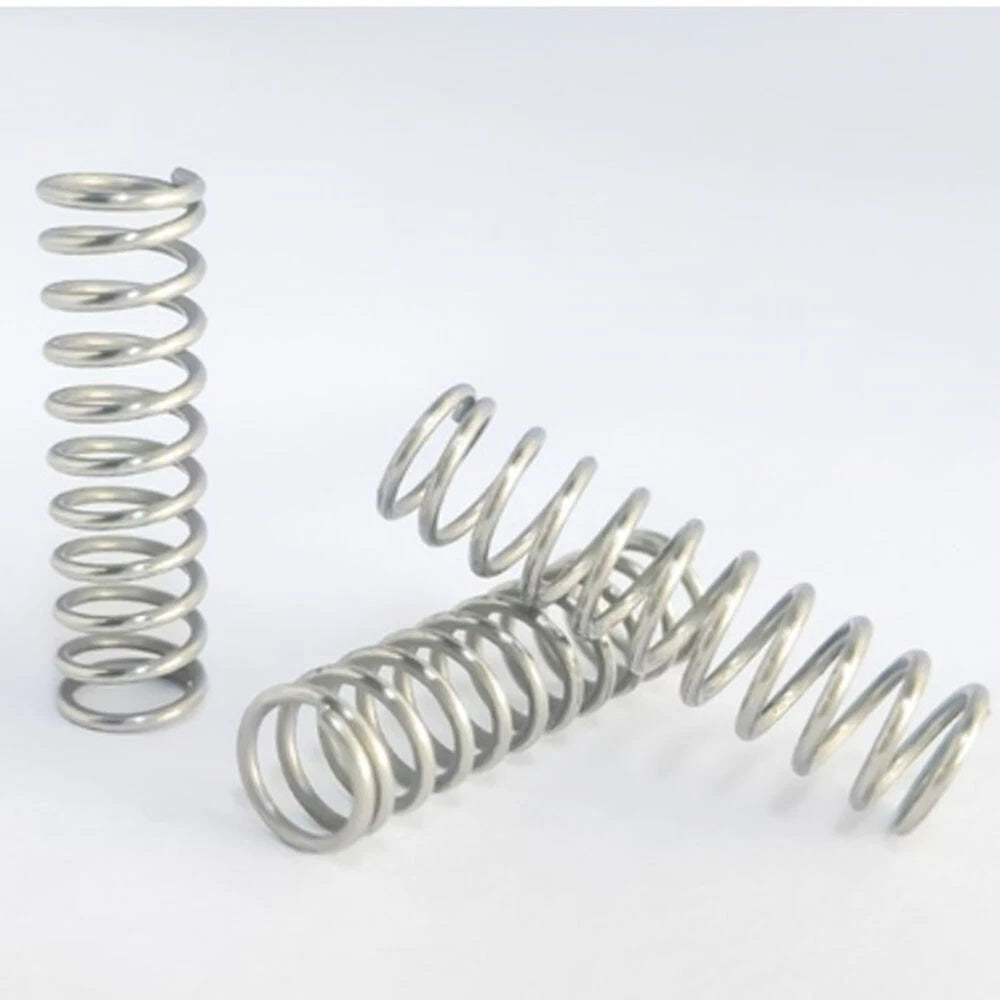
1.5mm-2.0mm Wire Dia 60-100mm Length Stainless steel Pressure Compression Spring

No reviews

Price:
Sale price$4.20 USD
Stock:
In stock (500 units), ready to be shipped

Payment & Security

Ach Direct Debit Amazon American Express Apple Pay Bancontact BLIK Diners Club Discover EPS Google Pay iDEAL Wero JCB Maestro Mastercard Multibanco MobilePay PayPal Przelewy24 Shop Pay Twint Union Pay USDC Visa

Your payment information is processed securely. We do not store credit card details nor have access to your credit card information.

Limited Offer — Spend More, Save More
Spend $55+
Save $5
Spend $100+
Save $10
Spend $200+
Save $25
HomeDIYer DIY Expert Support

DIY Expert Support

Get fitment advice & recommendations

Mon–Fri  8:30 AM – 8:00 PM
24-Hour Fast Ship
Arrives in 3–14 Days
Worldwide Shipping
30-Day Returns
1 tree planted with every purchase

Description

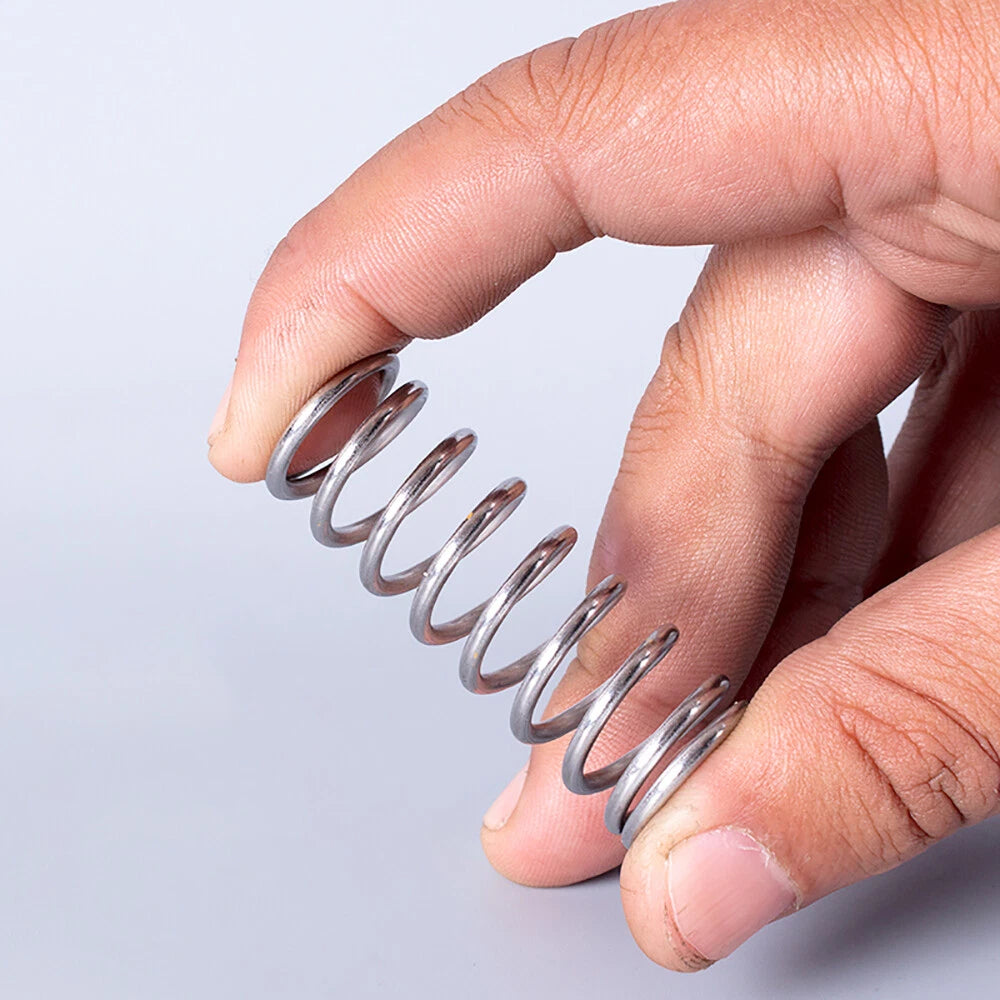
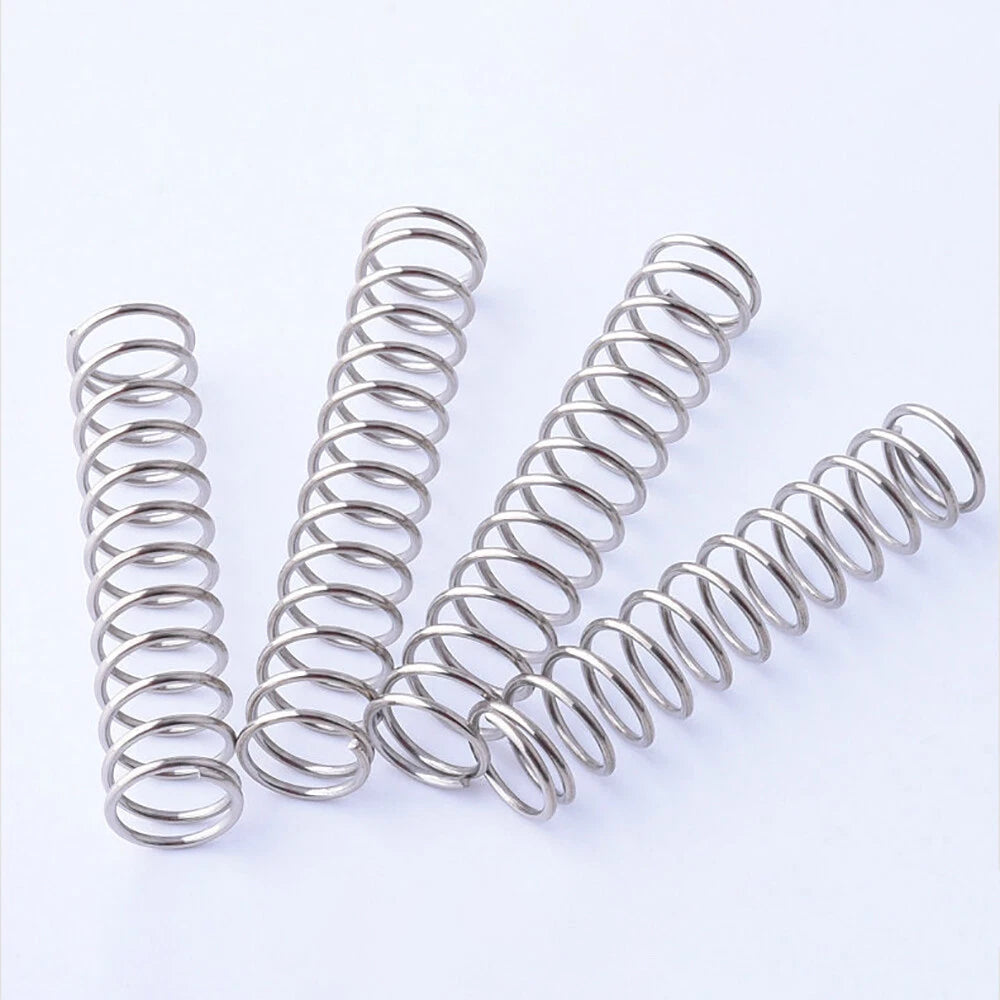
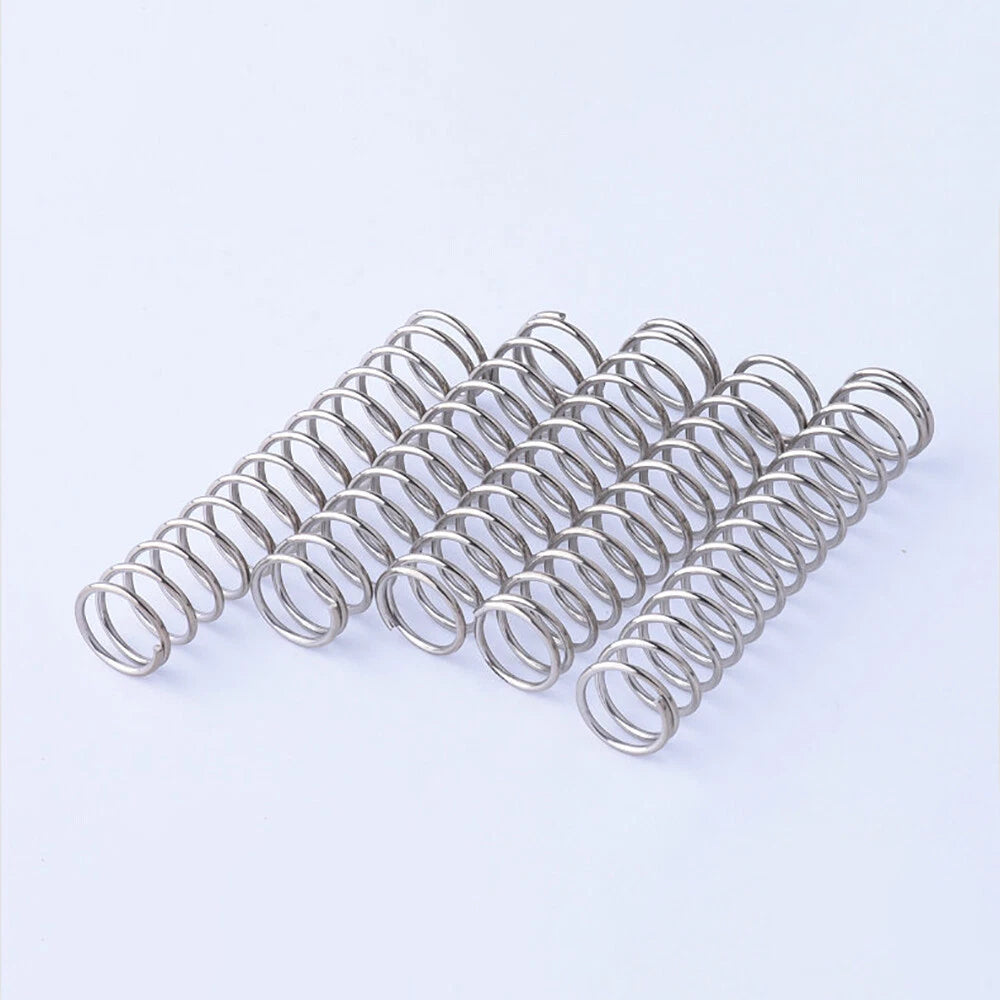
Stainless Steel Compression Springs — Reliable Elastic Force for Precision DIY & Mechanical Applications

When a project demands consistent return force and dimensional accuracy, a poorly matched spring becomes the weakest link. Engineers, robotics builders, and hands-on DIYers who work with actuators, jigs, valves, or mechanical assemblies need compression springs that hold their rated load cycle after cycle without corroding or fatiguing prematurely. These stainless steel pressure compression springs are engineered to deliver exactly that.

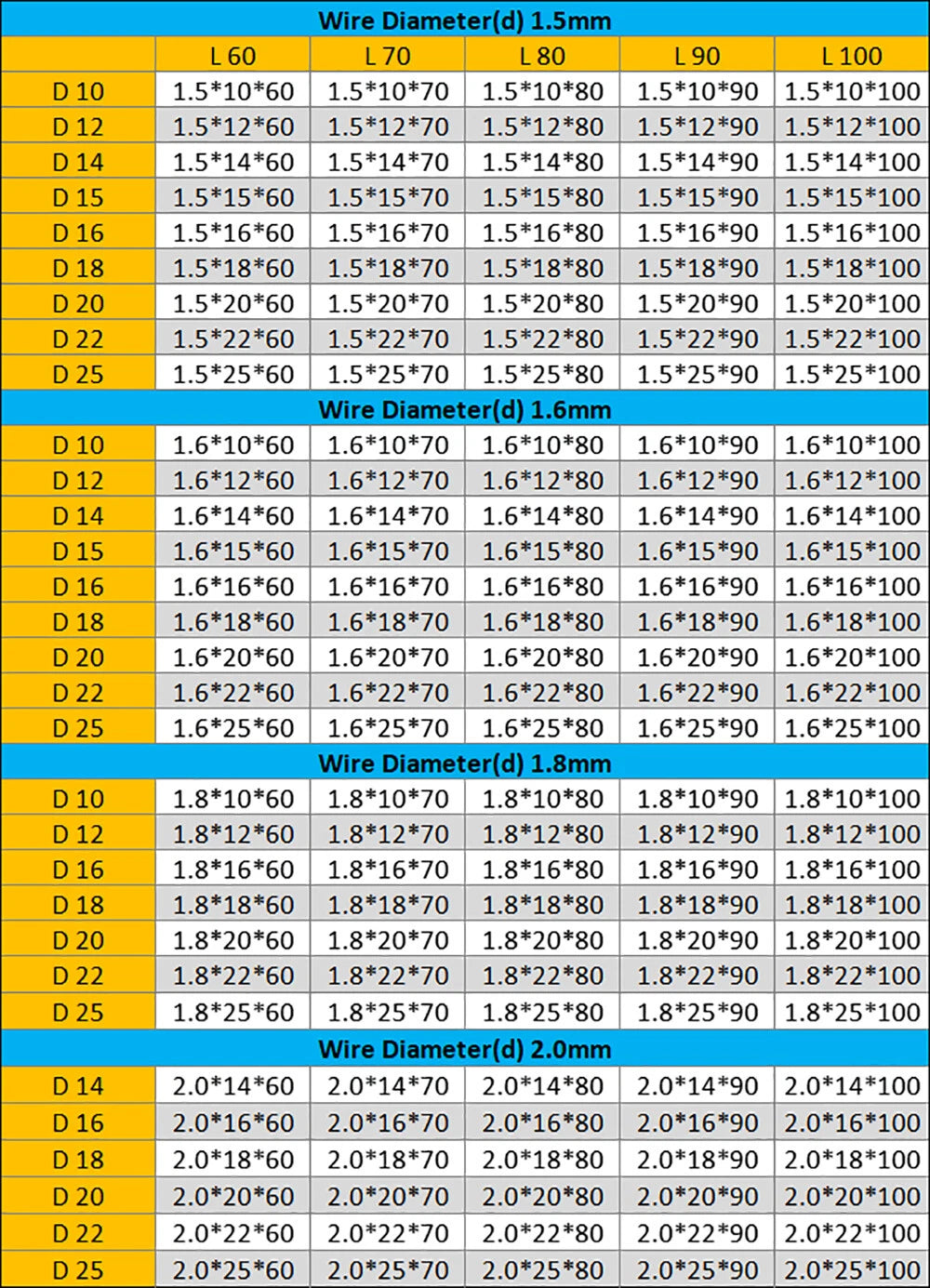
Each spring is formed from stainless steel wire with a diameter ranging from 1.5 mm to 2.0 mm (approximately 0.059 in to 0.079 in). Outside diameters span 10 mm to 30 mm (roughly 0.39 in to 1.18 in), and free lengths run from 60 mm to 100 mm (2.36 in to 3.94 in). The closed and ground ends ensure flat, stable seating on both contact surfaces.

Typical use cases include return-force mechanisms in 3D printer extruder assemblies, spring-loaded clamps and fixtures for small-batch manufacturing, valve and plunger assemblies in fluid-handling equipment, and robotics joints requiring repeatable elastic response. The corrosion-resistant alloy also makes these springs well-suited for outdoor enclosures and humid workshop environments where carbon steel would degrade.

⚙️ Compatible with standard spring seats, bores, and plunger housings. Select wire diameter and outside diameter to match your bore ID and housing OD tolerances.

✅ Key Features of These Stainless Steel Compression Springs

🔩Stainless Steel Construction

Formed from stainless steel wire for corrosion resistance in humid, outdoor, and light chemical environments.

📐Wide Size Matrix

Wire diameters from 1.5 mm to 2.0 mm; outside diameters from 10 mm to 30 mm; free lengths from 60 mm to 100 mm — covering a broad range of mechanical fits.

🎯Closed & Ground Ends

Flat end coils provide stable, perpendicular seating and reduce lateral deflection under load.

Consistent Spring Rate

Uniform coil pitch maintains a linear load-deflection curve, enabling predictable force output across the compression stroke.

🔄Multi-Cycle Fatigue Resistance

Work-hardened stainless wire resists set and fatigue, maintaining free length over repeated compression cycles.

📦Flexible Pack Quantities

Available in 1-piece or 2-piece packs per variant — order exactly what your build requires without excess stock.

📐 Technical Specifications — Compression Spring

Material Stainless Steel
Wire Diameter Range 1.5 mm – 2.0 mm (0.059 in – 0.079 in)
Outside Diameter Range 10 mm – 30 mm (0.39 in – 1.18 in)
Free Length Range 60 mm – 100 mm (2.36 in – 3.94 in)
End Type Closed & Ground
Coil Direction Right-hand (standard)
Spring Rate See variant options
Max Load See variant options
Surface Finish Natural (uncoated stainless)
Pack Quantity 1 pcs or 2 pcs (see variant options)

❓ Frequently Asked Questions

How do I choose the right wire diameter for my application?

Wire diameter directly determines the spring rate and maximum load capacity. A thicker wire (e.g., 2.0 mm) produces a stiffer spring with higher load capacity, while a thinner wire (e.g., 1.5 mm) yields a softer spring. Match the wire diameter to your required force range — if you need a light return force, start with 1.5 mm or 1.6 mm; for heavier loads, select 1.8 mm or 2.0 mm.

How do I select the correct outside diameter?

The outside diameter (OD) must fit inside your housing bore with adequate clearance — typically 0.5 mm to 1 mm of radial clearance on each side. If your bore ID is 12 mm, choose an OD of 10 mm or 11 mm. If the spring slides over a guide rod, the inside diameter (ID = OD minus 2× wire diameter) must clear the rod diameter.

Are these springs corrosion-resistant enough for outdoor or humid environments?

Yes. Stainless steel offers significantly better corrosion resistance than carbon steel or zinc-plated springs. These springs are suitable for humid workshops, outdoor enclosures, and light-exposure environments. For highly aggressive chemical or saltwater immersion applications, verify the specific alloy grade against your media requirements.

What does free length mean, and how does it affect my design?

Free length is the overall length of the spring when no load is applied. Your housing or assembly must accommodate the full free length when the spring is uncompressed. The working stroke (compression travel) is the difference between the free length and the installed (compressed) length. Ensure your design allows sufficient travel without fully compressing the spring solid (solid height).

Can I use these springs in 3D printers, robotics, or automation fixtures?

Yes — these are well-suited for extruder return mechanisms, spring-loaded probe mounts, gripper fingers, valve actuators, and jig clamps. The consistent spring rate and closed-ground ends make them reliable in repetitive-cycle applications common in desktop robotics and small automation builds.

How do I decide between the 1-piece and 2-piece pack options?

If you need a single spring for a prototype or repair, select the 1-piece option to avoid unnecessary stock. For builds requiring matched pairs (e.g., bilateral symmetric mechanisms, dual-spring assemblies) or if you want a spare on hand, the 2-piece pack offers better value per unit. Check the "Length & Quantities" variant selector for available pack sizes.

What is the difference between compression springs and extension springs?

Compression springs resist being compressed — they push back when force is applied along their axis. Extension springs, by contrast, resist being stretched and pull back when elongated. These listings are compression springs; they are designed to sit between two surfaces and provide a return or separation force when compressed.

🛒 Select your Wire Diameter, Outside Diameter, and Length & Quantities above, then add to cart.

You may also like

Recently viewed