The chain is fine...but I ordered the wrong size. Nine links of the chain I ordered equals six of the size I wanted. My error...
How can I straighten out the springs? I can't use them coil uo as is.
Your payment information is processed securely. We do not store credit card details nor have access to your credit card information.
Get fitment advice & recommendations
When your project demands reliable electrical conductivity, thermal transfer, or a material that machines cleanly without contamination, generic alloy sheets fall short. Makers, electricians, jewellers, and fabricators who need verified 99.9% copper purity turn to T2-grade flat stock — a material that performs consistently whether you're winding transformer coils, fabricating bus bars, or cutting custom gaskets.
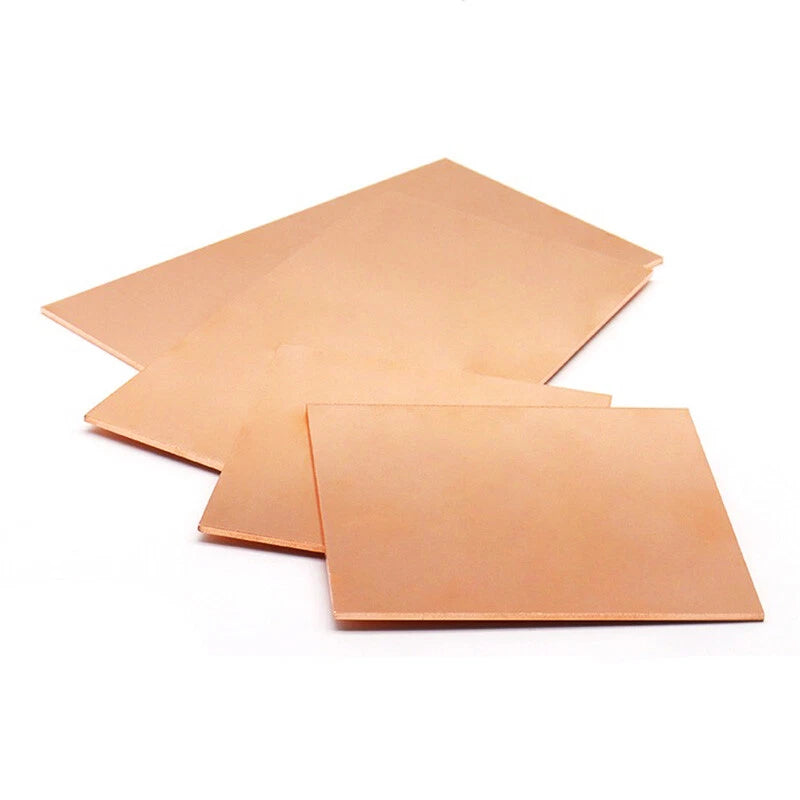
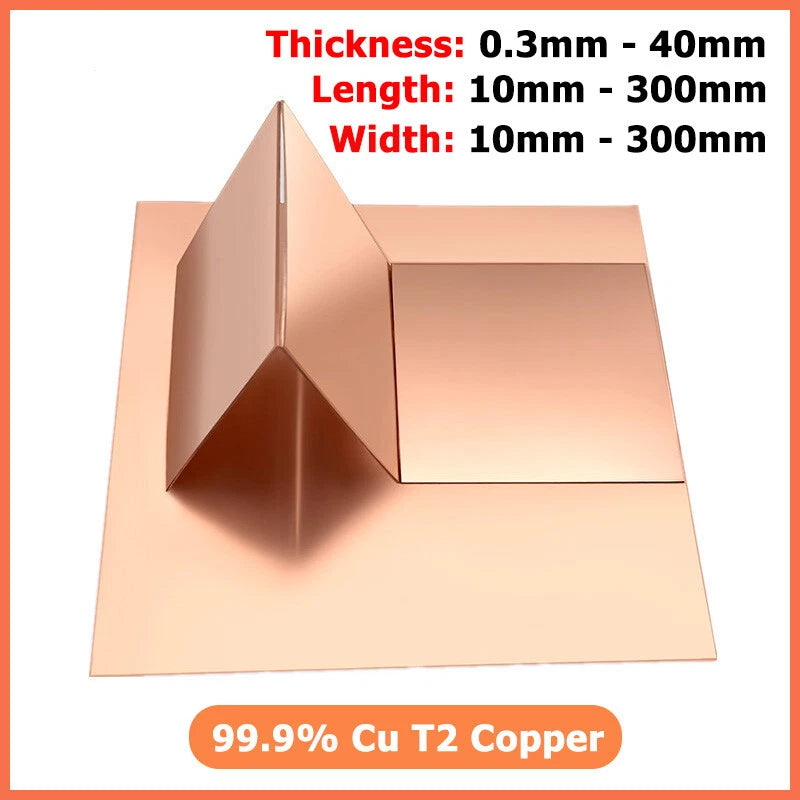
This listing covers T2 pure copper sheet plate and flat bar stock in thickness options ranging from 0.3 mm to 40 mm (approximately 0.012 in to 1.57 in), with width-by-length combinations from 10 mm × 10 mm up to 300 mm × 300 mm (roughly 0.4 in × 0.4 in to 11.8 in × 11.8 in). The material is supplied in a mill-finish or lightly polished surface condition typical of T2 copper flat stock.
Typical use cases include DIY electrical bus bar fabrication, RF shielding panels for electronics enclosures, heat-spreader plates in thermal management assemblies, decorative metalwork and jewellery blanks, and corrosion-resistant flashing or roofing repair patches.
T2-grade copper meets the threshold for electrolytic tough-pitch copper, delivering electrical conductivity of approximately 100% IACS — essential for bus bars, grounding straps, and conductive shims.
From ultra-thin 0.3 mm foil-like strips for RF shielding to solid 40 mm flat bar for heavy structural or thermal applications — one product family covers the full spectrum.
Each piece is cut to the selected Width × Length dimension, reducing waste and saving machining time. Edges are typically shear-cut; light deburring may be needed for precision fits.
With thermal conductivity of approximately 385–400 W/(m·K), these copper plates are well-suited for heat spreaders, cold plates, and thermal interface components in electronics cooling.
Copper forms a stable patina over time that slows further oxidation, making it a durable choice for outdoor flashing, plumbing patches, and decorative architectural elements.
T2 copper is soft enough to bend, stamp, and drill with standard tooling, yet rigid enough to hold shape in structural applications. Thinner gauges (0.3–1 mm) can be hand-formed; thicker sections (3 mm+) suit milling and turning.
| Material Grade | T2 Pure Copper (≥99.9% Cu) |
|---|---|
| Copper Purity | ≥ 99.9% |
| Electrical Conductivity | Approx. 100% IACS |
| Thermal Conductivity | Approx. 385–400 W/(m·K) |
| Thickness Range | 0.3 mm – 40 mm (0.012 in – 1.57 in) |
| Width Range | 10 mm – 300 mm (0.4 in – 11.8 in) |
| Length Range | 10 mm – 300 mm (0.4 in – 11.8 in) |
| Surface Finish | Mill finish / lightly polished (typical) |
| Density | Approx. 8.9 g/cm³ |
| Hardness | See variant options |
| Temper | See variant options |
| Quantity per Order | 1 PCS (per variant selected) |
For electrical bus bars and grounding straps, 1–3 mm is typical. RF shielding panels usually use 0.3–1 mm. Heat spreaders for electronics commonly range from 1–3 mm. Structural flat bar or heavy thermal applications may require 5–40 mm. If you are unsure, select the thickness closest to your existing component or contact us to confirm.
T2 pure copper is a relatively soft metal (Vickers hardness typically 40–80 HV depending on temper). It is suitable for light structural brackets, clamps, and fixtures, but is not recommended for high-load structural applications where steel or brass would be more appropriate. Thicker sections (10 mm+) provide significantly more rigidity.
Copper does not rust. Over time it develops a patina (initially brown, eventually green verdigris) that acts as a protective layer, slowing further oxidation. This makes it suitable for outdoor flashing, roofing patches, and decorative architectural applications. For a bright finish, apply a clear lacquer after cleaning.
Yes. T2 copper solders and brazes readily with standard copper-compatible fluxes and filler materials. It is also TIG and MIG weldable using copper or silicon-bronze filler wire. Clean the surface with isopropyl alcohol or fine abrasive before joining to remove any surface oxidation.
T2 is the Chinese national standard designation for electrolytic tough-pitch copper, which is functionally equivalent to C11000 (UNS) / ETP copper used in North American and European standards. Both specify ≥99.9% copper purity and similar electrical conductivity. They are interchangeable for most electrical and thermal applications.
For 3–6 mm, a metal-cutting bandsaw, angle grinder with a thin cutting disc, or a jigsaw with a bi-metal blade works well. For 10 mm and above, a milling machine, cold saw, or waterjet cutter is recommended for clean, accurate cuts. Always use cutting fluid to extend tool life and reduce heat buildup when machining copper.
Select a Width × Length that is at least 5–10 mm larger than your heat source footprint on each side to allow for mounting holes and thermal spreading. Thickness of 2–5 mm is typical for most electronics cooling applications. For high-power applications (100 W+), 5–10 mm thick plates provide better lateral heat spreading.