Thrust Ball Bearings 20mm 25mm 30mm 35mm 40mm 45 - 130mm Inner Dia Various Sizes

No reviews

Price:
Sale price$8.60 USD
Stock:
In stock (500 units), ready to be shipped

Payment & Security

Ach Direct Debit Amazon American Express Apple Pay Bancontact BLIK Diners Club Discover EPS Google Pay iDEAL Wero JCB Maestro Mastercard Multibanco MobilePay PayPal Przelewy24 Shop Pay Twint Union Pay USDC Visa

Your payment information is processed securely. We do not store credit card details nor have access to your credit card information.

Limited Offer — Spend More, Save More
Spend $55+
Save $5
Spend $100+
Save $10
Spend $200+
Save $25
HomeDIYer DIY Expert Support

DIY Expert Support

Get fitment advice & recommendations

Mon–Fri  8:30 AM – 8:00 PM
24-Hour Fast Ship
Arrives in 3–14 Days
Worldwide Shipping
30-Day Returns
1 tree planted with every purchase

Description

Thrust Ball Bearings 20–130mm Inner Dia — Reliable Axial Load Support for Shafts & Machinery

When a rotating shaft needs to handle axial (thrust) loads without wobble or premature wear, the wrong bearing becomes the weakest link in your build. Whether you're a machinist replacing a worn spindle bearing, a fabricator assembling a rotary table, or a DIYer building a lazy-susan turntable, these thrust ball bearings give you the precise axial support your project demands — in a wide range of sizes to match your exact shaft diameter.

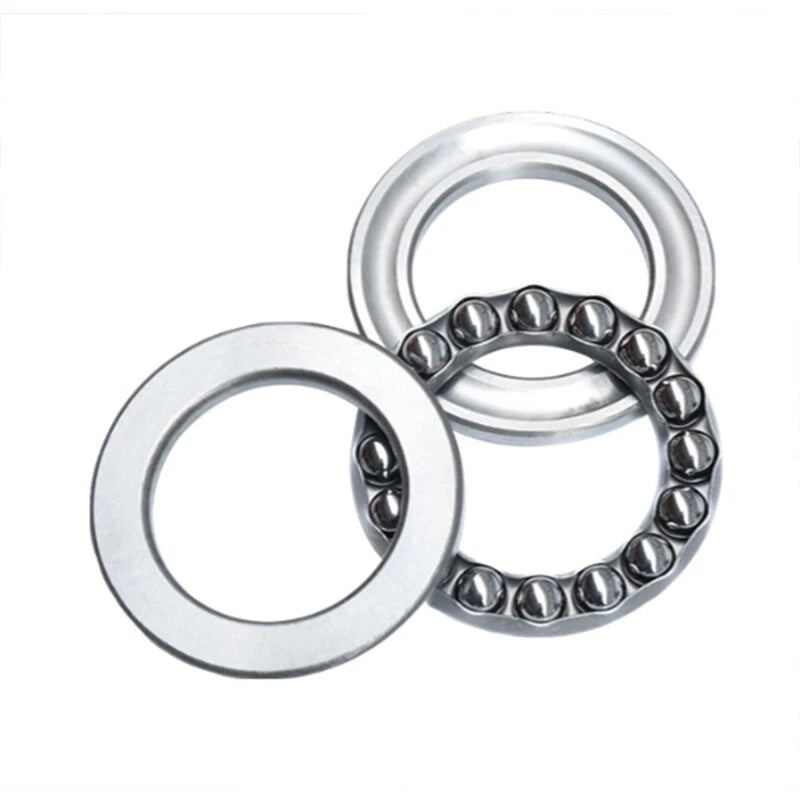
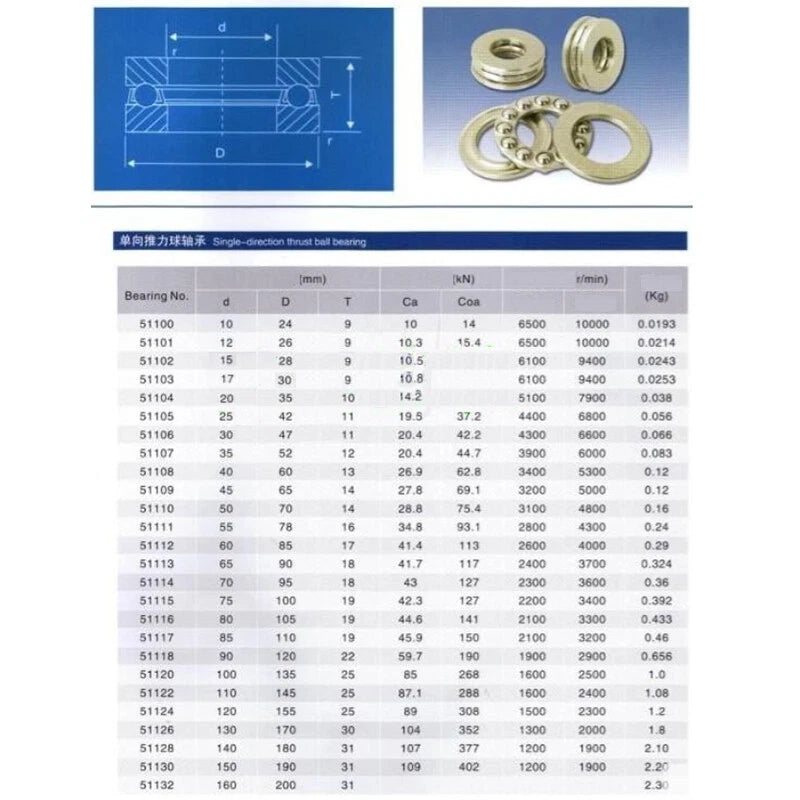
Each bearing consists of two hardened steel washers (shaft washer and housing washer) with a ball-and-cage assembly sandwiched between them. Inner diameters span 20 mm (0.79 in) to 130 mm (5.12 in), with outer diameters ranging from 35 mm (1.38 in) to 170 mm (6.69 in) and heights from 10 mm (0.39 in) to 35 mm (1.38 in) depending on the selected size. The steel construction provides solid load capacity across the full size range.

Typical use cases include thrust ball bearing replacement for lathe spindles and milling machine tables, axial load management in rotary indexing fixtures and turntables, and shaft support in conveyor drives, jacks, and vertical-shaft assemblies where radial bearings alone are insufficient.

🔩 Compatibility: Designed for standard metric shaft diameters from 20 mm to 130 mm. Verify your shaft diameter, housing bore, and axial clearance against the selected size variant before ordering. These bearings carry axial (thrust) loads only — combine with a radial bearing for combined load applications.

✅ Key Features of These Thrust Ball Bearings

  • 📐Wide Size Range: Inner diameters from 20 mm to 130 mm (0.79–5.12 in) across 35 variants — covering light-duty instrument shafts up to heavy industrial spindles.
  • ⚙️Axial Load Optimized: Two-washer design with ball-and-cage assembly handles pure thrust loads efficiently, keeping shaft end-play tight under sustained axial force.
  • 🔧Steel Construction: Hardened steel washers and balls resist deformation under load, maintaining dimensional stability across repeated load cycles.
  • 📏Metric Dimensioned: All sizes follow standard metric bearing designations (511xx / 513xx series), making cross-referencing with OEM specs and bearing catalogs straightforward.
  • 🔄Drop-In Replacement Ready: Matches standard 511xx and 513xx series dimensional envelopes — suitable for direct replacement in lathes, milling machines, rotary tables, and vertical shaft assemblies.
  • 📦Sold Individually: Each listing is for one (1) bearing unit, so you order exactly the quantity you need without paying for extras.

📐 Technical Specifications — Thrust Ball Bearings

Bearing Type Single-direction thrust ball bearing
Series 511xx (thin section) / 513xx (standard section)
Inner Diameter (ID) 20 mm – 130 mm (0.79 in – 5.12 in)
Outer Diameter (OD) 35 mm – 170 mm (1.38 in – 6.69 in)
Height / Thickness 10 mm – 35 mm (0.39 in – 1.38 in)
Material Hardened steel (washers & balls)
Load Direction Axial (thrust) only
Lubrication See variant options
Operating Temperature See variant options
Dynamic Load Rating (C) See variant options
Static Load Rating (C₀) See variant options
Pack Quantity 1 piece per order

❓ Frequently Asked Questions

How do I choose the right thrust ball bearing size for my shaft?

Match the bearing's inner diameter (ID) to your shaft diameter. For example, if your shaft is 30 mm, select the 51106 (30×47×11 mm) variant. Then confirm the outer diameter fits within your housing bore and that the height clears your assembly. Always measure your shaft with calipers rather than relying on nominal drawings.

What is the difference between the 511xx and 513xx series bearings?

The 511xx series (e.g., 51104–51126) are thin-section thrust bearings with a relatively compact height-to-diameter ratio, suited for applications where axial space is limited. The 513xx series (e.g., 51304–51311) have a taller cross-section and higher load capacity for the same shaft diameter, making them better for heavier axial loads. Check the dimensional table in the variant selector to compare OD and height for your specific shaft size.

Can these bearings handle radial (side) loads as well?

No — thrust ball bearings are designed exclusively for axial (thrust) loads. Applying significant radial loads will cause rapid wear and premature failure. For combined axial and radial loads, pair a thrust ball bearing with a deep-groove radial ball bearing on the same shaft.

Are these bearings corrosion-resistant or suitable for wet environments?

These bearings are made from hardened steel, which provides good mechanical strength but limited corrosion resistance in wet or chemically aggressive environments. For outdoor, washdown, or humid applications, apply a compatible grease or consider stainless-steel thrust bearings. Keep the bearing lubricated and protected from direct moisture exposure for best service life.

Do I need to lubricate these bearings before installation?

Thrust ball bearings typically require lubrication before or during installation. Apply a thin, even coat of a lithium-based or general-purpose bearing grease to the ball-and-cage assembly and both washer faces. Avoid over-greasing, which can cause churning and heat buildup. Re-lubricate periodically based on your application's duty cycle and operating conditions.

How do I know if a thrust ball bearing is the right choice versus a tapered roller bearing?

Thrust ball bearings are ideal for moderate axial loads at moderate-to-high speeds where low friction and compact size matter — common in rotary tables, jacks, and instrument spindles. Tapered roller bearings handle heavier combined axial and radial loads at lower speeds and are common in wheel hubs and gearboxes. If your application involves pure axial load at moderate speed, a thrust ball bearing is typically the more efficient and cost-effective choice.

What does the part number format (e.g., 51106) mean?

The number follows the ISO/JIS thrust bearing designation system. The first two digits (51) indicate a single-direction thrust ball bearing. The third digit indicates the series (1 = thin section, 3 = standard section). The last two digits indicate the bore size code — multiply by 5 to get the inner diameter in mm for codes 04 and above (e.g., code 06 = 30 mm ID). This makes it easy to cross-reference with bearing catalogs and OEM replacement lists.

🛒 Select your size (inner diameter) above, then add to cart.


You may also like

Recently viewed